
If you are wondering how to study effectively for exams, here is the good news: effective studying is a skill, not a talent. Decades of research in cognitive science show that the techniques you use matter far more than the number of hours you put in. A student who spends three focused hours testing themselves with flashcards will usually remember more than a student who spends eight hours passively rereading a textbook.
Most of us were never actually taught how to study. We picked up habits in school, rereading notes, highlighting pages, cramming the night before, and assumed that the feeling of familiarity meant real learning. Psychologists call this the “illusion of competence”: the material looks easy while the book is open, but the knowledge vanishes the moment you close it. This guide replaces those weak habits with science-backed methods that genuinely work: spaced repetition, active recall, and interleaving, plus a sample study week you can copy and exam-day tips that keep you calm under pressure.
Why Most Study Habits Don’t Work
Before we talk about what works, it helps to understand what does not. Rereading your notes feels productive because every sentence looks familiar, but familiarity is not the same as memory. Highlighting has a similar problem: dragging a marker across a page makes you feel busy, yet research reviews consistently rank highlighting and rereading among the least effective study techniques. They create recognition without recall, which is why so many students walk out of an exam feeling blindsided even though they “studied” for hours.
Cramming, the classic night-before marathon, is only slightly better. It can carry information into short-term memory for a morning exam, but the knowledge decays within days, which is painful when finals build on earlier chapters or when you need the material for a future course. Cramming also wrecks your sleep, and sleep is when your brain consolidates memories. An all-nighter before an exam is one of the few study strategies that can actively make your score worse.
How Memory Actually Works: A Quick Primer
To understand why better techniques work, you need a simple model of memory. Learning has three stages: encoding (getting information in), storage (keeping it), and retrieval (getting it back out). Most students spend nearly all their time on encoding, reading and rereading, while almost ignoring retrieval. That is backwards. Every time you successfully retrieve a fact from memory, you strengthen the neural pathway to that fact, making the next retrieval easier. Testing yourself is not just a way to check what you know; it is one of the most powerful ways to learn.
Learning researchers also talk about “desirable difficulty.” The strategies that feel hard, quizzing yourself with the book closed, mixing up topics, spacing sessions apart, produce stronger long-term memory than the strategies that feel easy. If your study session feels a little uncomfortable, that friction is usually a sign that real learning is happening. Keep that idea in mind as you read the three core techniques below.
Spaced Repetition: Spread Review Over Time
Spaced repetition is the single most well-supported study technique in learning science. The idea is simple: instead of reviewing material in one long session, you review it in short sessions spread over days or weeks, with the gaps between reviews gradually getting longer. Psychologist Hermann Ebbinghaus first mapped the “forgetting curve” more than a century ago, showing that memories fade fast at first and then more slowly. Each time you review just as you are about to forget, you flatten that curve, and the memory lasts longer.
In practice, spaced repetition looks like this. After learning a topic on Monday, review it briefly on Wednesday, again on the following Monday, and once more two weeks later. The reviews do not need to be long; fifteen to twenty minutes of self-testing per topic is often enough. What matters is the timing. A practical way to run this system is with flashcards, either physical cards or a spaced repetition app that schedules reviews automatically based on how well you remembered each card.
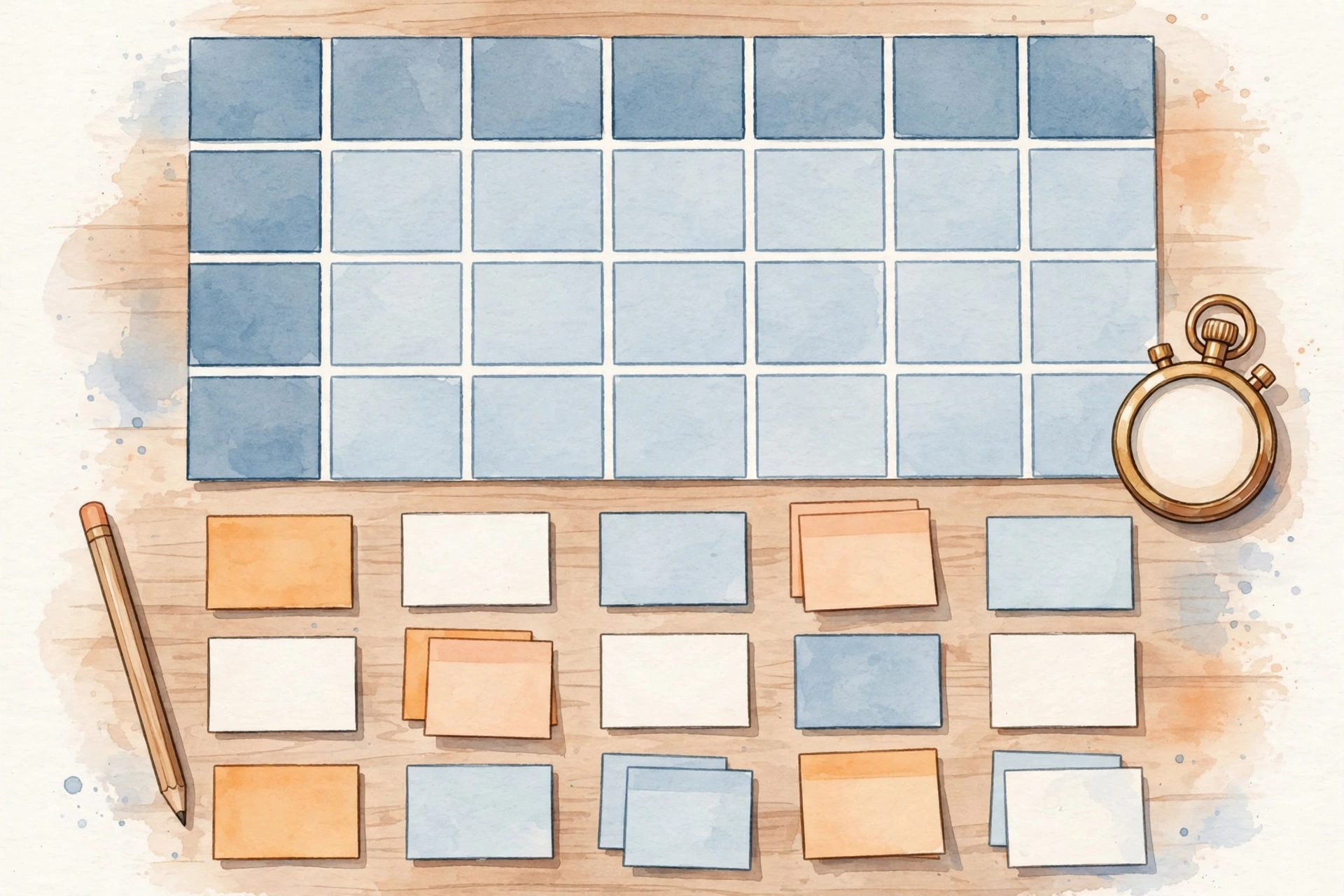
To build your own spaced schedule, list every topic for the exam and note when you last reviewed each one. Topics you find difficult get shorter intervals; topics you know cold get longer ones. Many students keep this schedule in a notes app or a task manager. If you want help choosing one, our Notion AI vs ClickUp Brain comparison walks through two popular options for organizing study plans and review reminders.
Active Recall: Test Yourself, Don’t Just Reread
Active recall means pulling information out of your brain rather than pushing it in. Instead of rereading a chapter, close the book and try to explain the key ideas out loud or on a blank page. Instead of reviewing highlighted notes, turn each heading into a question and answer it from memory. This feels harder than rereading, and that difficulty is exactly the point: effortful retrieval builds durable memory.
One of the most effective active recall routines is the “blurting” method. Read a section of your notes, close them, and write down everything you remember on a blank sheet. Then reopen the notes and check what you missed, marking the gaps in a different color. Your next session starts by blurting those missed points again. Another strong routine is the past-paper method: work through old exam questions under realistic conditions, then review every mistake carefully. Mistakes you correct yourself are some of the most memorable learning events there are.
Flashcards deserve a special mention because they are the cleanest form of active recall: one question, one answer, instant feedback. Make your cards specific, one fact per card, and phrase them as questions whenever possible. And if you want to generate practice questions from your own notes quickly, some of the best AI tools for students can turn a document or a set of notes into a quiz in seconds, which is a great way to build a retrieval practice habit without spending hours writing cards by hand.
Interleaving: Mix Topics Instead of Studying in Blocks
Most students study in blocks: all of Chapter 4 on Monday, all of Chapter 5 on Tuesday, and so on. Blocked practice feels smooth because every problem looks like the last one, but it skips a crucial skill: deciding which method to use. Real exams mix everything together, and that is where interleaving comes in. Interleaved practice means mixing different topics or problem types within a single session, so your brain has to work out which strategy fits each question.
For example, instead of doing twenty quadratic equation problems in a row, you might do five quadratics, five geometry problems, and five word problems, shuffled together. Studies on math and science learning show that students who interleave often score higher on delayed tests than students who block, even though interleaved practice feels slower in the moment. To use it, simply shuffle your practice sets: mix chapters, mix subjects, or rotate between topics every twenty to thirty minutes. Pair it with spaced repetition, and you have a system where old topics keep resurfacing in new company, which is excellent for long-term retention.

More Evidence-Based Techniques Worth Adding
Spaced repetition, active recall, and interleaving are the big three, but a few more techniques have strong research support and are easy to add to your routine.
Elaborative interrogation means asking “why” and “how” as you study. Why does this formula work? How does this concept connect to last week’s topic? Explaining the reasons behind facts creates richer memory traces than memorizing bare facts. Self-explanation is its close cousin: as you work through an example problem, narrate each step to yourself and why it makes sense.
Teaching someone else is one of the strongest tests of understanding. If you can explain a concept clearly to a friend, a sibling, or even an empty chair, you truly know it. If you stumble, you have found exactly what to review next. Practice under exam conditions is also valuable: sit a full timed practice test with no phone and no notes. This builds stamina, reveals time-management problems, and reduces test anxiety because the real exam feels familiar.
Finally, do not neglect the basics of focus and health. The Pomodoro technique, twenty-five minutes of focused work followed by a five-minute break, helps many students sustain concentration without burnout. Sleep is non-negotiable: memory consolidation happens during deep sleep, so a full night’s rest beats an extra hour of midnight review. Regular exercise and short breaks also support attention and mood. You can find more study and productivity guides on the DigitalGeekSpot homepage, including roundups of tools that make focused work easier.
A Sample Study Week: Seven Days Before the Exam
Here is a concrete plan that combines everything above. Adjust the times to fit your schedule, but keep the structure: short spaced sessions, constant self-testing, and mixed topics.
Day 7 (one week out): Map the territory. List every topic that could appear on the exam. Rate each one: confident, shaky, or unknown. Make flashcards or a question bank for the shaky and unknown topics. Set up your spaced review schedule for the week.
Day 6: First deep pass. Study the two hardest topics using active recall. Blurting or self-quizzing for each, then check and correct. End the day by reviewing the flashcards you made.
Day 5: Interleave. Mix medium-difficulty topics in one session, rotating every thirty minutes. Do a short quiz on yesterday’s hard topics first; this is spaced repetition in action.
Day 4: Practice test one. Sit a full past paper or timed question set under exam conditions. Mark it honestly and log every mistake in an error notebook: the question, the correct answer, and why you got it wrong.
Day 3: Fix the gaps. Spend this day on your error notebook and your weakest flashcards. Teach the hardest concepts out loud as if explaining them to a friend. Review older flashcards again.
Day 2: Practice test two and interleave. Take another timed set, ideally mixing all topics. Review mistakes the same day. In the evening, do a light pass over your full flashcard deck.
Day 1 (the day before): Light review only. Skim your error notebook and a short summary sheet. No new material, no marathon sessions. Pack your bag, set out your clothes, and go to bed at a normal time. Your brain needs sleep more than it needs one more chapter.
The Day of the Exam
Eat a normal meal, arrive early, and bring everything you need so logistics do not add stress. During the exam, read every question carefully before answering, and do a quick plan for essay questions. If you get stuck, mark the question and move on; your subconscious often works on it while you answer others. Save the last ten minutes for review: check for skipped questions, silly arithmetic slips, and incomplete answers. Trust your preparation. You studied with a system built on how memory actually works, and that gives you a real edge.
FAQ
How many hours should I study per day for exams?
There is no magic number, but quality beats quantity. Three to four hours of focused, active study usually beats eight hours of passive rereading. Break study into focused blocks with short breaks, and increase gradually in the final week rather than pulling marathon sessions.
Is cramming the night before ever okay?
Cramming can help for a low-stakes quiz the next morning, but it is a poor strategy for anything important. Information learned in one rushed session fades within days, and lost sleep harms the memory consolidation you need for exam day. Spacing the same material over a week takes no more total time and produces far better retention.
Are highlighters and rereading completely useless?
Not completely, but they should never be your main strategy. A first careful read is fine for encoding, and highlighting key definitions can help you find things later. The mistake is stopping there. Always follow reading with active recall: close the book and test yourself on what you just read.
Should I take notes by hand or on a laptop?
Both can work if you use them actively. Handwriting slows you down, which encourages summarizing in your own words, and that paraphrasing aids memory. Typing is faster and easier to search. Whichever you choose, the key step is the same: revisit the notes later with self-testing, not just rereading.
Can I listen to music while studying?
It depends on the task and the music. Instrumental or familiar background music is fine for light review or organizing notes, but lyrics and unpredictable music tend to hurt concentration during hard tasks like problem solving or memorization. When in doubt, study the difficult material in silence and save the playlist for breaks.