


Every business belongs somewhere, and business vertical classification categories are the map that shows where it belongs. A business vertical is a group of companies that serve the same kind of customer, solve a similar problem, or work in the same industry. When you understand how these categories work, you can describe your business more clearly, find the right customers, choose better tools, and compare your results with companies that are truly similar to yours.
This guide explains business vertical classification categories in plain language. You will learn what a business vertical is, how the main classification systems work, which categories matter most for small businesses, and how to choose the right category for your own company.
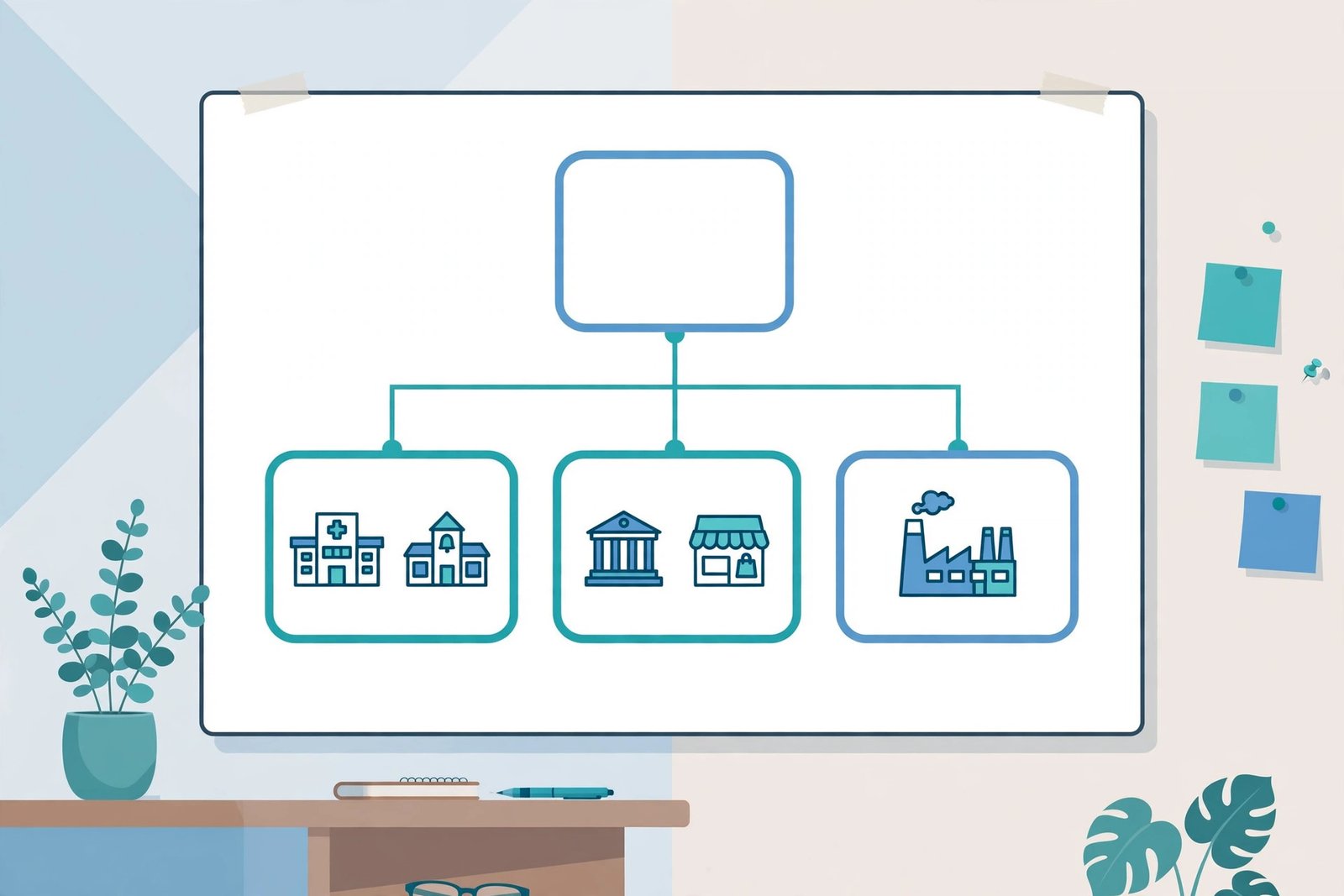
Key Takeaways: A business vertical is an industry group defined by the customers it serves and the problems it solves. The main business vertical classification categories include healthcare, finance, retail, manufacturing, technology, education, real estate, hospitality, transportation, and professional services. NAICS is the standard classification system used in the United States, while GICS is widely used by investors and analysts. Choose your vertical by looking at who pays you, what you deliver, and which industry rules shape your work.
What Is a Business Vertical?
A business vertical is a narrow slice of the economy where companies share customers, needs, and ways of working. Healthcare is a vertical, and so are retail, construction, education, and financial services. Inside each vertical are smaller groups called sub-verticals. Healthcare, for example, includes hospitals, dental clinics, home care services, pharmacies, and medical device makers, and each sub-vertical has its own customers, regulations, and buying habits.
The word vertical is often used together with the word horizontal. A horizontal product works across many industries, such as email software. A vertical product is built for one industry only, such as software for dental clinics or a booking system for hotels. Classification matters because it shapes how people find and judge you. A search engine, a directory, a lender, and a customer all use categories to place your business, and a clear category is a short cut to trust.
What Are Business Vertical Classification Categories?
Business vertical classification categories are the named groups used to sort companies by industry. Most systems start broad and then get narrower, from services or manufacturing, to an industry such as healthcare or retail, to a niche such as pediatric dentistry. For a small business, the useful level is usually the industry plus the niche. Saying you are a home care agency for older adults in one city is far more useful than saying you are in healthcare, because it tells a customer what you do and tells a search engine what to rank you for.

Why Does Business Vertical Classification Matter?
Classification sharpens marketing, because you learn where your customers spend time, which words they use, and which problems they face. It improves sales, because buyers in a vertical often share a buying process and a set of decision makers. It also guides product choices and supports compliance, since many verticals have their own rules for privacy, safety, licensing, and advertising.
Finally, classification makes benchmarking fair. Comparing a restaurant with a software company tells you little, while comparing a restaurant with similar restaurants tells you a great deal about pricing and staffing. If you are writing a plan for a new venture, classification belongs near the start. For practical help, read our guide on how to write a business plan for a small business.
What Are the Main Business Vertical Classification Categories?
The list below covers the main business vertical classification categories used in everyday business talk, in directories, and in many classification systems. The names vary slightly from one system to another, but the groups are widely recognized.
1. Healthcare and Life Sciences
Hospitals, clinics, dental practices, pharmacies, home care, mental health services, medical devices, and biotechnology. Trust, privacy, and regulation shape almost every decision here.
2. Financial Services
Banks, credit unions, insurers, investment firms, payment processors, and accounting firms. Customers want security, clear fees, and reliable advice.
3. Retail and Ecommerce
Shops, online stores, marketplaces, and direct to consumer brands. The focus is on product range, price, convenience, and customer experience.
4. Manufacturing and Industrial
Factories, workshops, and suppliers that make physical goods, from food and clothing to machinery and electronics. Supply chains and quality control are central concerns.
5. Technology and Software
Software companies, IT services, cloud providers, cybersecurity firms, and hardware makers. Many technology firms also serve one other vertical, such as health technology or financial technology.
6. Education and Training
Schools, colleges, tutoring services, online courses, corporate training, and test preparation. Providers must show what learners can do after the course.
7. Real Estate and Construction
Residential and commercial property, property management, construction, renovation, and related trades. Projects are often large and local, so reputation and referrals carry great weight.
8. Hospitality, Travel, and Food Services
Hotels, restaurants, cafes, travel agencies, tour operators, and event venues. Customer experience is the product, and reviews have a direct effect on bookings.
9. Transportation and Logistics
Trucking, delivery services, warehousing, freight, airlines, and public transport. Timing, reliability, and cost per delivery are the measures that matter most.
10. Professional Services
Law firms, consulting firms, marketing agencies, design studios, and accounting practices. Clients buy expertise and trust, and many of these firms specialize in one client vertical.
11. Media, Entertainment, and Publishing
News, publishing, film, music, gaming, and social media. Audience attention is the core asset, and revenue often comes from advertising, subscriptions, or direct sales.
12. Agriculture, Energy, and Environment
Farming, food production, energy, water, waste, and environmental services. Weather, land, regulation, and commodity prices shape results.
How Do Formal Classification Systems Work?
Formal systems give every business a code as well as a name, so governments, researchers, lenders, and software can sort and compare companies. The best known systems are described below.
What Is NAICS?
NAICS stands for the North American Industry Classification System. It is the standard system used in the United States, Canada, and Mexico to classify businesses by what they produce, using a hierarchy from broad sectors down to detailed industries.
What Is SIC?
SIC stands for Standard Industrial Classification. It is an older system that was widely used before NAICS, and some older databases and reports still use SIC codes.
What Is GICS?
GICS stands for the Global Industry Classification Standard. It is used mainly by investors, analysts, and fund managers to group listed companies into sectors and industry groups.
What Is ISIC?
ISIC stands for the International Standard Industrial Classification of All Economic Activities. It is maintained by the United Nations and is used to compare industries across countries.
| System | Used mainly by | Best for |
|---|---|---|
| NAICS | Governments and businesses in North America | Finding your official industry code and market data |
| SIC | Older databases and some legacy reports | Reading older research and supplier records |
| GICS | Investors, analysts, and fund managers | Understanding how listed companies are grouped |
| ISIC | International agencies and researchers | Comparing industries across countries |
For most small businesses, NAICS is the system to learn first. Find your code by describing your main activity in plain words and matching it to the closest NAICS description. If two codes seem close, choose the one that matches the activity that brings in most of your revenue.
How Are Verticals Different From Industries, Sectors, and Niches?
A sector is the broadest group, such as healthcare. An industry is a narrower group inside a sector, such as dental services. A vertical is a group defined by the customer and the problem, such as dental clinics that need scheduling software. A niche is the narrowest group, such as scheduling software for pediatric dental clinics. Start with the sector, name the industry, then name the exact customer you serve best.
How Do You Choose the Right Business Vertical Category?
Choosing a category is a practical decision, not a branding exercise. First, look at who pays you. List your last twenty customers and note what they have in common. If most of them share an industry, that industry is probably your vertical. Second, look at what you deliver. A bookkeeping service is horizontal, but bookkeeping for restaurants is vertical, and the second version is easier to sell. Third, check the rules that shape your work, such as privacy rules in healthcare or licensing rules in finance. Finally, pick one primary vertical for your marketing and your main offer, even if you serve a second one as well. A business that tries to be known for everything is rarely known for anything.
How Do Business Verticals Affect Marketing and Sales?
Vertical knowledge tells you which channels to use, which words to use, and which proof to show, because a case study from the same vertical is far more persuasive than one from an unrelated industry. In sales, a vertical focus helps you build a repeatable process, since you learn the usual objections, decision makers, and timeline. Tools also work better when they match the vertical. For help choosing one, see our guide to the best CRM for small business, and compare banking options in our guide to the best business bank accounts for LLCs in 2026.
How Do Verticals Apply to Online and Dropshipping Businesses?
Online businesses also need a vertical, even though they can sell to anyone. A dropshipping store that sells everything will struggle to build trust, rank in search, or run focused ads. A store that focuses on one vertical, such as home fitness or pet supplies, can build a clear brand and write descriptions that speak to one kind of buyer. If you are exploring this model, our guide on how to start a dropshipping business in 2026 explains the setup steps in order. For more context on the site itself, visit the DigitalGeekSpot homepage.
FAQs About Business Vertical Classification Categories
What is a business vertical in simple terms?
A business vertical is a group of companies that serve the same kind of customer or solve the same kind of problem. Healthcare, retail, and manufacturing are all business verticals.
What is the difference between a vertical and a niche?
A vertical is a broad industry group, such as healthcare. A niche is a small part of that vertical, such as home care for older adults in one city.
How many business verticals are there?
There is no single fixed number, because different systems group industries in different ways. Most everyday lists use ten to fifteen main verticals, each breaking down into many sub-verticals and niches.
What is the most common business vertical classification system?
NAICS is the most common system for businesses in the United States, Canada, and Mexico. GICS is the most common system for investors and listed companies.
Can a business belong to more than one vertical?
Yes. A software company might serve healthcare and finance, and a manufacturer might sell to retail and construction. It is still useful to pick one primary vertical for marketing.
How do I find my NAICS code?
Describe your main activity, the one that brings in most of your revenue, and match it to the closest NAICS description. Government and census sites publish the full NAICS list.
Should a small business focus on one vertical?
In most cases, yes. A single vertical makes marketing clearer, sales faster, and referrals easier. You can expand into a second vertical later, once the first one is working well.
Conclusion
Business vertical classification categories are a simple idea with practical value. They tell you who you serve, how you compare with similar companies, and where to focus your time and money. Start with the customer who pays you, name the industry that fits best, check the formal code that matches it, and then use that focus in your marketing, your sales, and your choice of tools.


