Written by James Foster for Digital Geek Spot. Last updated: November 2026.
Understanding food labels means reading the Nutrition Facts panel, the ingredient list, and the front-of-package claims as one connected system, and using them to judge a food in under a minute. A food label is the regulated panel on packaged food that lists serving size, calories, nutrients, ingredients, and allergens. Start at the serving size, check calories, use the 5/20 rule for % Daily Value, read the first three ingredients, and check the allergen statement. This guide walks through each part in order, decodes the claims on the front of the pack, compares labels across countries, and ends with a 60 second checklist you can use on your next shopping trip.
Key Takeaways
- Every number on a Nutrition Facts panel refers to one serving, not the whole package. Check servings per container first.
- The 5/20 rule works fast: 5% Daily Value or less is low, 20% or more is high.
- The FDA names three nutrients to get less of: saturated fat, sodium, and added sugars.
- Ingredients appear in descending order by weight, so the first three ingredients make up most of the food.
- Front-of-package words like “natural” have no legal definition, while “low fat” and “sugar free” do.
- A label can legally say 0 g trans fat with up to 0.49 g per serving, so check the ingredient list for partially hydrogenated oils.
Table of Contents
- What Is a Food Label?
- What Are the Parts of a Food Label?
- How Do You Read a Nutrition Facts Label Step by Step?
- What Does Serving Size Mean and Why Does It Matter?
- How Do You Use Percent Daily Value?
- Which Nutrients Should You Get Less Of?
- Which Nutrients Should You Get More Of?
- How Do You Read an Ingredients List?
- What Do Front-of-Package Claims Really Mean?
- Food Labels Around the World: US vs EU vs UK vs Canada
- What Is Changing on Food Labels in 2026 to 2028?
- Common Label Reading Mistakes
- A 60 Second Label Checklist for Your Health Goal
- Frequently Asked Questions
- Conclusion
What Is a Food Label?
A food label is the regulated information printed on packaged food that tells you what is inside the package and how much of each nutrient one serving contains. The label has two main parts: the Nutrition Facts panel and the ingredient list. The Nutrition Facts panel gives measured numbers for calories and nutrients. The ingredient list names every component in descending order by weight. A third layer sits on the front of the pack: marketing claims such as “low fat” or “good source of fiber.” Some of those claims have legal definitions and some do not. The U.S. Food and Drug Administration (FDA) requires the Nutrition Facts label on most packaged foods. The current U.S. label format dates from a 2016 update that made serving sizes more realistic and added a separate line for added sugars. Nutrition facts labels were first introduced in the U.S. in 1994 (Source: Wikipedia, 2026).
What Are the Parts of a Food Label?
A food label has 6 parts, and each part answers a different question. The parts are the serving information, calories, nutrients to limit, nutrients to get enough of, the % Daily Value column, and the ingredient list with its allergen statement. The serving information sits at the top and sets the scale for every number below it. The nutrients section lists total fat, saturated fat, trans fat, cholesterol, sodium, total carbohydrate, dietary fiber, total sugars, added sugars, and protein. Vitamin D, calcium, iron, and potassium are required at the bottom of the panel. The footnote explains that % Daily Value is based on 2,000 calories a day for general nutrition advice. The allergen statement names any of the 9 major food allergens in the product. The Health section at Digital Geek Spot covers nutrition topics like this one, from everyday eating habits to the supplements people ask about most.
How Do You Read a Nutrition Facts Label Step by Step?
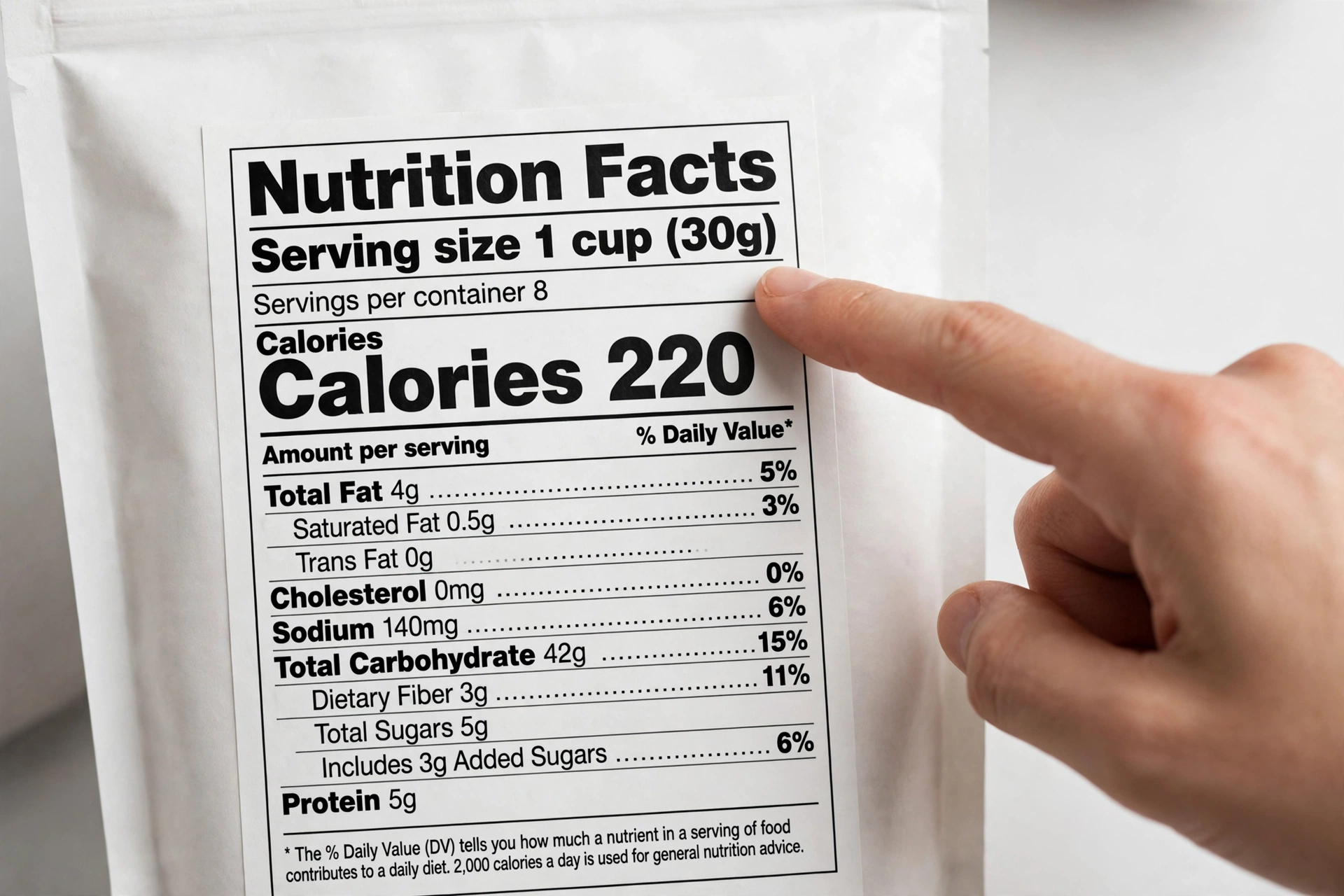
Read a Nutrition Facts label from the top down in 5 steps: servings per container, serving size, calories, % Daily Value for the nutrients you watch, and the first three ingredients. The order matters because every number on the panel depends on the serving size at the top. Step 1: read servings per container and serving size together. A bag of chips may list 2.5 servings, so eating the whole bag means multiplying every number by 2.5. Step 2: check calories per serving and multiply by the servings you will eat. Step 3: scan the % Daily Value column with the 5/20 rule. Step 4: look at the three nutrients the FDA says Americans eat too much of, saturated fat, sodium, and added sugars, and aim for low % Daily Value numbers. Step 5: read the first three ingredients, because those three make up most of the food by weight. This order takes about a minute once you know where to look.
What Does Serving Size Mean and Why Does It Matter?
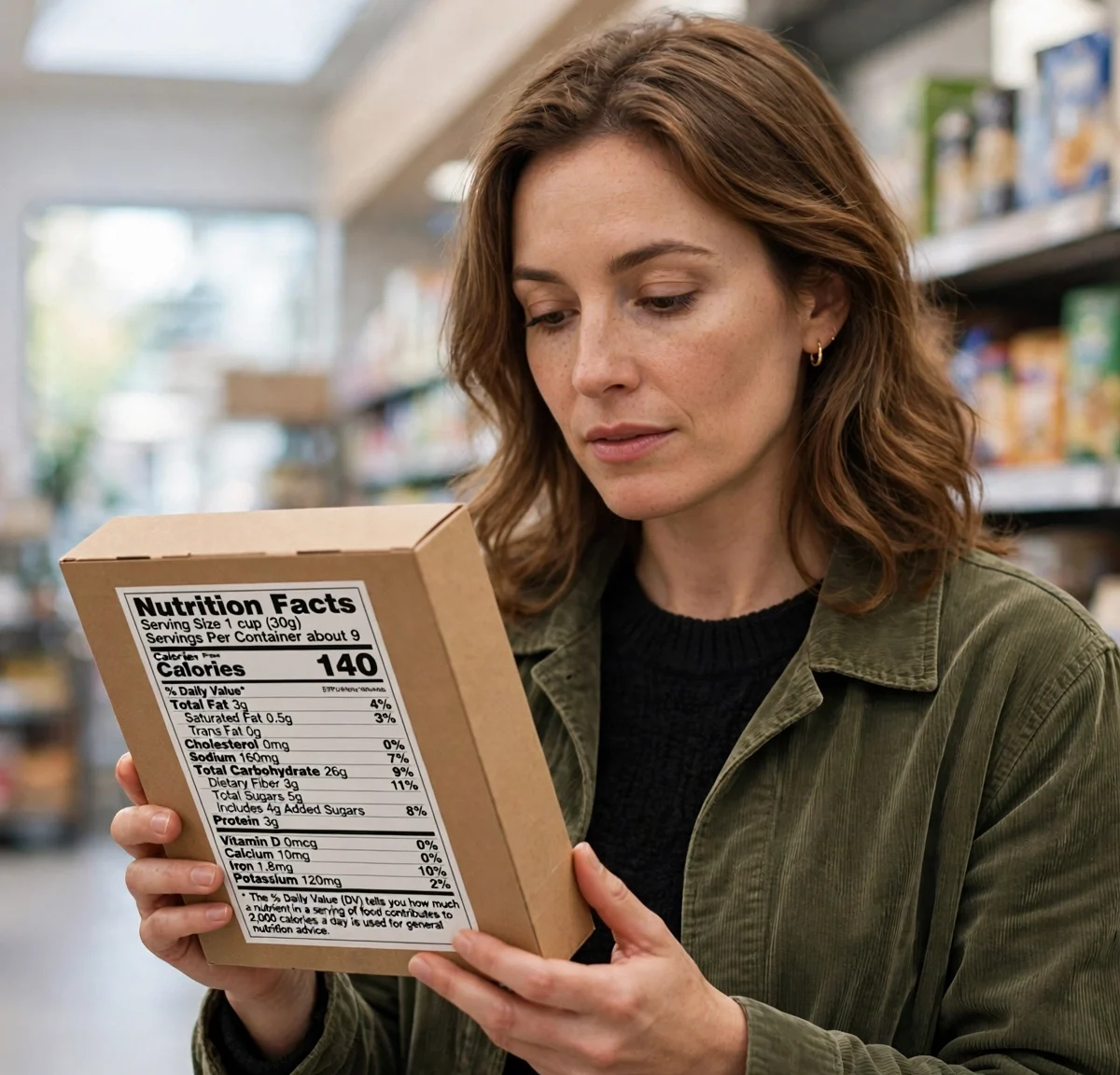
Serving size is the amount of food that all the numbers on the label describe, and it reflects the amount people typically eat or drink, not the amount you should eat. The FDA sets serving sizes from national eating surveys, so a serving of cereal is usually 30 to 55 grams and a serving of soda is 12 fluid ounces. A small bag of pretzels may list 2 servings, and the 140 calories on the panel become 280 calories if you eat the whole bag. The FDA gives a clear example: a lasagna with 280 calories per 1 cup serving and 4 servings in the package contains 1,120 calories in the whole package (Source: FDA, 2024). Always multiply before you judge a food, because a low calorie number on a small serving can hide a large number for the portion you actually eat.
How Do You Use Percent Daily Value?
Percent Daily Value (%DV) shows how much of a day’s worth of a nutrient one serving of a food gives you, based on a 2,000 calorie reference diet. The %DV column lets you judge a food without doing math. The FDA’s rule of thumb is the 5/20 rule: 5% DV or less of a nutrient per serving is low, and 20% DV or more is high. Use the rule in two directions. For nutrients to limit, saturated fat, sodium, and added sugars, look for 5% DV or less. For nutrients to get enough of, dietary fiber, vitamin D, calcium, iron, and potassium, look for 20% DV or more. The %DV column does not add up to 100%, because each line stands alone against a full day for that nutrient. The fixed reference amounts behind the percentages are: total fat 78 g, saturated fat 20 g, sodium 2,300 mg, total carbohydrate 275 g, dietary fiber 28 g, added sugars 50 g, and protein 50 g per day (Source: FDA, 2024).
| Nutrient | FDA Daily Value (100% DV) | Aim for |
|---|---|---|
| Total fat | 78 g | No fixed target, watch saturated fat |
| Saturated fat | 20 g | 5% DV or less per serving |
| Sodium | 2,300 mg | 5% DV or less per serving |
| Total carbohydrate | 275 g | Depends on your diet |
| Dietary fiber | 28 g | 20% DV or more per serving |
| Added sugars | 50 g | 5% DV or less per serving |
| Protein | 50 g | 20% DV or more per serving |
| Vitamin D | 20 mcg | 20% DV or more per serving |
| Calcium | 1,300 mg | 20% DV or more per serving |
| Iron | 18 mg | 20% DV or more per serving |
| Potassium | 4,700 mg | 20% DV or more per serving |
Which Nutrients Should You Get Less Of?
Get less of 3 nutrients: saturated fat, sodium, and added sugars. The FDA names these three because Americans generally eat too much of each. Saturated fat raises LDL cholesterol, and the Daily Value is 20 g per day. Foods high in saturated fat include butter, cheese, fatty cuts of meat, and many baked goods. Sodium raises blood pressure, and the Daily Value is 2,300 mg per day. A single serving of canned soup often carries 30% to 40% DV for sodium. Added sugars add calories without nutrients, and the Daily Value is 50 g per day. The added sugars line separates sugars added during processing from sugars that occur naturally in foods like milk and fruit. Honey, maple syrup, agave, and fruit juice concentrate all count as added sugars under FDA rules.
Which Nutrients Should You Get More Of?
Get more of 5 nutrients: dietary fiber, vitamin D, calcium, iron, and potassium. The FDA lists these as nutrients Americans generally do not get enough of, and the current label requires all 5 on the panel. Dietary fiber supports digestion and fullness, and the Daily Value is 28 g per day. Vitamin D supports bone health, and the Daily Value is 20 mcg per day. Calcium builds bone, and the Daily Value is 1,300 mg per day. Iron carries oxygen in the blood, and the Daily Value is 18 mg per day. Potassium helps control blood pressure, and the Daily Value is 4,700 mg per day. One practical check is the 5:1 rule for packaged grain foods: choose products with no more than 5 g of sugar for every 1 g of fiber. For more on foods that support digestion, read our guide to the best foods for gut health.
How Do You Read an Ingredients List?
Read an ingredients list from the top down, because ingredients appear in descending order by weight, so the first ingredient is the one used in the greatest amount. The first three ingredients tell you what the food is mostly made of. If sugar, corn syrup, or refined flour sits first, the food is mostly sugar or refined flour, no matter what the front of the pack says. Watch for 3 red flags. First, multiple types of sugar in one list: high fructose corn syrup, cane sugar, molasses, and dextrose all add to the same added sugars total. Second, hydrogenated oils, which signal trans fat even when the panel says 0 g. A product with less than 0.5 g of trans fat per serving may legally declare 0 g, so the ingredient list is the only place the trans fat shows up. Third, a long list of additives and colorings, such as Red 40 and BHA/BHT, which points to a heavily processed food. U.S. law requires the label to name 9 major food allergens: milk, eggs, fish, crustacean shellfish, tree nuts, peanuts, wheat, soybeans, and sesame. The names appear in bold or in a separate “Contains” statement, under the Food Allergen Labeling and Consumer Protection Act of 2004 (Source: FDA, 2024). Check the allergen statement every time you buy, because recipes change.
What Do Front-of-Package Claims Really Mean?
Front-of-package claims are short marketing phrases on the front of the pack, and only some of them have legal definitions. The table below gives the FDA definitions for the claims that do, and flags the ones that do not. “Natural” has no legal definition on most foods, so a product can call itself natural with no standard behind the word. “Made with whole grains” has no minimum amount, so a product can carry the phrase with a small amount of whole grain flour. “No added sugar” means no sugar was added during processing, but the food can still contain natural sugars. Read the panel behind every front-of-package claim, because the claim describes one feature and the panel describes the whole food.
| Claim | What it legally requires, per serving |
|---|---|
| Low fat | 3 g of fat or less |
| Low sodium | 140 mg of sodium or less |
| Sugar free | Less than 0.5 g of sugar |
| Good source of | 10% to 19% DV of the nutrient |
| Excellent source / High | 20% DV or more of the nutrient |
| Reduced fat / Less sugar | At least 25% less than the regular version |
| Light | One third fewer calories or half the fat |
| Natural | No legal definition on most foods |
| Made with whole grains | No minimum amount required |
| No added sugar | No sugar added during processing |
Food Labels Around the World: US vs EU vs UK vs Canada
Food labels differ by country in 4 ways: the reference amount, the nutrients listed, the front-of-package system, and the language rules. The U.S. label gives values per serving, with calories in large bold type and a % Daily Value column. The European Union label gives values per 100 g or 100 ml first, which makes comparison between products easy, and a per serving column is optional. The EU panel lists energy, fat, saturates, carbohydrates, sugars, protein, and salt in a fixed order. The UK follows the EU format and adds a voluntary traffic light system that colors fat, saturates, sugars, and salt red, amber, or green. Canada uses a Nutrition Facts table in English and French, and from January 2026 prepackaged foods in Canada must also display a front-of-package advisory label when they contain set amounts of saturated fat, sodium, or sugars (Source: Wikipedia, 2026). China gives values per 100 g or 100 ml, and its 2025 standard adds trans fat and sugar as core nutrients from March 2027. The practical point is simple: a per 100 g label lets you compare two products gram for gram, while a U.S. label hides comparison behind serving sizes.
A Worked Example: Two Cereals Side by Side
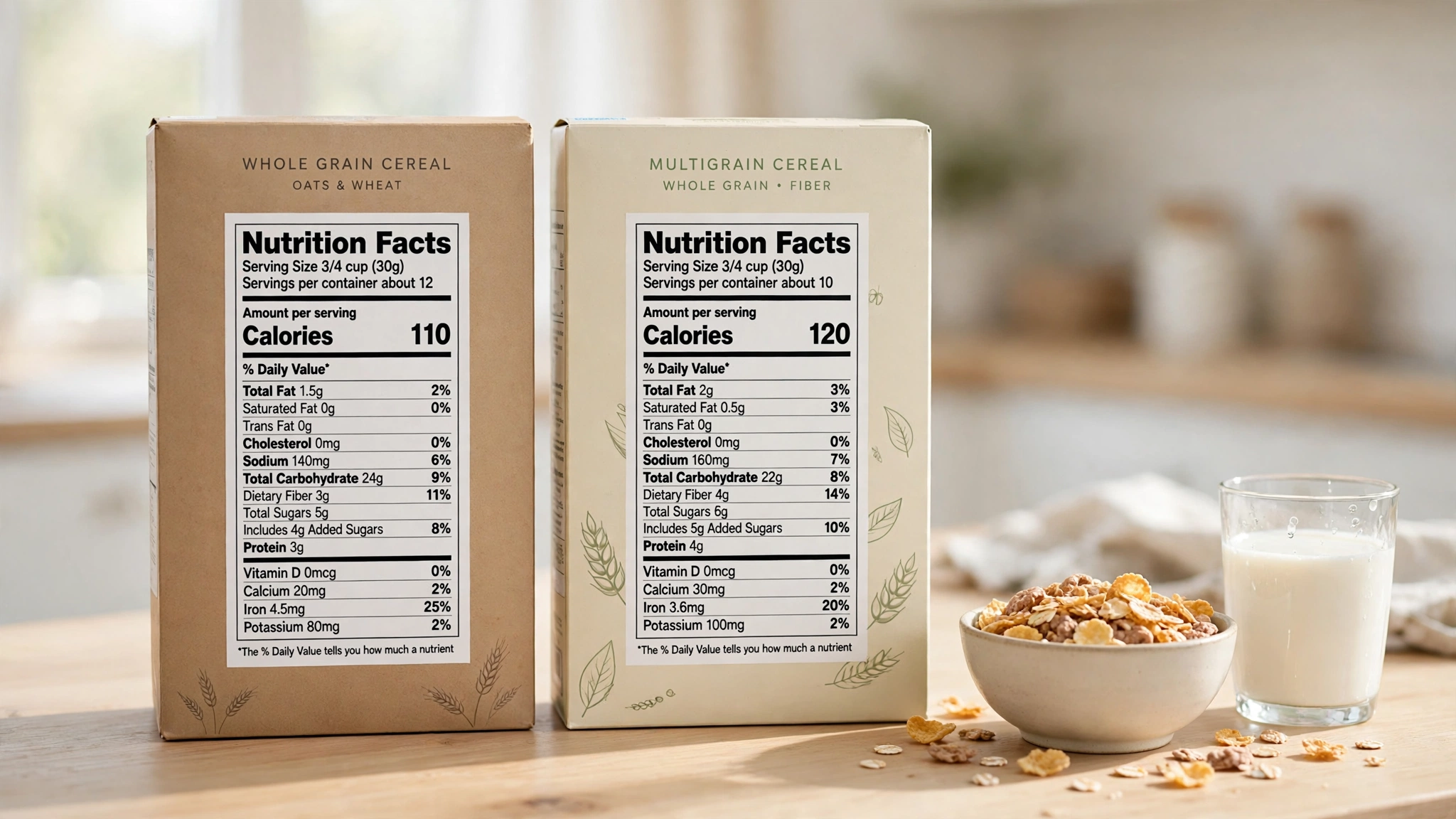
Compare two cereals with the same 40 g serving to see how the method works. Cereal A lists 150 calories, 1 g saturated fat (5% DV), 190 mg sodium (8% DV), 3 g fiber (11% DV), 6 g total sugars with 5 g added sugars (10% DV), and its first three ingredients are whole wheat, oat bran, and almonds. Cereal B lists 170 calories, 1.5 g saturated fat (8% DV), 220 mg sodium (10% DV), 1 g fiber (4% DV), 14 g total sugars with 12 g added sugars (24% DV), and its first three ingredients are corn, sugar, and high fructose corn syrup. Cereal A wins on every line that matters: more fiber, less added sugar, and whole grains first. Cereal B gives you nearly a quarter of a day’s added sugar in one bowl, and its first ingredient after corn is sugar. Both boxes call themselves a good source of vitamins, and both claims are true, but the panels tell the full story. Run the same 5 step check on any two products in the aisle: same serving weight, then saturated fat, sodium, added sugars, fiber, and the first three ingredients.
What Is Changing on Food Labels in 2026 to 2028?
Two changes are coming to U.S. food labels. First, the FDA has finalized a new definition of the word “healthy” for food labels, with a compliance date of 25 February 2028. Under the new definition, a product must supply a meaningful amount of food from a food group and stay under limits for added sugars, saturated fat, and sodium before it can use the word healthy. Many products that use the word today will lose it. Second, the FDA proposed in January 2025 a mandatory front-of-package Nutrition Info box that shows saturated fat, sodium, and added sugars as Low, Med, or High. That rule is still proposed rather than final as of September 2026, and compliance would follow 3 to 4 years after it becomes final (Source: FDA, 2025). Canada’s front-of-package advisory starts sooner, in January 2026. These changes point in one direction: regulators want the 3 nutrients to limit visible at a glance, without a trip to the back of the pack. Until the new boxes arrive, the 5 step method in this guide gives you the same information from the panel that already exists.
Common Label Reading Mistakes
Shoppers make 6 common mistakes when they read food labels. Mistake 1: judging the whole package by one serving. A bag with 2.5 servings and 140 calories per serving holds 350 calories, not 140. Mistake 2: trusting the front of the pack. A “low fat” cookie can still carry 15 g of added sugars per serving. Mistake 3: ignoring the added sugars line and reading total sugars only. Total sugars include natural sugars from milk and fruit, while added sugars show what the maker put in. Mistake 4: reading 0 g trans fat as zero trans fat. A serving can hold up to 0.49 g and still declare 0 g, so check for partially hydrogenated oils in the ingredients. Mistake 5: assuming a small package is one serving. Single serve bottles and snack bags often list 2 servings. Mistake 6: skipping the allergen statement on a familiar product. Recipes change, and a familiar product can gain a sesame or milk warning. The FDA requires labels to be accurate within 20% of the stated values, so a label that says 100 calories can legally contain 80 to 120 calories (Source: FDA, 2024). Treat label numbers as close guides, not exact counts, and use them to compare products.
A 60 Second Label Checklist for Your Health Goal
Use this checklist in the aisle, and pick the 3 lines that match your goal. For weight control: check servings per container, calories per serving, and added sugars. For blood pressure: check sodium %DV, aim for 5% DV or less per serving, and compare two brands of the same food. For blood sugar: check total carbohydrate, added sugars, and dietary fiber, and favor foods with more fiber than added sugar. For gut health: check dietary fiber %DV, aim for 20% DV or more, and look for whole grains in the first three ingredients. For heart health: check saturated fat %DV, aim for 5% DV or less, and avoid partially hydrogenated oils in the ingredients. For allergies: check the “Contains” statement every time, even on familiar products. The checklist works because it narrows a full panel to the 3 numbers that decide your goal, and it takes about a minute per product. Supplement labels deserve the same care: tested melatonin products held 74% to 347% of the stated dose (Source: Journal of the American Medical Association, 2023), so read the label amounts on supplements with the same care you give food labels. For more on that topic, read our guide on what melatonin is and whether it is safe.
Frequently Asked Questions
What is the most important part of a food label?
The serving size is the most important part of a food label, because every number on the panel refers to one serving and not the whole package. A low calorie number means little until you know the serving size and how many servings the package holds. Check servings per container and serving size first.
Is understanding food labels a skill that saves money?
Yes, understanding food labels saves money by stopping you from paying extra for the same food in a health halo package. A store brand and a premium brand often share the same first three ingredients and the same panel numbers, while the premium box costs twice as much. Compare the panels before you pay for the claim on the front.
How accurate are nutrition labels?
Nutrition labels are accurate within 20% of the stated values under FDA rules, so a label that says 100 calories can legally contain 80 to 120 calories. The FDA allows this range because natural foods vary by batch and season. Use label numbers to compare products, not to track exact single calorie counts.
What does 5% DV and 20% DV mean on a label?
5% DV or less per serving is low, and 20% DV or more is high, under the FDA’s 5/20 rule. Aim for 5% DV or less on saturated fat, sodium, and added sugars, and aim for 20% DV or more on fiber, vitamin D, calcium, iron, and potassium. Each %DV line stands alone against a full day for that nutrient.
Do food labels list all allergens?
Yes, U.S. food labels must name 9 major food allergens: milk, eggs, fish, crustacean shellfish, tree nuts, peanuts, wheat, soybeans, and sesame. The names appear in bold in the ingredient list or in a separate “Contains” statement. Check the statement every time you buy, because recipes change.
Is the “natural” claim on food labels regulated?
No, the word “natural” has no legal definition on most foods, so a product can use the word with no standard behind it. The FDA has not set a formal definition for natural on food labels. Treat “natural” as marketing and read the Nutrition Facts panel and the ingredient list to judge the food.
Are food labels the same in every country?
No, food labels differ by country. The U.S. label gives values per serving with a % Daily Value column, while the EU and UK labels give values per 100 g or 100 ml first, which makes comparison easier. Canada uses a bilingual Nutrition Facts table and adds a front-of-package advisory from January 2026.
Conclusion
Understanding food labels is a 5 step habit: check servings per container and serving size, read calories, use the 5/20 rule on % Daily Value, read the first three ingredients, and check the allergen statement. The method works on every packaged food, and it takes about a minute once you know where to look. Start with the three nutrients to limit, saturated fat, sodium, and added sugars, and look for the five nutrients to get enough of, fiber, vitamin D, calcium, iron, and potassium. Treat front-of-package claims as hints and the panel as the evidence, and compare two products side by side before you choose. The 2028 healthy definition and the proposed front-of-package Nutrition Info box will make the three nutrients to limit easier to spot, but the panel already gives you everything you need today. Use the 60 second checklist on your next shopping trip and let the label, not the box, decide what goes in your cart. More practical health guides like this one appear every day on Digital Geek Spot.