

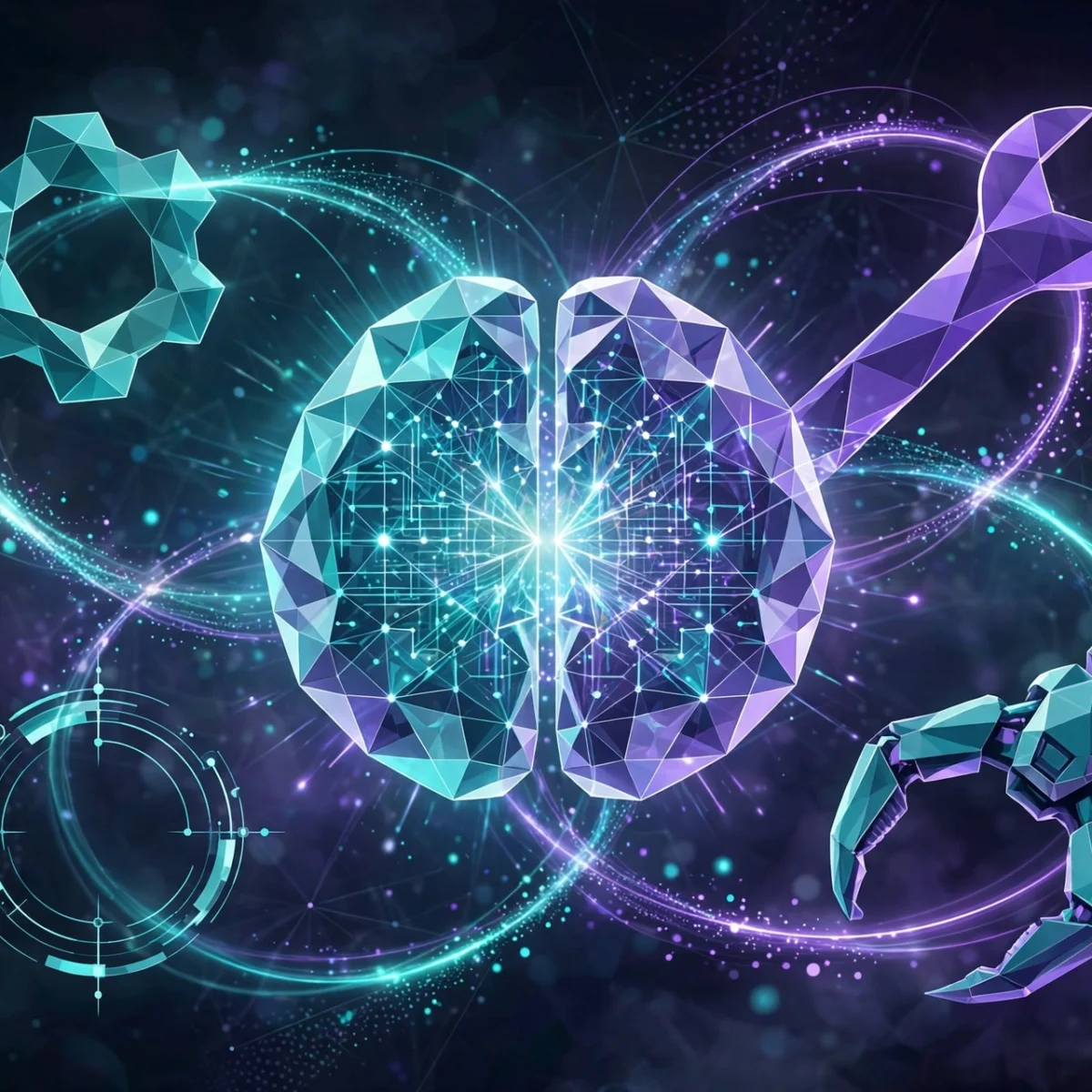
In plain English: an AI agent is software that can perceive its environment, reason about a goal, and take actions to achieve it, often using tools like web browsers, code interpreters, and databases. Where a chatbot answers your questions, an agent does your errands.
This beginner-friendly guide explains what AI agents are, how they work under the hood, how they differ from the chatbots you already use, the main types and frameworks in 2026, where they are genuinely useful today, and where the hype outruns reality.
Quick Answer: What Are AI Agents?
- Definition: an AI agent is a system built around a large language model (the “brain”) that can plan multi-step work, use external tools (the “hands”), remember context, and adapt when things go wrong, all to accomplish a goal you give it.
- Chatbot vs agent: a chatbot waits for your next message and replies; an agent keeps working between messages, searching, clicking, writing files, calling APIs, until the task is done.
- How they work: most agents run a loop: observe the situation, reason about what to do next, take an action with a tool, check the result, and repeat. This is called the ReAct (Reason + Act) pattern.
- Where you have already met them: agentic coding tools, customer-support bots that actually resolve tickets, research assistants that browse and cite sources, and business automations that process invoices end to end.
- The catch: agents can make cascading mistakes, run up API bills, and take actions you did not intend, so production agents need guardrails and human oversight.
AI Agents vs Chatbots: What Is the Difference?
The confusion is understandable because agents and chatbots often share the same underlying model. The difference is in what the system is allowed to do, not how smart the model is:
| Chatbot | AI agent | |
|---|---|---|
| Core job | Answer questions in conversation | Complete tasks toward a goal |
| Initiative | Waits for your next message | Acts on its own between messages |
| Tools | Usually none (or a fixed few) | Browser, code execution, APIs, files, databases |
| Memory | Current conversation only | Short-term plus long-term memory across sessions |
| Planning | Responds turn by turn | Breaks goals into steps and replans on failure |
| Example | “Explain photosynthesis” | “Research three competitors and draft a comparison doc” |
How AI Agents Work: The ReAct Loop

Strip away the marketing and most agents run the same cycle, formalized in AI research as ReAct, Reasoning + Acting:
- Perceive: the agent takes in context, your goal, the conversation history, and the results of any previous actions.
- Reason: the language model thinks about what to do next. (“I need current pricing, so I should search the web first, not guess from training data.”)
- Act: the agent calls a tool, a web search, a database query, running a snippet of code, writing a file.
- Observe: the tool’s result comes back into context. The search returned prices; the code threw an error.
- Repeat: the agent reasons again with the new information, acts again, and keeps looping until the goal is met or it gets stuck.
This loop is what makes agents feel autonomous, the model reasons its way through setbacks the same way a person would. It is also why agents are slower and pricier than chatbots: one chatbot call can become twenty agent calls.
The Five Building Blocks of an AI Agent
Every agent, from a weekend hobby project to an enterprise deployment, combines the same five capabilities:
1. The LLM brain
A large language model, GPT-class, Claude-class, or a strong open model, does the reasoning. It decides what to do next and interprets tool results. The model’s quality largely determines the agent’s reliability: stronger reasoning means fewer wrong turns in the loop.
2. Tools (the hands)
Tool calling (also called function calling) lets the model invoke real software: search engines, calculators, code interpreters, email clients, CRMs, databases. Without tools, a model can only talk; with tools, it can do. Standards like the Model Context Protocol (MCP) are making tools plug-and-play across agents instead of requiring custom integrations.
3. Memory
Short-term memory is the working context of the current task, what has been tried, what the tools returned. Long-term memory persists across sessions, often in vector databases: past conversations, user preferences, documents read. Agents without good memory repeat mistakes and ask the same questions twice.
4. Planning
Planning is how an agent decomposes “plan our product launch” into steps, and backtracks when a step fails. In 2026 the most capable systems use graph-based orchestration (like LangGraph) or role-based agent teams (like CrewAI) rather than simple linear step lists.
5. Perception
The agent’s senses: your prompt, uploaded files, API responses, web pages. Techniques like retrieval-augmented generation (RAG) feed the agent fresh documents so it reasons from current facts instead of hallucinating from stale training data.
Types of AI Agents
Not all agents aim for the same level of independence. The main types you will encounter:
- Autonomous agents: you give a goal (“research electric bike regulations in Texas and summarize them”) and the agent figures out the steps itself. Modern versions are far more reliable than early demos like AutoGPT.
- Multi-agent systems: several specialized agents collaborate, one researches, one writes, one fact-checks, coordinated by a supervisor agent. This is the pattern behind frameworks like CrewAI and Microsoft’s AutoGen.
- Human-in-the-loop agents: the agent works autonomously but pauses for your approval at critical moments, before sending an email, charging a card, or deleting data. The responsible default for anything with real-world consequences.
- Domain-specific agents: purpose-built for one job, coding assistants, support resolvers, data-analysis bots. Narrower scope means higher reliability, which is why these are the agents most people actually use.
What AI Agents Are Actually Used For in 2026
Beyond the demos, agents have settled into a handful of jobs where they genuinely earn their keep:
Software development
AI coding assistants such as Cursor and GitHub Copilot are the most mature agent category. They explore codebases, write and run tests, fix the failures they find, and open pull requests. Developers still review everything, but the tedious middle of the work is increasingly delegated.
Customer support
Support agents that can actually do things, check order status, issue refunds within policy, rebook appointments, resolve a large share of routine tickets untouched by humans. The advance over old chatbots is tool access: the agent operates the same systems a human rep would.
Research and analysis
Deep-research agents browse dozens of sources, cross-check claims, and return cited reports. Work that took a junior analyst a full day, competitor scans, market overviews, now takes an hour of agent time plus human verification.
Business operations
Invoice processing, lead enrichment, meeting follow-ups, data entry between systems. Agents handle the judgment calls that rigid workflow automations cannot, reading an unstructured email and deciding what it needs, for example.
Popular AI Agent Frameworks in 2026
If you want to build agents rather than just use them, these are the frameworks the developer community has standardized around:
| Framework | Best for | Architecture style |
|---|---|---|
| LangGraph (LangChain) | Complex, stateful workflows | Graph-based: agents as nodes, conditional edges, cycles |
| CrewAI | Teams of role-based agents | Define a “crew” with roles; framework handles delegation |
| AutoGen (Microsoft) | Conversational multi-agent apps | Agents collaborate through shared message threads |
| OpenAI Agents SDK | Quick starts on OpenAI models | Lightweight SDK with built-in function calling and handoffs |
| Semantic Kernel (Microsoft) | Enterprise .NET/Java/Python apps | Plugin-based, Azure-friendly |
| LlamaIndex | Document-grounded agents | RAG-first: agents that reason over your data |
Beginner advice: start with a high-level option (CrewAI or the OpenAI Agents SDK) before touching graph orchestration, and you do not need a framework at all to experiment with a simple ReAct loop script.
The Protocols Connecting Agents: MCP and A2A
Two open standards are shaping how agents plug into the world. MCP (Model Context Protocol), introduced by Anthropic in late 2024, standardizes how an AI application connects to external tools and data, one protocol instead of a custom integration per tool, often described as “USB-C for AI.” A2A (Agent-to-Agent) is the complementary standard for agents built by different vendors to talk to each other and delegate work.
Risks and Limitations: The Honest Part
Agents are powerful precisely because they act in the world, and that is also what makes them risky. The failure modes to understand before you trust one:
- Cascading errors: one bad reasoning step compounds. An agent that misreads a search result builds its whole plan on the error. Long autonomous runs drift more than short ones.
- Unintended actions: an agent with email, payment, or database access can send, spend, or delete. Every production agent needs permission boundaries and human approval gates for irreversible actions.
- Security exposure: tools expand the attack surface. A compromised data source can inject malicious instructions into the agent’s context (“prompt injection”), one of the most actively researched agent vulnerabilities in 2026.
- Cost and latency: an agent run can involve dozens of model calls plus tool usage. Unbounded loops (“keep trying until it works”) can burn through API budgets fast without step limits and timeouts.
- Accountability gaps: when an agent makes a bad call, who is responsible, the user, the developer, the model provider? Organizations are still writing the policies for this.
Analysts expect rapid enterprise adoption, Gartner has predicted that 40% of enterprise applications will embed AI agents by the end of 2026, but the serious deployments all share one trait: the agent’s blast radius is deliberately limited.
How to Start With AI Agents Today
You do not need to build anything to get value from agents right now:
- Use an agentic product: try a deep-research feature in a major AI assistant or an agentic coding tool. Notice where it helps and where it fumbles, that intuition is the real education.
- Delegate one recurring task: pick something with clear steps (weekly competitor scan, inbox triage drafts, or transcribing meetings with AI meeting assistants) and hand it to an agent with tight boundaries.
- Build a toy agent: a short script that loops “reason → call a tool → observe” teaches more than ten tutorials. Add one tool at a time.
- Learn frameworks later: reach for LangGraph or CrewAI only when your toy outgrows a simple loop.
Related Articles
Continue learning about AI agents and the tools around them:
- What Is MCP? Model Context Protocol Explained (2026)
- Cursor vs GitHub Copilot: Which AI Coding Assistant Wins in 2026?
- How to Build an AI Chatbot Without Coding
- How to Automate Tasks with Zapier (2026)
Frequently Asked Questions
What is an AI agent in simple terms?
An AI agent is AI software that does tasks, not just answers questions. You give it a goal, and it plans the steps, uses tools like web search or email, checks its own results, and keeps going until the job is done, like delegating to a capable assistant instead of consulting an encyclopedia.
Are AI agents the same as ChatGPT?
No. ChatGPT in its basic form is a chatbot: it responds to each message. But modern AI assistants increasingly include agentic features, browsing, running code, calling tools, which blur the line. Think of “agent” as a capability pattern that can be added to any assistant, not a separate species of AI, including chatbots you can build without coding.
Do AI agents really work autonomously?
Partly. Agents handle multi-step work without constant guidance, but reliable deployments keep humans in the loop for important decisions. “Fully autonomous” agents exist in demos; in production, the trustworthy pattern is supervised autonomy with clear boundaries.
What is the difference between an AI agent and agentic AI?
“AI agent” usually means one system that acts toward goals. “Agentic AI” is the broader trend and design philosophy, systems built around autonomous, tool-using behavior, including multi-agent systems where several agents collaborate. In casual use the terms overlap heavily.
Are AI agents safe?
They can be, with guardrails: limited tool permissions, approval checkpoints before irreversible actions, spending caps, and audit logs. The unsafe pattern is giving an agent broad access (your email, your bank, your production database) with no oversight. Treat a new agent like a new employee: start with narrow responsibilities and expand trust gradually.
Will AI agents replace jobs?
They are already absorbing specific tasks, ticket triage, first-draft research, boilerplate code, which changes some roles more than it eliminates them. The honest 2026 picture: teams using agents well get significantly more done per person, and roles are shifting toward supervising, verifying, and handling the exceptions agents cannot.
Final Verdict
AI agents are real, useful, and here to stay, but they are junior colleagues, not magic. Understand the loop, respect the failure modes, and start by delegating narrow, reversible tasks with clear boundaries. Students and beginners can start with free tiers, see our roundup of AI tools for students, and find more practical AI guides on the DigitalGeekSpot homepage.
Frameworks, protocols, and analyst predictions described as of September 2026. This is a fast-moving field, check official documentation for the current state of any framework or standard before building on it.



2 Comments