Written by James Foster for Digital Geek Spot. Last updated: November 2026.
Does ashwagandha reduce anxiety? Yes, ashwagandha may reduce anxiety for some people, and the effect is modest rather than strong. Clinical trials show lower anxiety scores and lower cortisol in stressed adults who take 300 to 600 mg of a standardized root extract each day for 6 to 8 weeks. The evidence is real but limited: trials are small, results vary, and ashwagandha is not a replacement for prescribed anxiety treatment.
Ashwagandha is an herb from Ayurvedic medicine, the traditional medicine system of India, and it is now one of the most searched supplements for stress and sleep. This article covers what ashwagandha is, how it works, what the trials found, the dose most studies used, how long it takes to work, its side effects, and who should avoid it.
Key Takeaways
- Ashwagandha may modestly reduce anxiety, with the clearest signal at 300 to 600 mg a day of a standardized root extract.
- Benefits build over weeks, not hours: most trials ran 6 to 8 weeks, and sleep gains were clearest after 8 weeks.
- Ashwagandha lowers cortisol in several trials, including a 23% drop in morning cortisol over 60 days at 240 mg a day.
- Common side effects are mild (upset stomach, loose stools, nausea, drowsiness), but rare liver injury has been reported.
- Pregnant or breastfeeding people, people with liver or thyroid conditions, and people on sedatives should ask a doctor first.
- Long term safety beyond about 3 months is not well studied, so breaks and medical advice matter.
Table of contents
- Does ashwagandha reduce anxiety?
- What is ashwagandha?
- How does ashwagandha work for anxiety?
- What does the research say about ashwagandha and anxiety?
- How much ashwagandha should you take for anxiety?
- How long does ashwagandha take to work for anxiety?
- Ashwagandha vs other anxiety supplements
- What are the side effects of ashwagandha?
- Who should avoid ashwagandha?
- How to choose a good ashwagandha supplement
- Does ashwagandha help with sleep and stress too?
- FAQs
- Conclusion
Does ashwagandha reduce anxiety?
Yes, ashwagandha may reduce anxiety, and the effect is modest. In randomized trials, adults who took ashwagandha root extract reported lower anxiety scores than adults who took a placebo, and several trials also measured lower cortisol, the stress hormone. A 2021 review of 7 studies with 491 adults and a 2022 meta-analysis of 12 trials with 1,002 people both found lower stress and anxiety scores than placebo, though the authors rated the certainty of the evidence as low and results varied widely.
That mixed picture is the honest answer. Ashwagandha is not a fast calming pill, and it does not work for everyone. It has been tested mostly in generally healthy, stressed adults rather than in people with a diagnosed anxiety disorder, and most trials lasted only 6 to 12 weeks.
If your anxiety is severe, constant, or stops you working, sleeping or leaving the house, a supplement is not the right first step. A doctor can check for causes such as thyroid problems, and can discuss proven treatments such as therapy and prescribed medicine. Ashwagandha may suit mild daily stress and worry, and it works best as part of a wider plan that includes sleep, movement and stress habits. Readers who want a broader view can browse the Health section on Digital Geek Spot for related guides on sleep, vitamins and everyday wellbeing.
What is ashwagandha?
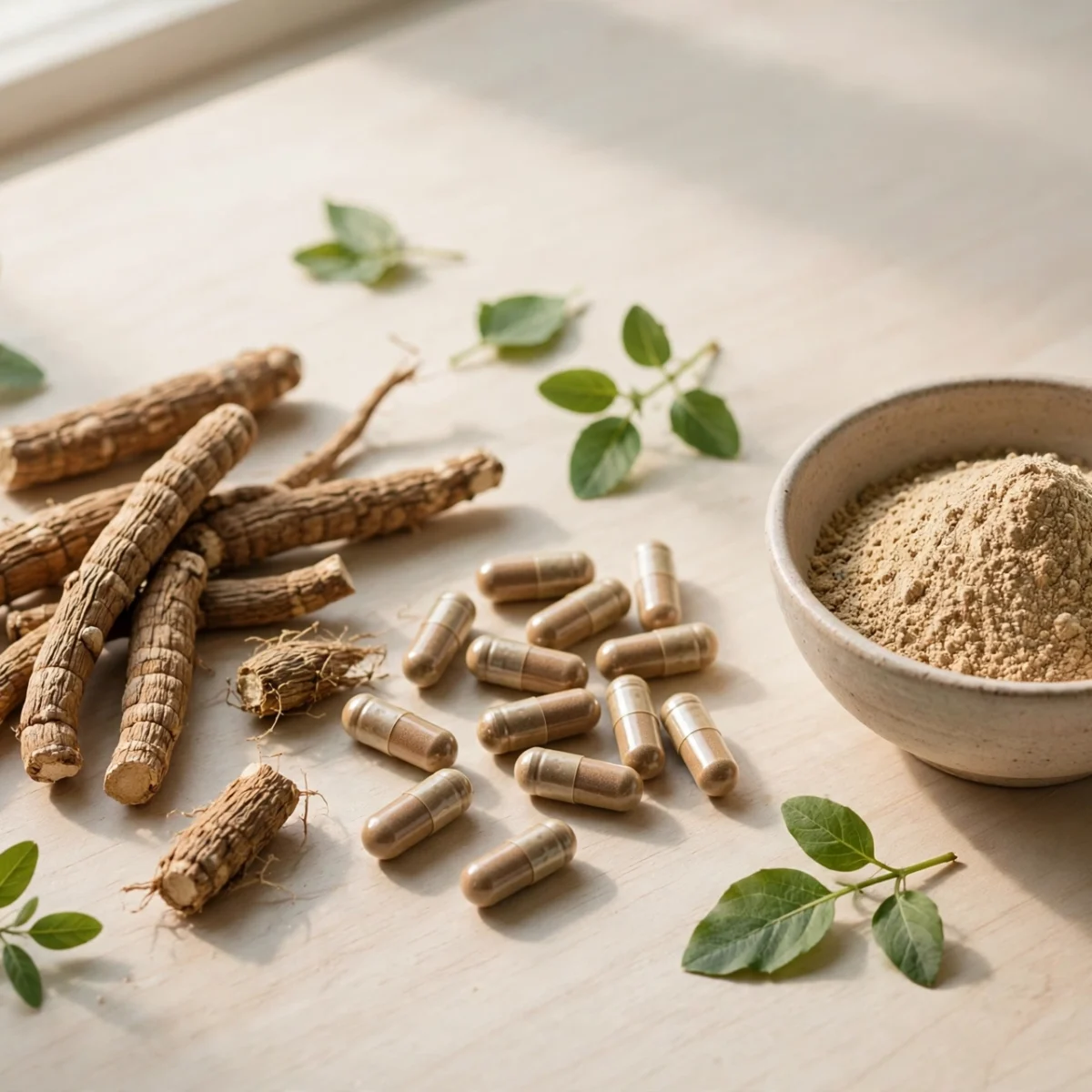
Ashwagandha is an evergreen shrub with the botanical name Withania somnifera, and its root extract is used as a supplement for stress, anxiety and sleep. Ashwagandha has been used for thousands of years in Ayurvedic medicine, where it is classed as a rasayana, a tonic meant to restore strength. The plant grows in India, Africa and parts of the Middle East.
Ashwagandha is also known as Indian ginseng and winter cherry, though it does not belong to the ginseng family. Supplements usually contain extracts made from the root, or from the root and leaves together. The active compounds are called withanolides, a group of steroidal lactones. Good products standardize the extract to a stated withanolide percent, often 5%, so each capsule holds a known amount of active compounds.
Ashwagandha is classed as an adaptogen, a substance that helps the body resist and adapt to physical, chemical and biological stress. An adaptogen is not a sedative, and ashwagandha does not make most people feel drowsy in the daytime, though drowsiness is listed as a possible side effect.
How does ashwagandha work for anxiety?
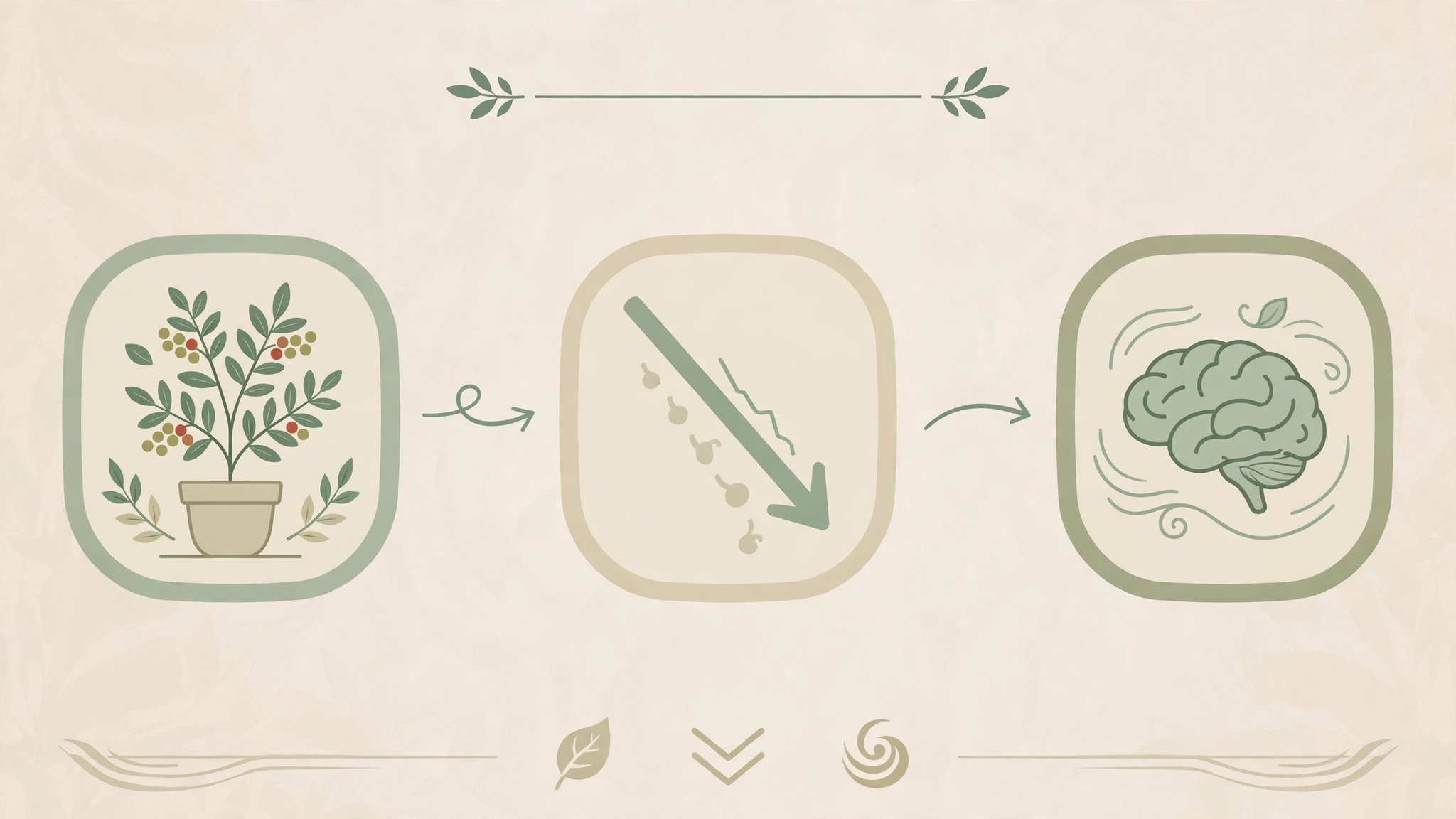
Ashwagandha works for anxiety mainly by calming the stress hormone system, and researchers point to three linked actions. Ashwagandha lowers cortisol, supports the hypothalamic pituitary adrenal axis (HPA axis) that controls the stress response, and acts on calming signals in the brain. These actions build over weeks, which is why trials measure results at 6 to 8 weeks rather than after a single dose.
Cortisol is the hormone the body releases under stress, and high cortisol is linked to worry, poor sleep and fatigue. In a 60 day trial, adults who took 240 mg a day had a 23% drop in morning cortisol, while the placebo group showed almost no change (Source: Lopresti, 2019). Another trial with 58 people found that 250 mg or 600 mg a day for 8 weeks lowered both perceived stress and cortisol compared with placebo.
Ashwagandha also acts on gamma-aminobutyric acid (GABA), the brain signal that slows nerve activity and promotes calm. Withanolides appear to support GABA signalling, which may explain the better sleep and calmer mood some people report. Researchers describe the effect as a combined action on the nervous system, the hormone system and the immune system.
What does the research say about ashwagandha and anxiety?
The research says ashwagandha probably helps anxiety a little, and the quality of the evidence is low to moderate. Meta-analyses lean positive, but the trials are few, small and short, and the results vary a lot between studies.
A 2021 systematic review of 7 studies with 491 adults with high stress and anxiety found that ashwagandha reduced stress and anxiety scores, sleeplessness and fatigue, and lowered serum cortisol, with greater benefits at 500 to 600 mg a day than at lower doses (Source: National Institutes of Health, Office of Dietary Supplements, 2024).
A 2022 meta-analysis of 12 trials with 1,002 people found that ashwagandha reduced anxiety (standardized mean difference minus 1.55) and stress (minus 1.75) more than placebo, but rated the certainty of the evidence as low, with wide variation between trials (I squared 94%). A 2024 meta-analysis of 9 trials with 558 people found lower Hamilton Anxiety scores by 2.19 points and lower Perceived Stress Scale scores by 4.72 points.
A 2025 review of 14 trials with 713 participants found a large average reduction in anxiety symptoms, but flagged high variability and signs of publication bias, which means favourable results may be over represented. The reviews agree on direction and disagree on size, and that is why official guidance stays cautious: the National Center for Complementary and Integrative Health (NCCIH) calls the anxiety findings inconclusive.
Three limits matter. First, most trials used branded extracts, so results may not carry over to a different product. Second, most participants were stressed but otherwise healthy adults in India, so the findings may not match people with a clinical anxiety diagnosis. Third, few trials ran longer than 12 weeks, so nobody knows the effect of taking ashwagandha for a year or more.
How much ashwagandha should you take for anxiety?
Most trials that showed a benefit used 300 to 600 mg a day of a standardized root extract, and 500 to 600 mg a day gave the stronger signal. The provisional guidance from the World Federation of Societies of Biological Psychiatry and the Canadian Network for Mood and Anxiety Treatments is 300 to 600 mg a day standardized to 5% withanolides for generalized anxiety disorder. The National Institutes of Health notes the sleep benefit is clearer at 600 mg a day or above.
Start at the low end if you and your doctor decide to try it, and judge it over a full 8 weeks. A simple plan is 300 mg a day for 2 weeks, then 600 mg a day if it is well tolerated, taken once or split into two doses. No trial proved a best time of day; if ashwagandha makes you drowsy, take it in the evening. Taking it with food is reasonable because stomach upset is the most common side effect.
The form matters more than the brand name. Root extract is the form used in most trials, and capsules or tablets are the common way to take it. Look for a label that states the extract amount in mg, the standardization (for example 5% withanolides), and the plant part. Avoid products that hide the dose inside a blend with no amounts listed.
How long does ashwagandha take to work for anxiety?
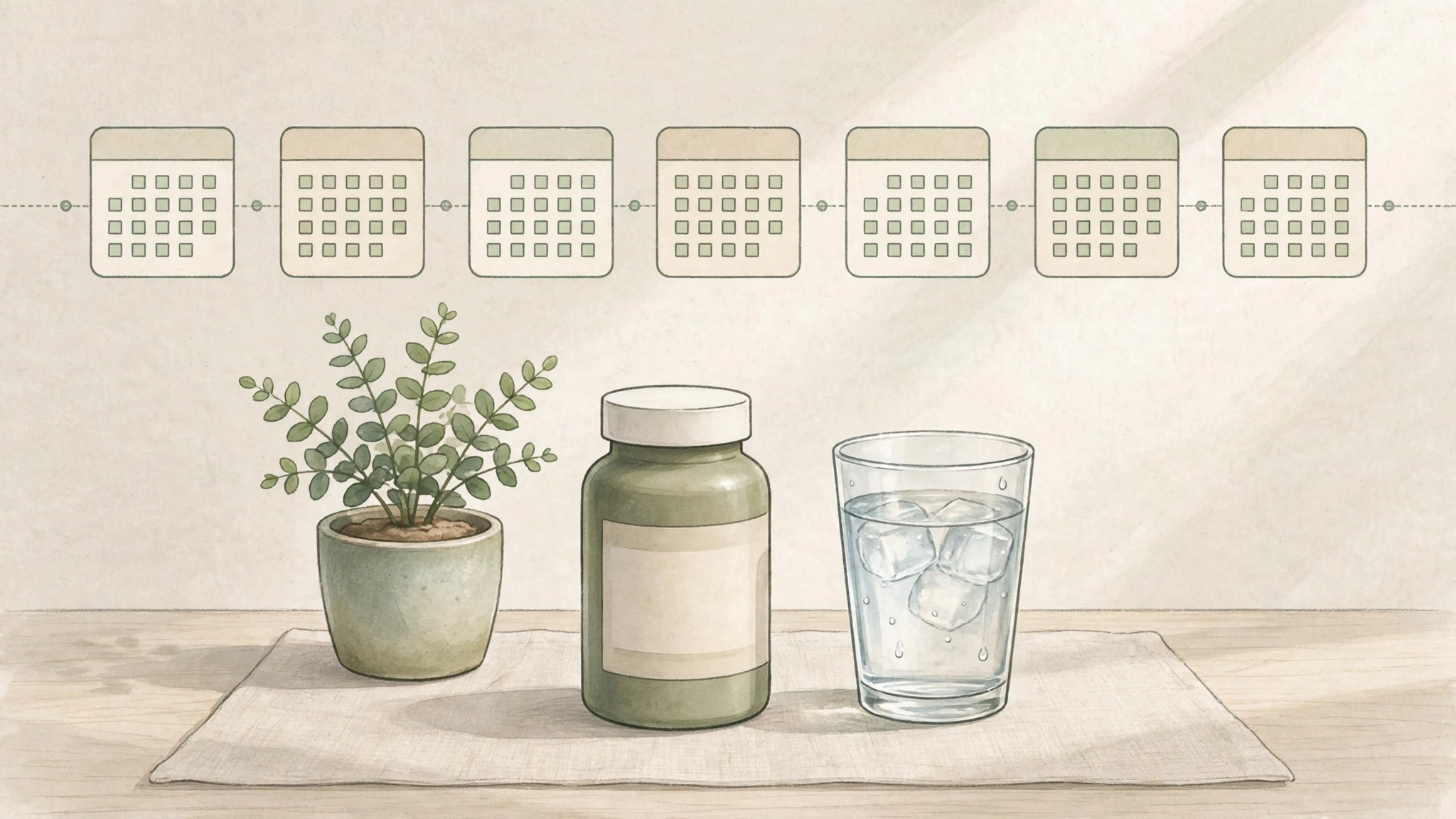
Ashwagandha takes 4 to 8 weeks of daily use before most people notice a change in anxiety, and sleep gains are clearest after 8 weeks. Ashwagandha is not a fast acting calming pill. The trials that found a benefit ran 6 to 12 weeks, and the clearest cortisol and sleep changes appeared around week 6 to week 8.
| Time point | What the trials show |
|---|---|
| Week 1 to 2 | No clear change in anxiety scores; some people notice slightly better sleep |
| Week 4 | Small drops in perceived stress in some trials; cortisol changes begin |
| Week 6 | Cortisol reductions and lower anxiety scores documented in 60 day trials |
| Week 8 and beyond | Clearest benefits for anxiety, stress and sleep; sleep meta-analysis found larger effects at 8 weeks or more |
Judge a trial over 8 weeks, and keep notes on sleep, worry and energy. If nothing has changed after 8 weeks at 300 to 600 mg a day, ashwagandha is probably not the right tool for you. Stop sooner if you develop yellow skin or eyes, dark urine, itching, or lasting nausea.
Ashwagandha vs other anxiety supplements
Ashwagandha has stronger trial evidence for anxiety than most other common calming supplements, but magnesium and L-theanine suit different needs. The table below compares the four supplements people ask about most, using the same questions: evidence level, onset, best use and main caution.
| Supplement | Evidence for anxiety | Onset | Best use | Main caution |
|---|---|---|---|---|
| Ashwagandha | Moderate, meta-analyses of small trials | 4 to 8 weeks | Daily stress, worry, poor sleep | Liver injury rare, avoid in pregnancy |
| L-theanine | Low, small short trials | 30 to 60 minutes | Short term calm, focus, before a stressful event | Drowsiness, low blood pressure |
| Magnesium | Low to moderate, best when levels are low | Days to weeks | Sleep, muscle tension, stress with low intake | Loose stools at high doses |
| Valerian root | Low, mixed trial results | 30 to 60 minutes | Occasional sleeplessness | Morning grogginess, vivid dreams |
L-theanine is an amino acid from tea that acts within an hour, so it suits a single stressful day rather than a daily anxiety plan. Magnesium supports sleep and muscle relaxation, and it helps most when diet intake is low. Valerian is a traditional sleep herb with mixed trial results, and its main use is occasional sleeplessness. Ashwagandha has the strongest trial evidence of the four, and also the only documented liver injury risk.
Read this next: if sleep is part of your anxiety pattern, see the benefits of magnesium for sleep guide on Digital Geek Spot for a full dose and timing plan.
What are the side effects of ashwagandha?
Ashwagandha is generally well tolerated for short term use, and the most common side effects are mild gut problems and drowsiness. The National Institutes of Health lists upset stomach, loose stools, nausea and drowsiness as the most reported effects, and trials found no safety concerns for use up to about 3 months. Long term safety beyond 3 months is not well studied.
The serious risk is liver injury, and it is rare but real. A case series in Liver International described 5 people who developed jaundice 2 to 12 weeks after starting ashwagandha, and liver tests returned to normal within 1 to 5 months after stopping. The National Institutes of Health LiverTox database rates ashwagandha a likely cause of clinically apparent liver injury, and one case series from India reported three deaths from liver failure. People with liver disease should not take ashwagandha without a doctor.
Ashwagandha may also raise thyroid hormone levels, which matters if you have a thyroid condition or take thyroid medicine. It can add to the effect of sedatives and sleep medicines, and it may interact with immune suppressing medicines and with diabetes and blood pressure medicines. Stop taking ashwagandha and seek medical advice if you notice yellow skin or eyes, dark urine, itching, pain in the upper right belly, or lasting nausea.

Who should avoid ashwagandha?
Pregnant or breastfeeding people should avoid ashwagandha, and so should people with liver disease, thyroid disorders, autoimmune conditions, or surgery planned soon. The National Center for Complementary and Integrative Health advises against ashwagandha in pregnancy and breastfeeding, before surgery, and in autoimmune conditions, and it advises asking a doctor first for thyroid disorders.
The full avoid or ask first list is:
- Pregnancy or breastfeeding: avoid, because safety data is lacking.
- Liver disease or raised liver enzymes: avoid unless a doctor approves and monitors liver tests.
- Thyroid condition or thyroid medicine: ask first, because ashwagandha may raise thyroid hormone levels.
- Autoimmune disease: ask first, because ashwagandha may stimulate the immune system.
- Surgery planned: stop at least 2 weeks before surgery.
- Sedatives, sleep medicines or anxiety medicines: ask first, because combined drowsiness is possible.
- Diabetes or blood pressure medicines: ask first, because ashwagandha may change blood sugar and blood pressure.
- Children: safety is not established, so a paediatrician should decide.
If you take any prescribed medicine, check with a doctor or pharmacist before adding ashwagandha.
How to choose a good ashwagandha supplement
Choose a product that states the extract amount, the withanolide percent, the plant part and third party testing on the label. A good label reads like a trial product: 300 mg or 600 mg of root extract, standardized to 5% withanolides. A weak label hides the dose in a blend or makes disease claims such as cures anxiety, which no supplement can legally claim.
Use this checklist before you buy:
- Root extract, not raw powder, with the mg amount per capsule printed clearly.
- Standardization stated, for example 5% withanolides, so the active level is known.
- Third party testing named on the label or the brand site, with a certificate you can read.
- No blend with hidden amounts, and no added stimulants or sedatives you did not ask for.
- A dose that matches the trials, 300 to 600 mg a day, without needing 4 or more capsules.
- A brand that lists a contact address and a batch number, so a problem can be traced.
Price is a weak guide: a cheap powder with no standardization is poor value, and an expensive branded extract is not better than a plain standardized extract at the same dose. Note the start date, and stop after 3 months unless a doctor advises a longer course.
Does ashwagandha help with sleep and stress too?
Yes, ashwagandha may help sleep and stress as well as anxiety, and the sleep evidence is the clearest of the three. A meta-analysis of 5 trials with 400 people found a small to moderate improvement in overall sleep, with larger effects in people with insomnia, at 600 mg a day or more, for 8 weeks or longer. One study found that 72% of people taking ashwagandha reported better sleep, compared with 29% on placebo.
Sleep, stress and anxiety feed each other, so a supplement that helps one often helps the others a little. Better sleep lowers next day worry, and lower cortisol helps sleep onset. Ashwagandha is best seen as a stress and sleep support tool with a modest anxiety benefit, rather than a dedicated anxiety treatment. Digital Geek Spot covers sleep, stress and everyday health in plain language.
FAQs
Does ashwagandha reduce anxiety?
Yes, ashwagandha may modestly reduce anxiety. Trials show lower anxiety scores and lower cortisol at 300 to 600 mg a day over 6 to 8 weeks, but the evidence is low to moderate quality and ashwagandha is not a replacement for prescribed treatment.
How long does ashwagandha take to work for anxiety?
Ashwagandha takes 4 to 8 weeks of daily use before most people notice a change in anxiety. Cortisol and sleep changes appear around week 6, and the clearest benefits show after 8 weeks at 300 to 600 mg a day.
How much ashwagandha should I take for anxiety?
Most trials used 300 to 600 mg a day of a standardized root extract, with the stronger signal at 500 to 600 mg a day. A task force provisionally recommends 300 to 600 mg a day standardized to 5% withanolides. Ask a doctor before starting.
Is ashwagandha safe to take every day?
Ashwagandha appears safe for up to about 3 months in trials, with mild side effects such as stomach upset and drowsiness. Long term safety beyond 3 months is not well studied, and rare liver injury has been reported, so take breaks and seek medical advice.
Can ashwagandha make anxiety worse?
Ashwagandha does not commonly make anxiety worse, but some people report drowsiness, vivid dreams, or feeling numb to emotions. If anxiety rises after starting ashwagandha, stop taking it and speak to a doctor, because the cause may be an interaction or an unrelated problem.
Who should not take ashwagandha?
Pregnant or breastfeeding people should not take ashwagandha. People with liver disease, thyroid disorders, autoimmune conditions, or surgery planned soon should ask a doctor first, as should anyone taking sedatives, thyroid medicine, or immune suppressing drugs.
Conclusion
Does ashwagandha reduce anxiety? The research says yes, modestly, for some people, at 300 to 600 mg a day of a standardized root extract taken for 6 to 8 weeks. Trials show lower anxiety scores, lower perceived stress and lower cortisol, with the clearest gains at 500 to 600 mg a day and after 8 weeks. The evidence is low to moderate quality, and publication bias means the true effect may be smaller than the published average. Side effects are usually mild, but rare liver injury, thyroid effects and drug interactions mean ashwagandha is not safe for everyone. If you try ashwagandha, pick a standardized root extract, judge it over a full 8 weeks, and treat it as one part of a wider plan for sleep, stress and anxiety.
Start exploring: for a related health check, read the signs of vitamin B12 deficiency guide on Digital Geek Spot, because low B12 can mimic anxiety and fatigue, and a simple blood test can rule it out.