Last updated: November 2026 | Written by James Foster for Digital Geek Spot
How much protein do you need per day? Most healthy adults need 0.8 grams of protein per kilogram of body weight each day as a minimum, which works out to about 46 grams for the average woman and 56 grams for the average man. The new 2025-2030 Dietary Guidelines for Americans set a higher goal of 1.2 to 1.6 grams per kilogram, and active adults, older adults, and people who want to build muscle or lose weight often need more than the minimum. Your exact number depends on your body weight, age, activity level, and goal, and this guide shows you how to calculate it in four simple steps.
Protein is a nutrient your body uses to build and repair muscle, make enzymes and hormones, and support your immune system. Your body cannot store protein the way it stores fat, so you need a steady supply from food every day.
Key Takeaways
- The Recommended Dietary Allowance (RDA) for protein is 0.8 grams per kilogram of body weight per day, and this figure is a minimum to prevent deficiency, not an ideal target.
- The 2025-2030 Dietary Guidelines for Americans set a goal of 1.2 to 1.6 grams of protein per kilogram per day for most adults.
- Active adults need 1.2 to 2.0 grams per kilogram, and people who lift weights need about 1.6 grams per kilogram to build muscle.
- Adults over 65 need at least 1.0 to 1.2 grams per kilogram per day to slow age-related muscle loss.
- Spread protein across meals at 20 to 40 grams per meal instead of eating most of it at dinner.
- Healthy kidneys handle high protein intakes from food well, and only people with chronic kidney disease need to limit protein, with a doctor’s guidance.
Table of Contents
- How Much Protein Do You Need Per Day?
- What Is the Recommended Dietary Allowance for Protein?
- How to Calculate Your Daily Protein Needs
- How Much Protein Do You Need for Weight Loss?
- How Much Protein Do You Need to Build Muscle?
- How Much Protein Do Older Adults Need?
- How Much Protein Should You Eat at Each Meal?
- What Are the Best Sources of Protein?
- Is Too Much Protein Bad for You?
- Who Needs More Protein Than Average?
- Protein vs Carbohydrates vs Fat: Where Protein Fits
- Common Protein Myths
- Conclusion
- Frequently Asked Questions
How Much Protein Do You Need Per Day?
Most healthy adults need 0.8 grams of protein per kilogram of body weight each day as a minimum, and 1.2 to 1.6 grams per kilogram as a practical daily target. A 70 kilogram adult needs about 56 grams at the minimum and 84 to 112 grams at the new guideline target. Athletes need 1.2 to 2.0 grams per kilogram, and adults over 65 need at least 1.0 to 1.2 grams per kilogram.
There is no single number that fits every person, because protein needs change with body weight, age, activity level, and health goals. The table below gives the main targets used by health authorities.
| Who you are | Grams per kilogram per day | What it means for a 70 kg adult |
|---|---|---|
| Sedentary adult (RDA minimum) | 0.8 | 56 grams |
| Healthy adult (new US guideline goal) | 1.2 to 1.6 | 84 to 112 grams |
| Active adult | 1.2 to 2.0 | 84 to 140 grams |
| Adult over 65 | 1.0 to 1.2 | 70 to 84 grams |
| Person building muscle | 1.4 to 2.0 | 98 to 140 grams |
| Pregnant woman | 1.1 plus 25 grams | About 102 grams |
The numbers in this table come from the National Academies of Sciences, Engineering, and Medicine, the 2025-2030 Dietary Guidelines for Americans, the International Society of Sports Nutrition, and the PROT-AGE Study Group. Readers who want a broad view of healthy eating will find more guides in the Health section of Digital Geek Spot.
What Is the Recommended Dietary Allowance for Protein?
The Recommended Dietary Allowance (RDA) for protein is 0.8 grams of protein per kilogram of body weight per day for healthy adults aged 18 and older. The RDA meets the nutritional needs of 97 to 98 percent of healthy people, and its purpose is to prevent deficiency. The RDA is a floor, not a target to aim for and stop at.
The 0.8 grams per kilogram figure comes from the Dietary Reference Intakes set by the Institute of Medicine, based on a 2003 meta-analysis of nitrogen balance studies. The figure has stayed almost unchanged for more than 70 years, and it reflects the minimum intake that keeps a healthy adult in balance.
The RDA also works as a share of calories. The Institute of Medicine sets an Acceptable Macronutrient Distribution Range (AMDR) of 10 to 35 percent of daily calories from protein. Research since the RDA was set shows higher intakes help older adults keep muscle and help people who lose weight keep lean tissue, and the new 2025-2030 Dietary Guidelines for Americans reflect that research with a goal of 1.2 to 1.6 grams per kilogram per day.
Read our guide to the best foods for gut health to pair protein with fiber rich meals that support digestion. best foods for gut health
How to Calculate Your Daily Protein Needs
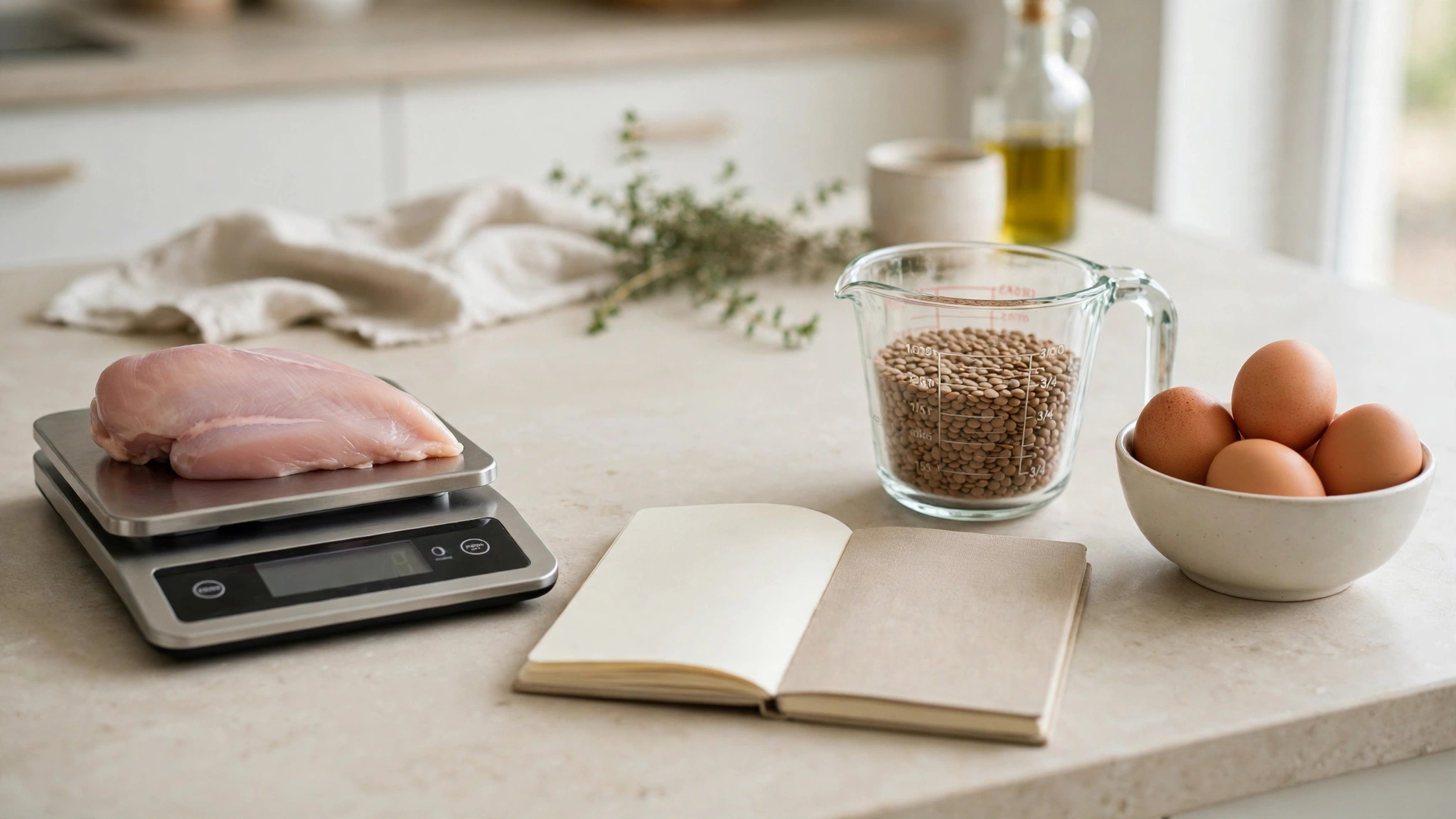
To calculate your daily protein needs, divide your weight in pounds by 2.2 to get kilograms, pick a multiplier from the goal table, and multiply your weight in kilograms by that multiplier. A 150 pound adult weighs about 68 kilograms, and at 1.2 grams per kilogram the daily target is about 82 grams. At 1.6 grams per kilogram the same adult needs about 109 grams. The four steps below take less than a minute.
- Weigh yourself in pounds, or use your weight in kilograms if you know it.
- Convert pounds to kilograms by dividing by 2.2.
- Pick your multiplier: 0.8 for the minimum, 1.2 to 1.6 for general health, 1.4 to 2.0 for muscle building, 1.0 to 1.2 if you are over 65.
- Multiply your weight in kilograms by the multiplier to get your daily grams.
The table below does the math for common body weights at the four most used multipliers, so you can find your number without a calculator. Use the 0.8 column as your floor and the 1.2 to 1.6 columns as your working target. If you carry a large amount of body fat, use your lean body mass or a healthy target weight instead.
| Body weight | 0.8 g/kg (RDA) | 1.2 g/kg | 1.6 g/kg | 2.0 g/kg |
|---|---|---|---|---|
| 50 kg (110 lb) | 40 g | 60 g | 80 g | 100 g |
| 60 kg (132 lb) | 48 g | 72 g | 96 g | 120 g |
| 70 kg (154 lb) | 56 g | 84 g | 112 g | 140 g |
| 80 kg (176 lb) | 64 g | 96 g | 128 g | 160 g |
| 90 kg (198 lb) | 72 g | 108 g | 144 g | 180 g |
| 100 kg (220 lb) | 80 g | 120 g | 160 g | 200 g |
How Much Protein Do You Need for Weight Loss?
People who want to lose weight need about 1.2 to 1.6 grams of protein per kilogram of body weight per day. A 150 pound adult needs about 82 to 109 grams per day at that range. Research shows that this range helps preserve lean muscle and improves body composition during weight loss, while higher intakes up to 2.0 grams per kilogram suit people who train hard while cutting calories.
Protein helps weight loss in three ways. First, protein is more filling than carbohydrates or fat, so a high protein meal keeps you full for longer. Second, your body burns more calories digesting protein than it burns digesting the other macronutrients. Third, protein protects muscle while you lose fat.
The risk of a low protein diet during weight loss is muscle loss. When you eat fewer calories than you burn, your body draws on both fat and muscle for energy. A higher protein intake, paired with resistance training, shifts that balance toward fat loss.
People who take GLP-1 medications for weight loss face the same issue in a sharper form, because these medicines cut appetite and total food intake drops fast. The Mayo Clinic Diet team advises around 1.0 to 1.2 grams per kilogram per day as a starting point, with more if they train. A practical plate puts protein first: a palm sized portion of chicken, fish, eggs, Greek yogurt, tofu, or lentils at each meal.
How Much Protein Do You Need to Build Muscle?
People who lift weights need about 1.6 grams of protein per kilogram of body weight per day to build muscle, and gains level off near that figure. A 150 pound adult needs about 109 grams per day at 1.6 grams per kilogram. The International Society of Sports Nutrition gives a range of 1.4 to 2.0 grams per kilogram for most exercising people who want to build or keep muscle.
Muscle grows when muscle protein synthesis, the process of building new muscle protein, exceeds muscle protein breakdown over the day. Resistance training turns synthesis on, and protein from food supplies the amino acids that synthesis uses. Without enough protein, training still builds some muscle, but the gains are smaller.
Timing matters less than the daily total, but it still helps. Research from the International Society of Sports Nutrition finds that a dose of 20 to 40 grams of high quality protein every three to four hours supports muscle protein synthesis through the day. A shake right after training is convenient, but a meal within a couple of hours works just as well.
Protein quality matters for muscle building. Animal proteins such as whey, eggs, chicken, and fish contain all nine essential amino acids in proportions that match human needs. Plant proteins can build muscle too, but you need a mix of sources, such as beans with rice or lentils with whole grains, to cover all nine. Leucine, one of the essential amino acids, acts as the main trigger for muscle protein synthesis.

How Much Protein Do Older Adults Need?
Adults over 65 need at least 1.0 to 1.2 grams of protein per kilogram of body weight per day, and active older adults need 1.2 grams per kilogram or more. A 70 kilogram older adult needs at least 70 to 84 grams per day. Older adults who face acute or chronic illness need 1.2 to 1.5 grams per kilogram, according to the PROT-AGE Study Group.
Older adults need more protein for two reasons. First, aging muscle responds less strongly to protein, a change called anabolic resistance, so a larger dose is needed to trigger the same synthesis. Second, muscle loss speeds up with age, and higher protein intake, paired with resistance exercise, slows that loss.
Per-meal dose matters more for older adults than for younger adults. A younger adult can trigger muscle protein synthesis with 20 grams of protein, while an older adult often needs 30 to 40 grams per meal. Practical fixes are simple: add Greek yogurt or eggs to breakfast, add a palm sized portion of fish, chicken, or lentils to lunch, and keep dinner protein rich.
How Much Protein Should You Eat at Each Meal?
You should eat 20 to 40 grams of protein at each meal, spread across three to four meals a day, instead of eating most of your protein at one meal. A 70 kilogram adult who needs 100 grams a day reaches the target with 25 grams at breakfast, 35 grams at lunch, and 40 grams at dinner.
Most people eat protein unevenly: a typical day runs 10 grams at breakfast, 20 grams at lunch, and 60 grams at dinner. That pattern wastes protein, because muscle protein synthesis switches on per meal and caps out near 40 grams. Spreading the same total across meals gives three synthesis triggers instead of one.
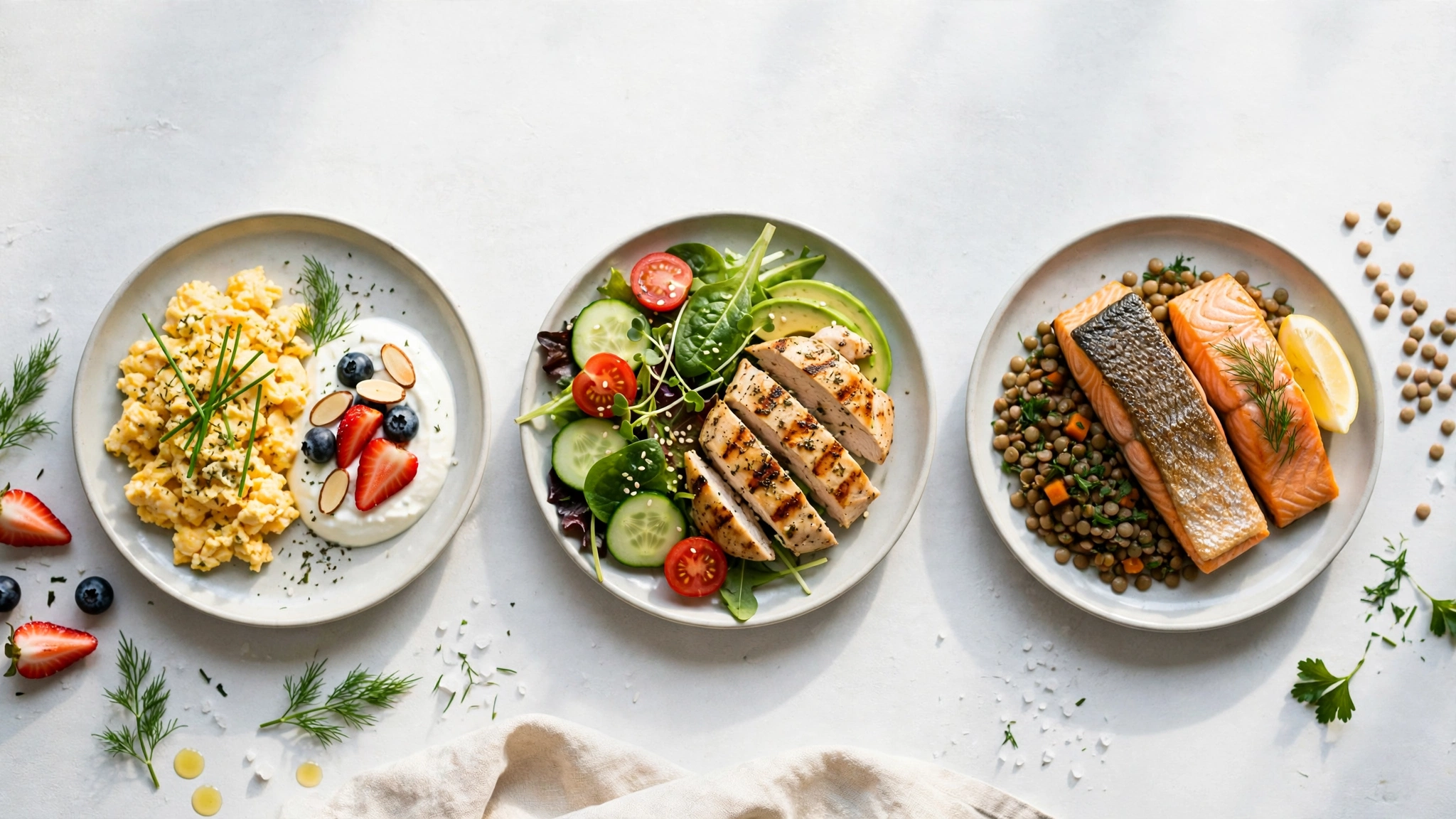
Breakfast is the meal to fix first. Swap a plain bagel or a bowl of cereal for eggs with toast, Greek yogurt with nuts, or a smoothie with milk and protein powder. Each of those options lands near 25 to 30 grams. Total daily intake still matters most, so if your schedule allows only two large meals, hit the daily total first and spread it when you can.
What Are the Best Sources of Protein?
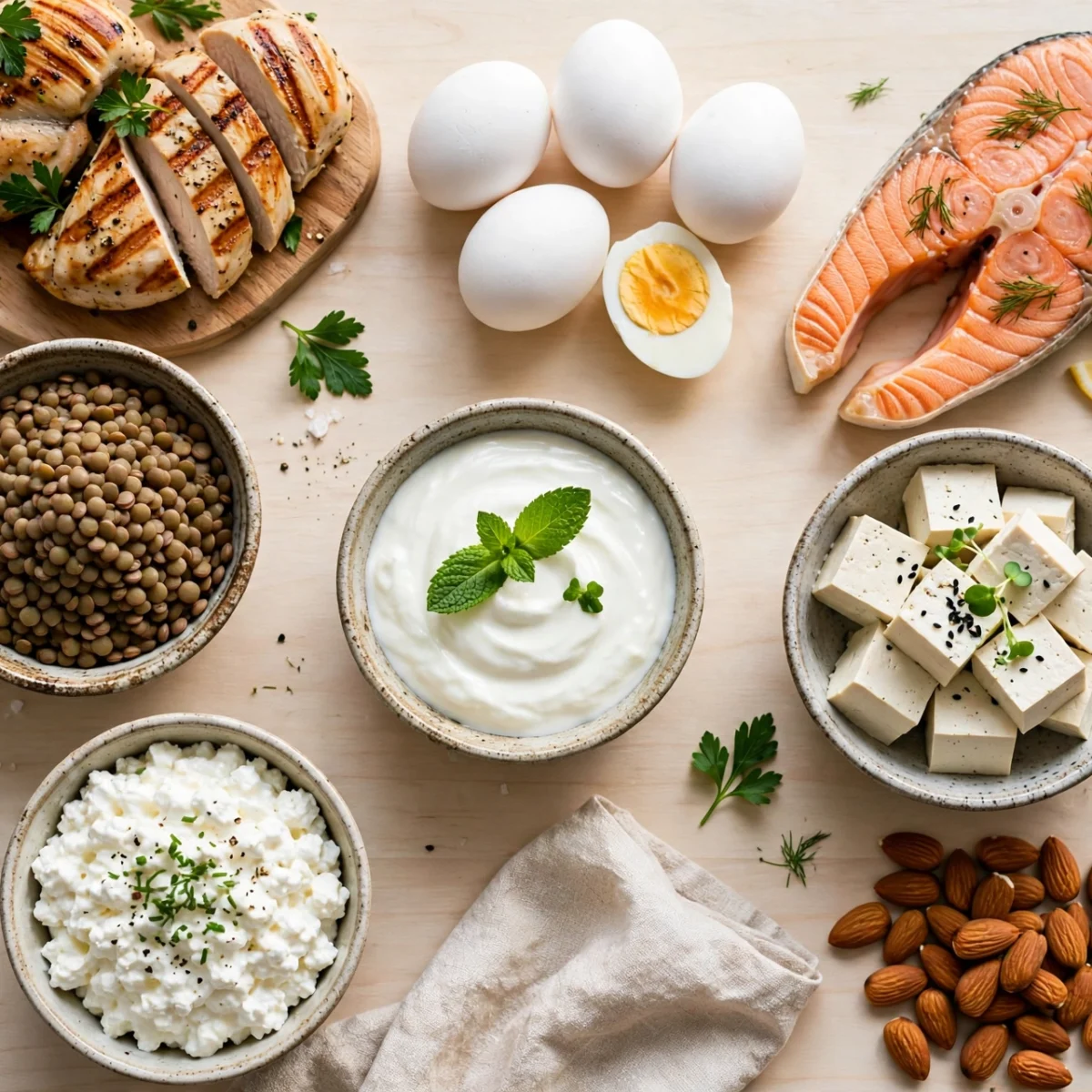
The best sources of protein are foods that give a high amount of protein per calorie and cover all nine essential amino acids. Chicken breast, fish, eggs, Greek yogurt, and lentils lead the list for most people. Animal foods are complete proteins by nature, while plant foods need a mix.
A protein is a chain of amino acids, and nine of the twenty amino acids are essential, which means your body cannot make them and food must supply them. A complete protein contains all nine in useful amounts. Meat, fish, eggs, and dairy are complete, while most plant foods need a mix: beans with rice, lentils with whole grains, or hummus with whole wheat bread. Soy foods such as tofu, tempeh, and edamame are complete on their own. Protein is a macronutrient built from amino acids, and the Wikipedia page on protein explains how amino acid chains fold into the structures your body uses.
| Food (serving) | Protein | Notes |
|---|---|---|
| Chicken breast, 3 ounces cooked | 26 g | Lean, complete, low fat |
| Greek yogurt, 1 cup plain nonfat | 20 g | High protein, adds calcium |
| Salmon, 3 ounces cooked | 19 g | Complete, adds omega-3 fats |
| Lentils, 1 cup cooked | 18 g | High fiber, mix with grains |
| Tofu, 3 ounces | 15 g | Complete plant protein |
| Eggs, 2 large | 12 g | Complete, rich in leucine |
| Cottage cheese, 1/2 cup | 12 g | Slow digesting casein |
| Black beans, 1 cup cooked | 15 g | Mix with rice for completeness |
| Peanut butter, 2 tablespoons | 7 g | Energy dense, watch portions |
| Quinoa, 1 cup cooked | 8 g | Complete grain, rare among plants |
Protein quality also depends on digestibility. Your body absorbs close to 95 percent of the protein in eggs and whey, about 90 percent of the protein in meat and fish, and 70 to 85 percent of the protein in most plant foods. A plant based eater should aim for the upper end of the target range and eat a mix of sources through the day.
Is Too Much Protein Bad for You?
No, too much protein from food is not bad for healthy adults, and the Institute of Medicine has set no upper limit for protein because the risk of harm from protein in food is very low. Studies of intakes up to 2.0 grams per kilogram per day find no harm to kidneys, liver, or bones in healthy people.
The kidney worry is the oldest protein myth. The logic runs that kidneys filter the waste from protein breakdown, so more protein must strain them. In healthy kidneys, a higher protein intake raises filtration rate, which is a normal adjustment, not damage. Large reviews of trials find no decline in kidney function in healthy adults who eat high protein diets. People with chronic kidney disease are different: the KDIGO guideline advises about 0.8 grams per kilogram per day for stages 3 to 5, set with a care team.
Bone health follows a similar pattern. An old claim said high protein leaches calcium from bones, but trials now show the opposite for most adults: adequate protein, paired with calcium and vitamin D, supports bone density. Very high intakes can still crowd out fiber rich foods and cause constipation, so keep protein near your target and keep plants on the plate.
Who Needs More Protein Than Average?
Athletes, older adults, pregnant and breastfeeding women, people who recover from illness or surgery, and people who lose weight need more protein than the average adult. Each group needs more for a different reason, and each group has a range backed by a named authority.
Athletes need 1.2 to 2.0 grams per kilogram per day, according to the American College of Sports Medicine, the Academy of Nutrition and Dietetics, and Dietitians of Canada. Endurance athletes sit near 1.2 to 1.4 grams per kilogram, and strength athletes sit near 1.2 to 1.7 grams per kilogram.
Pregnant women need about 1.1 grams per kilogram plus 25 extra grams per day, and breastfeeding women need about 1.3 grams per kilogram. The extra protein builds fetal tissue, the placenta, and extra blood volume, then supports milk production.
People who recover from illness, surgery, or injury need more protein to rebuild tissue and support the immune system, often 1.2 to 1.5 grams per kilogram, set by a clinical dietitian. Vegans need more than the RDA suggests, because plant protein digests less fully, so the daily target should sit near 1.2 to 1.6 grams per kilogram with a mix of sources.
Protein vs Carbohydrates vs Fat: Where Protein Fits
Protein, carbohydrates, and fat each supply energy, but protein is the only one your body uses mainly to build and repair tissue. Carbohydrates are the body’s preferred fuel for quick energy, fat stores energy and carries fat soluble vitamins, and protein builds muscle, enzymes, hormones, and immune cells. A balanced plate uses all three, and the Institute of Medicine sets a range of 10 to 35 percent of calories from protein, 45 to 65 percent from carbohydrates, and 20 to 35 percent from fat.
| Nutrient | Calories per gram | Main job | Best sources |
|---|---|---|---|
| Protein | 4 | Build and repair tissue | Meat, fish, eggs, dairy, beans, lentils |
| Carbohydrates | 4 | Quick energy | Whole grains, fruit, vegetables |
| Fat | 9 | Stored energy, vitamins | Olive oil, nuts, seeds, avocado, fatty fish |
Protein stands out for satiety. A meal with 30 grams of protein keeps you full longer than a meal with the same calories from carbohydrates alone, because protein slows stomach emptying and triggers fullness hormones. Weight rises when total calories exceed total burn, whatever the source, so set protein first at your target, then fill the rest with carbohydrates and fat.
Common Protein Myths
Most protein myths come from old claims that later research overturned, and the table below gives the short answer to each one. The myths persist because they sound plausible and because they spread faster than the corrections. Each row states the claim, then the fact that current evidence supports.
| Myth | Fact |
|---|---|
| You need 1 gram of protein per pound of body weight | Most adults need 0.8 to 1.6 grams per kilogram, which is 0.36 to 0.73 grams per pound. The 1 gram per pound figure is a generous ceiling, not a need. |
| High protein harms healthy kidneys | Trials find no kidney harm in healthy adults at intakes up to 2.0 grams per kilogram. Only diagnosed kidney disease calls for a limit. |
| Your body can only use 30 grams of protein per meal | Muscle synthesis caps near 20 to 40 grams per meal, but the extra amino acids still feed other body processes. The daily total matters most. |
| Plant protein cannot build muscle | Plant protein builds muscle when the daily total is high enough and sources are mixed. Soy is complete on its own, and beans with grains cover the gaps. |
| Protein shakes are required to build muscle | Whole foods build muscle just as well. Shakes are convenient, not required, and they should fill gaps, not replace meals. |
| More protein always means more muscle | Muscle gains level off near 1.6 grams per kilogram. Extra protein past that point adds little, and training drives the gains. |
Conclusion
How much protein do you need per day? The minimum is 0.8 grams per kilogram of body weight, and the practical target for most adults is 1.2 to 1.6 grams per kilogram, the goal set by the 2025-2030 Dietary Guidelines for Americans. Active adults need 1.2 to 2.0 grams per kilogram, people who build muscle need about 1.6 grams per kilogram, and adults over 65 need at least 1.0 to 1.2 grams per kilogram. Spread the total across meals at 20 to 40 grams each, pick complete proteins or a mix of plant sources, and keep the daily total consistent. Calculate your number with the four steps in this guide, check one normal day of eating against it, and fix breakfast first, because that meal is where most people fall short. Digital Geek Spot covers health, nutrition, and everyday science in plain language.
Learn how to read nutrition labels so you can check the protein in packaged foods before you buy. understanding food labels complete guide
Frequently Asked Questions
How much protein do you need per day?
Most healthy adults need 0.8 grams of protein per kilogram of body weight per day as a minimum, and 1.2 to 1.6 grams per kilogram as a practical target. A 70 kilogram adult needs about 56 grams at the minimum and 84 to 112 grams at the target range.
Is 100 grams of protein a day too much?
No, 100 grams of protein a day is not too much for most adults. A 70 kilogram adult who trains needs about 98 to 140 grams per day, so 100 grams sits inside the normal range. Only people with chronic kidney disease need to limit protein, with a doctor’s guidance.
How much protein do you need per day to lose weight?
People who want to lose weight need about 1.2 to 1.6 grams of protein per kilogram of body weight per day. A 150 pound adult needs about 82 to 109 grams per day at that range, and the protein helps preserve muscle while fat is lost.
How much protein should a woman eat per day?
The average woman needs about 46 grams of protein per day at the 0.8 grams per kilogram minimum, and 72 to 96 grams at the 1.2 to 1.6 grams per kilogram target for a 60 kilogram woman. Active women, older women, and pregnant or breastfeeding women need more.
How much protein should a 70 kg person eat per day?
A 70 kilogram person needs about 56 grams of protein per day at the minimum and 84 to 112 grams per day at the 1.2 to 1.6 grams per kilogram target. Active 70 kilogram adults need 84 to 140 grams, and those who lift weights need about 112 grams.
Is too much protein bad for your kidneys?
No, too much protein from food is not bad for healthy kidneys, and trials find no kidney harm at intakes up to 2.0 grams per kilogram per day. People with diagnosed chronic kidney disease should limit protein to about 0.8 grams per kilogram, set with their doctor.
How much protein is in an egg?
One large egg contains about 6 grams of protein, so two large eggs give about 12 grams. Eggs are a complete protein with all nine essential amino acids, and they are rich in leucine, the amino acid that triggers muscle protein synthesis.