With rhythm serving as a fundamental principle of design, you can transform static artwork into dynamic visual experiences that guide the viewer’s eye across the composition. This artistic element creates movement and pattern through the repetition of colors, shapes, lines, and forms. You’ll discover how artists use five distinct types of rhythm to establish flow and unity in their work, from the structured regularity of regular rhythm to the spontaneous energy of random rhythm.
Defining Rhythm in the Visual Arts
Rhythm in visual art refers to the deliberate repetition of elements that creates a sense of organized movement across a composition. You’ll recognize it through recurring shapes, colors, lines, or forms that guide your eye through the artwork. Artists use rhythm to establish visual flow and create harmony, making their work more engaging and dynamic for viewers.
The Relationship Between Rhythm and Movement
Visual rhythm generates the illusion of movement even in static artworks by directing your gaze along a predictable path. Your eyes naturally follow repeated elements, creating a sense of motion and energy. This connection makes rhythm one of the most effective tools for controlling how you experience and interpret a piece.
Distinguishing Rhythm from Pattern and Repetition
Rhythm differs from simple pattern or repetition through its emphasis on variation and spacing. While patterns repeat elements identically, rhythm incorporates intentional changes in size, interval, or intensity. You’ll notice rhythm feels more organic and dynamic compared to the mechanical uniformity of pure pattern.
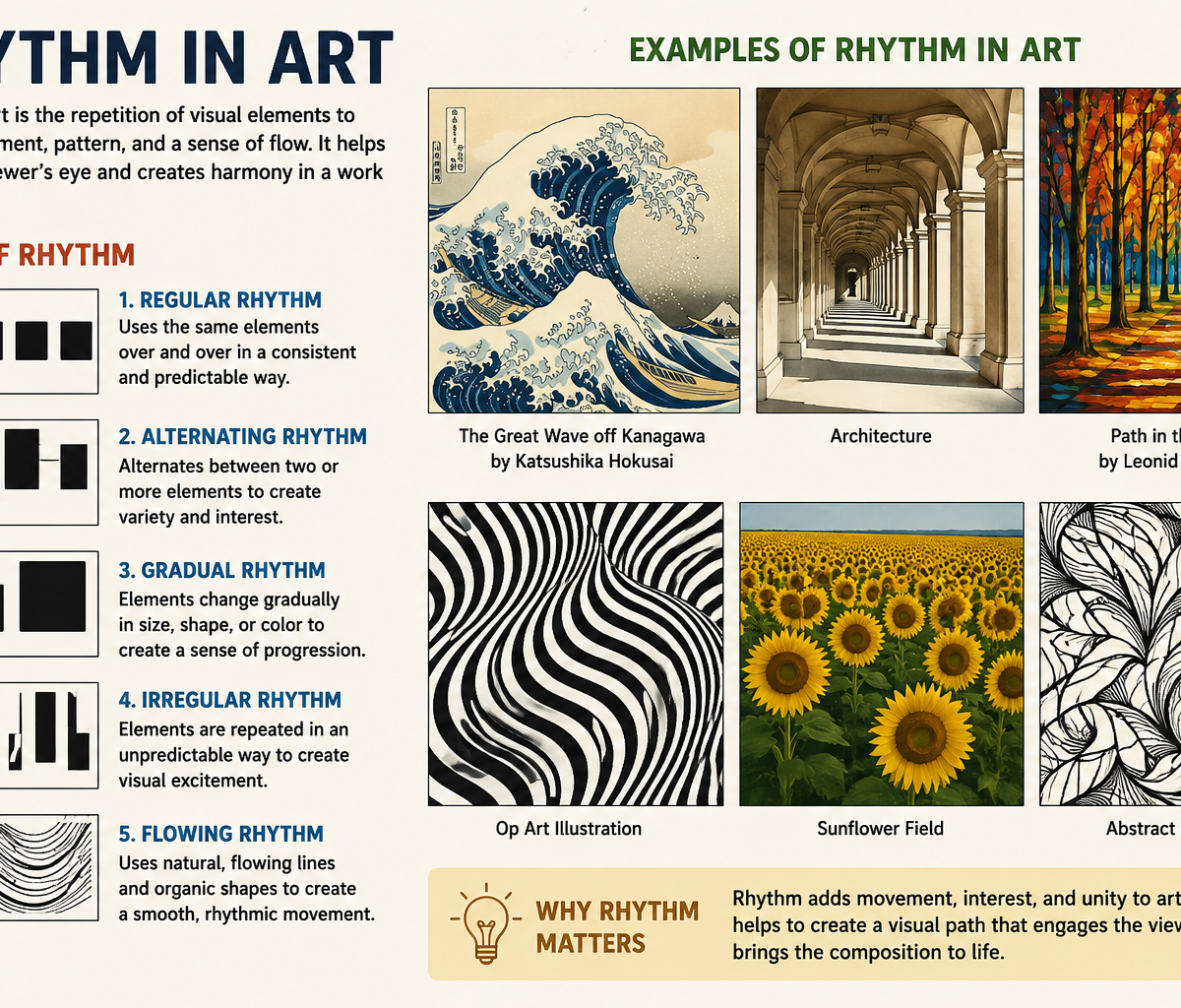
Understanding this distinction helps you appreciate the sophistication behind rhythmic compositions. Pattern creates predictable, uniform arrangements where elements repeat without variation-think of a checkerboard or wallpaper design. Rhythm, by contrast, introduces deliberate variations in spacing, scale, or emphasis between repeated elements. You might see shapes that gradually increase in size, colors that alternate with changing intensity, or lines that appear at irregular intervals. This variation gives rhythm its musical quality, similar to how beats in music aren’t just identical sounds repeated, but organized with different emphasis and timing. When you look at Hokusai’s “The Great Wave,” the repeating wave forms create rhythm rather than mere pattern because each wave differs slightly in size and placement, generating dynamic energy that pulls your eye through the composition.
The Five Fundamental Types of Rhythm
Artists employ five distinct rhythm types to create visual movement and pattern in their work. Each type serves a unique purpose in guiding your eye through a composition. You’ll find these rhythms working independently or combined within a single piece. Assume that mastering these categories will strengthen your ability to analyze and create compelling artwork.
- Random Rhythm
- Regular Rhythm
- Alternating Rhythm
- Flowing Rhythm
- Progressive Rhythm
| Rhythm Type | Key Characteristic |
| Random | Unpredictable spacing without pattern |
| Regular | Consistent, evenly-spaced repetition |
| Alternating | Two or more elements in sequence |
| Flowing | Organic, wave-like movement |
| Progressive | Gradual change in size or quality |
Random and Regular Rhythm
Random rhythm appears chaotic yet intentional, like Jackson Pollock’s drip paintings where splatters create energy without predictable patterns. Regular rhythm operates oppositely, featuring identical elements spaced at equal intervals, similar to Andy Warhol’s repeated soup cans or architectural columns.
Alternating and Flowing Rhythm
Alternating rhythm presents two or more different elements in a recurring sequence, creating visual interest through variation. Flowing rhythm mimics natural curves and organic movements found in waves, vines, or Art Nouveau designs by Alphonse Mucha.
You’ll recognize alternating rhythm in checkerboards, brick patterns, and M.C. Escher’s tessellations where contrasting shapes interlock systematically. Flowing rhythm appears less structured, guiding your eye along continuous curved paths that feel natural and harmonious. This type connects strongly with biomorphic forms and creates a sense of grace and fluidity in compositions. Your eye follows these undulating lines effortlessly, experiencing movement without jarring interruptions.
Progressive Rhythm and Visual Gradation
Progressive rhythm involves systematic changes in elements-size, color, or shape-that increase or decrease gradually. You observe this in concentric circles expanding outward or geometric forms that grow progressively smaller, creating depth and dimensional illusion.
This rhythm type generates powerful visual momentum through controlled transformation rather than simple repetition. You can see progressive rhythm in color gradients that shift from dark to light, or in architectural designs where columns decrease in width as they ascend. The technique creates perspective and draws your attention toward a focal point. Op Art pioneers like Bridget Riley used progressive rhythm to produce optical vibrations and movement on flat surfaces, demonstrating how gradual changes can generate dynamic visual experiences.
The Mechanics of Creating Visual Tempo
Creating visual tempo requires you to understand how elements work together to guide the viewer’s eye across your composition. You control the speed and flow by manipulating size, placement, and repetition of visual components. Your artistic choices determine whether the rhythm feels energetic and fast-paced or slow and contemplative. Mastering these mechanics allows you to orchestrate the viewer’s experience with precision.
Utilizing Shapes, Lines, and Colors
Shapes, lines, and colors serve as your primary tools for building rhythmic patterns in artwork. You can create movement by repeating geometric forms or organic shapes at varying intervals. Bold colors and dynamic lines accelerate visual tempo, while muted tones and gentle curves slow it down. Your strategic use of these elements establishes the composition’s pulse.
Establishing Intervals and Spacing
Intervals and spacing between elements define the beat of your visual rhythm. You determine tempo by adjusting distances-tight spacing creates urgency, while generous gaps produce calmness. Consistent intervals generate predictable patterns, whereas varied spacing introduces syncopation and visual interest. Your spacing decisions directly impact how viewers perceive movement.
Think of intervals as the silent pauses between musical notes that give rhythm its character. You achieve different effects by alternating between wide and narrow gaps, creating a visual cadence that either soothes or energizes. When you space elements evenly, the eye travels smoothly across the composition in a predictable manner. Varying your intervals disrupts expectations and draws attention to specific areas, much like a drummer emphasizing certain beats. The negative space between objects becomes just as important as the objects themselves, shaping the overall rhythmic experience you want your audience to feel.
Practical Techniques for Implementing Rhythm
You can establish rhythm in your artwork by applying several proven methods that work across different mediums. Repetition of shapes, colors, or lines creates visual beats that guide the viewer’s eye. Spacing between elements controls the tempo, while variations in size and intensity add dynamic movement to your composition.
Creating Harmony through Consistency
Consistent patterns form the foundation of rhythmic harmony in visual art. You achieve this by maintaining regular intervals between repeated elements, using similar color values, or establishing predictable directional flows. Your composition gains cohesion when viewers can anticipate and follow these established patterns throughout the piece.
Breaking the Rhythm for Focal Emphasis
Strategic disruptions in your established pattern draw immediate attention to specific areas. You create powerful focal points by intentionally interrupting repetitive elements with contrasting colors, unexpected shapes, or varied spacing. This technique transforms predictable rhythm into compelling visual interest.
The power of rhythmic interruption lies in its ability to surprise and engage your audience. When you’ve established a consistent pattern, breaking it creates tension that demands attention. You might insert a bright red circle among uniform blue squares, or place a large element within a series of small ones. The human eye naturally seeks anomalies, so these deliberate breaks become magnetic focal points. Your viewers will pause at these disruptions, giving you control over where they look and how long they linger. This technique works best when used sparingly-too many breaks destroy the rhythm entirely, while well-placed interruptions enhance both the pattern and the focal area.
Final Words
To wrap up, you now understand how rhythm creates visual flow through repetition, pattern, and movement in artistic compositions. You’ve explored the five main types-regular, flowing, progressive, alternating, and random-each offering distinct ways to guide your eye across artwork. By studying examples from classical paintings to modern design, you can recognize rhythmic elements in any piece you encounter. Apply these principles to analyze art more deeply or strengthen your own creative work with intentional rhythmic patterns.
FAQ
Q: What is rhythm in art and why does it matter?
A: Rhythm in art refers to the visual flow created by repeating elements like shapes, colors, lines, or patterns throughout a composition. Artists use rhythm to guide the viewer’s eye across the artwork and create a sense of movement, even in static images. This principle works similarly to musical rhythm, where beats and pauses create a pattern that feels organized and intentional.
When you look at a painting with strong rhythm, your eyes naturally move from one element to another in a predictable way. The repetition can be regular and uniform, or it can vary in spacing and intensity to create different emotional effects. Rhythm helps unify a composition and makes it more engaging to view, preventing the artwork from feeling chaotic or disconnected.
Q: What are the main types of rhythm used in visual art?
A: Artists employ five primary types of rhythm in their work. Regular rhythm uses identical elements spaced evenly, like windows on a building or a checkerboard pattern. Alternating rhythm switches between two or more different elements in a predictable sequence, such as a pattern of circles and squares.
Flowing rhythm creates movement through curved lines and organic shapes, often seen in Art Nouveau designs or natural forms like waves. Progressive rhythm shows gradual changes in the repeated element, such as shapes that get larger or colors that shift from light to dark. Random rhythm appears less structured but still contains repeated elements scattered throughout the composition without a strict pattern. Each type creates a different visual experience and emotional response, giving artists multiple tools to express their creative vision.
Q: Can you provide specific examples of rhythm in famous artworks?
A: Many masterpieces demonstrate rhythm brilliantly. Grant Wood’s “American Gothic” uses regular rhythm in the vertical lines of the pitchfork, which echo in the man’s overalls and the window patterns of the house behind the figures. Gustav Klimt’s “The Kiss” showcases alternating rhythm through its decorative patterns of rectangles and circular spirals that cover the figures’ robes.
Katsushika Hokusai’s “The Great Wave off Kanagawa” displays flowing rhythm in the curves of the waves and foam, creating dynamic movement across the print. Bridget Riley’s optical art pieces often feature progressive rhythm, with lines or shapes that gradually change size or direction to create illusions of movement. Andy Warhol’s repeated Campbell’s Soup Can prints demonstrate how regular rhythm can transform ordinary objects into compelling artistic statements through systematic repetition.