
If your semester feels like a constant juggling act, you are not alone. These time management tips for college students are built around one simple shift: stop managing tasks and start managing your week. Instead of reacting to whatever deadline is loudest, you build a repeatable weekly system with time-blocking, a clear prioritization method, and a few guardrails against the traps that quietly eat your hours.
This is not about becoming a productivity robot or squeezing study into every spare minute. It is about making deliberate choices with your 168 hours each week so that classes, assignments, sleep, work, and a social life all fit without the constant low-grade panic. The system below takes about 30 minutes to set up on a Sunday and only a few minutes of maintenance each day.
Why College Time Management Is Different
In high school, your day was scheduled for you. In college, the structure disappears and most students discover that freedom is the hardest part. Lectures might occupy only 12 to 15 hours a week, which leaves a huge block of unstructured time that can vanish into scrolling, naps, and last-minute cramming.
College work is also lumpy. One quiet Tuesday can be followed by a week with three midterms and a group project deadline. A rigid daily schedule breaks under that pressure, which is why a weekly system works better. You plan at the week level, move blocks around when life happens, and always know where your hours are going.
Another difference is the mix of obligations. You are not just studying. There is a part-time job, club meetings, laundry, commuting, and the general upkeep of adult life. A system that only tracks assignments will miss half your week. The weekly review below forces you to account for all of it.
Build Your Weekly System With Time-Blocking
Time-blocking means assigning every hour of your week a job in advance. Classes, meals, work shifts, and sleep go on the calendar first as fixed blocks. Then you add study blocks, and finally you protect a few open blocks for rest and fun. The point is not to follow the plan perfectly. The point is that when you sit down at 2 p.m., you already know what this hour is for, so you skip the 20-minute “what should I do now” drift.
Here is how to set it up in one Sunday session:
- Step 1: Anchor the fixed blocks. Put in classes, lab sessions, work shifts, and commute time. Block out sleep too, aiming for a consistent bedtime, since a tired brain studies at half speed.
- Step 2: Estimate study hours. A common rule of thumb is 2 hours of study per week for each credit hour, adjusted up for difficult courses. A 15-credit semester means roughly 20 to 30 study hours. Write the number down so you are working with reality, not hope.
- Step 3: Place study blocks before the week starts. Spread them across days, keep them between 50 and 90 minutes, and label each one with the course it belongs to. Vague blocks labeled “study” get skipped. Specific blocks labeled “Biology chapter 7 problems” get done.
- Step 4: Leave buffer blocks. College weeks are unpredictable. Keep two or three open blocks labeled “flex” each week. When something slips, it moves into a flex block instead of into your sleep.
- Step 5: Protect downtime. Schedule at least one full evening and part of one day with nothing academic. Rest is not the reward for finishing everything. It is fuel that makes everything else possible.
Use whatever tool you will actually open: a paper planner, Google Calendar, or a digital planning app. If you like comparing digital tools, this comparison of Notion AI vs ClickUp Brain breaks down two popular options for organizing coursework and tasks.
Prioritize With Simple Methods That Work
A calendar full of blocks is useless if you always work on the wrong thing first. Pick one prioritization method and use it every day.
The Eisenhower Matrix
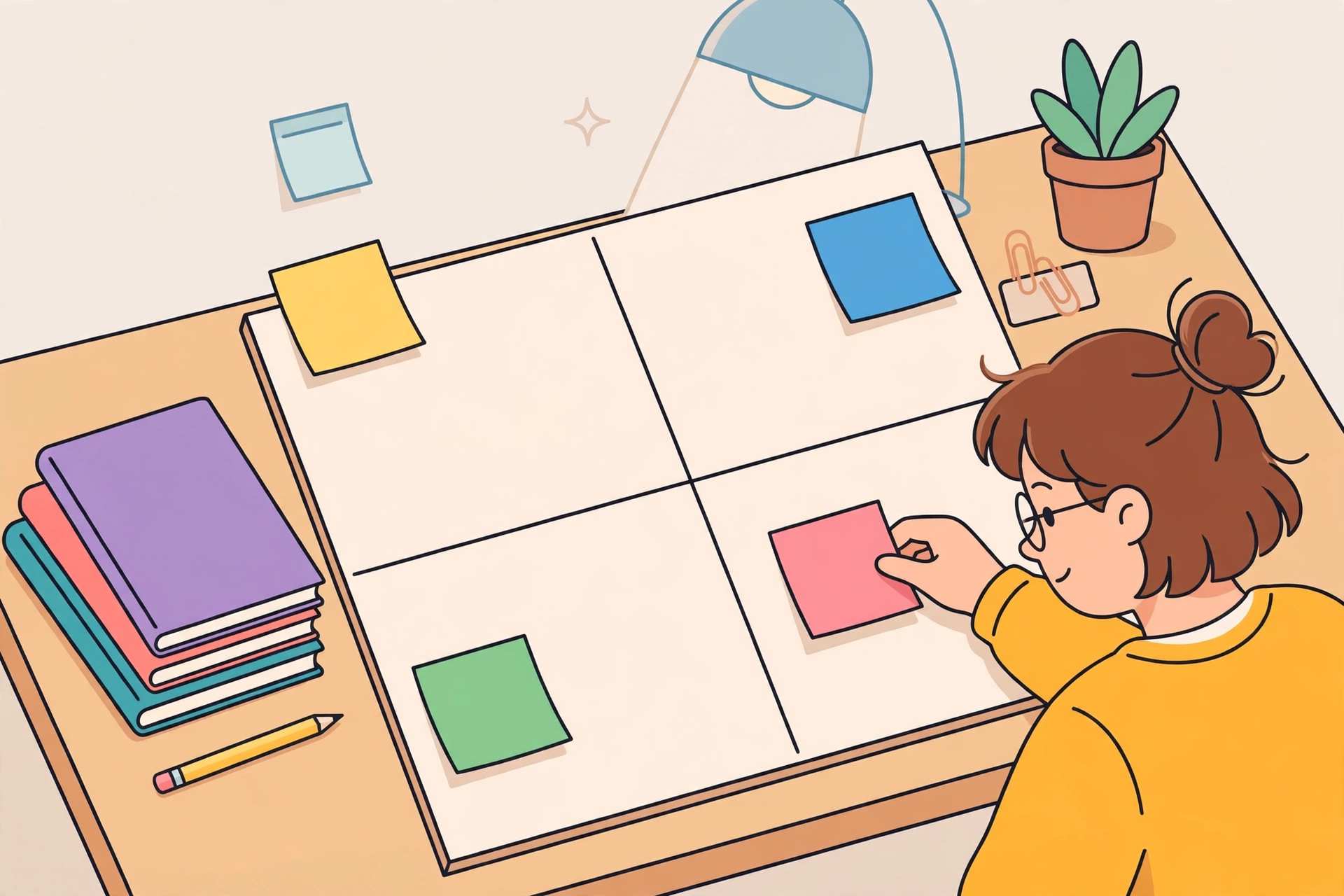
Draw a simple grid with four boxes: urgent and important, important but not urgent, urgent but not important, and neither. Exam prep and assignments due tomorrow go in box one. Reading ahead and long-term projects go in box two, and this is where most of your study blocks should live. Box three tasks get delegated or batched. Box four gets cut or minimized.
Eat the Frog
Do your hardest or most dreaded task first, before the day gets busy. One focused morning session on the difficult assignment beats three distracted evening attempts. The rest of the day feels lighter because the worst item is already crossed off.
The 1-3-5 Rule
Each day, aim to complete one big task, three medium tasks, and five small tasks. It is a realistic daily target that prevents the classic mistake of listing 14 things and finishing 3. On heavy exam days, shrink it to one big task and call that a win.
Whatever method you choose, write your top three priorities for the next day before you go to bed. Waking up with a short, clear list removes the morning decision fatigue that derails so many students.
Protect Your Focus During Study Blocks
The best schedule in the world fails if every study block dissolves into phone checks. Treat focus as a skill you train, not a trait you either have or lack.
- Phone out of reach. Put it in another room or inside your bag on silent. Studies on attention are consistent about one thing: even a face-down phone nearby divides attention. Out of sight is the only reliable setting.
- Use 50/10 or 90/20 cycles. Work for 50 minutes, then take a 10-minute break, or 90 minutes with a 20-minute break for deep topics. During breaks, move around, get water, or step outside. Do not open social media, because five planned minutes routinely becomes thirty.
- Single-task by design. Close extra tabs, silence notifications on your laptop, and keep only the materials for the current block on your desk. Multitasking with studying is really just rapid task-switching, and it makes everything slower and shallower.
- Study in the right place. The library, a quiet cafe, or an empty classroom beats your bed or a noisy dorm room for almost everyone. A consistent study spot trains your brain to switch into work mode on arrival.
If you want technology to help instead of distract, a good starting point is this roundup of the best AI tools for students, which includes apps that can summarize readings and help you plan study sessions more efficiently.

Avoid These Common Time Traps
Most students do not have a time problem so much as a leak problem. Hours disappear into a handful of predictable traps.
The All-Nighter
Cramming until 4 a.m. feels productive but trades tomorrow’s focus for tonight’s anxiety. Sleep consolidates memory, so a rested brain recalls more than an exhausted one that read the chapter twice. Plan backwards from exam dates instead: break the material into daily blocks starting a week or two early.
Saying Yes to Everything
Clubs, events, group chats, and side projects are wonderful, but every yes is a no to something else. Before committing, ask what you would drop to make room. A good rule: if it does not fit in a flex block or your scheduled downtime, it does not fit this week.
Perfectionism on Small Tasks
Spending two hours formatting a discussion post worth 2 percent of your grade is a budgeting error. Match effort to weight. Save your perfectionism for exams and major papers, and let small tasks be merely good.
The Endless Re-read
Re-reading notes feels like studying but produces weak results compared to active recall: closing the book and writing down what you remember, or testing yourself with practice questions. Shorter, active sessions beat longer, passive ones every time.
Automation can also quietly recover lost hours. This guide on how to automate tasks with Zapier shows how to set up reminders and routine workflows so small admin tasks stop stealing study time.
A Sample Weekly Schedule You Can Steal
Here is what a balanced week might look like for a full-time student with a part-time job. Adjust the blocks to your own fixed commitments.
- Monday: Classes 9 to 3, study block 4 to 6 (hardest subject), gym and dinner, light review 8 to 9.
- Tuesday: Classes 10 to 2, work shift 3 to 7, flex block 8 to 9 for overflow tasks.
- Wednesday: Classes 9 to 1, two study blocks 2 to 4 and 5 to 6:30, free evening.
- Thursday: Classes 10 to 3, study block 4 to 6, club meeting in the evening.
- Friday: Morning classes, afternoon study block to finish the week strong, full evening off.
- Saturday: Late morning weekly review and planning session, work shift or social time in the afternoon, free evening.
- Sunday: One or two study blocks for the week ahead, meal prep or chores, full evening off.
Notice what is missing: there are no 8-hour study marathons and no zero days where nothing gets done. Steady, moderate blocks compound over a semester in a way that heroic cram sessions never do.
Track, Review, and Adjust Every Week
A system only works if you maintain it. Spend 15 to 20 minutes once a week, ideally Sunday, doing a short review:
- What got done, and what slipped? Move slipped items into next week’s blocks instead of feeling guilty about them.
- Which study blocks actually happened? If evening blocks keep dying, move them to mornings.
- What is coming in the next two weeks? Exams, project milestones, and travel should appear on the calendar before they become emergencies.
- Did you get enough sleep and downtime? If the week felt awful, the schedule needs more rest, not more discipline.
Think of this as debugging, not judging. You are tuning a system to fit your real life, and every semester gets a little smoother. For more student productivity ideas, browse the other guides on the DigitalGeekSpot homepage, where new study and tech guides are published regularly.
FAQ
How many hours should a college student study per week?
It depends on your course load and the difficulty of your classes. A widely used guideline is about 2 hours of study per week for each credit hour, so a 15-credit semester suggests roughly 20 to 30 hours. Treat that as a starting estimate, then adjust based on your grades and how prepared you feel before exams.
What is the best time management method for students?
The combination that works for most students is weekly time-blocking plus one simple prioritization rule, such as the 1-3-5 rule or the Eisenhower Matrix. Fancy systems fail when they take more effort to maintain than the studying itself, so choose the simplest method you will actually follow every week.
How do I stop procrastinating on assignments?
Break the assignment into small first steps and schedule the first step as a specific time block, like “open the document and write the outline at 4 p.m.” Starting is the hard part, so make the starting step tiny. Working in a distraction-free place with your phone out of reach removes the most common escape routes.
Is it better to study in the morning or at night?
The best time is the time you can do consistently without distractions. Many students do their best deep work in the morning when willpower is fresh, but night owls can be equally effective with a consistent schedule. What matters most is protecting that block and getting enough sleep, not the exact hour on the clock.
How can I balance a part-time job with college classes?
Put work shifts on the calendar first as fixed blocks, then build study blocks around them. Keep your total commitments honest: if work plus classes plus study exceed what fits in a week with sleep, something has to give. Use flex blocks to absorb shift changes, and communicate your exam schedule to your employer early.