Written by James Foster for Digital Geek Spot. Last updated: October 2026.
Introduction
A nicotine strength guide for vapers answers one practical question for adult vapers: which number on the bottle or pod gives enough satisfaction without harshness, dizziness, or constant puffing? A nicotine strength guide for vapers starts with three facts: strength is measured in milligrams per millilitre (mg/mL) or percent, freebase nicotine and nicotine salt use different ranges, and the right number depends on past smoking, device power, and draw style. This guide covers mg to percent conversion, freebase versus salt, strength by smoking habit, device pairing, PG/VG ratio, warning signs, a step-down plan, and label reading for bottles, pods, and disposables, plus caps in the United States, the United Kingdom, and the European Union. Use the charts, test for a week, and adjust by one level.
Key Takeaways
- Nicotine strength is mg/mL or percent: multiply percent by 10 to get mg/mL, so 2 percent equals 20 mg/mL.
- Freebase nicotine usually runs from 0 mg to 18 mg, while nicotine salt usually runs from 10 mg to 50 mg and suits low power pods.
- A pack-a-day smoker often starts at 12 mg freebase or 20 mg to 30 mg nicotine salt in a mouth-to-lung pod.
- Low power mouth-to-lung devices need higher strengths, and high power sub-ohm devices need low strengths, usually 0 mg to 6 mg.
- Test a new strength for a full week before changing it, and move up or down by one level only.
- Adults who never smoked should start at 0 mg and should not start nicotine use to try vaping.
What Is Nicotine Strength and How Is It Measured?
Nicotine strength is the concentration of nicotine in e-liquid, stated as milligrams of nicotine in each millilitre of liquid (mg/mL) or as a percent of the liquid. A 6 mg/mL bottle holds 6 milligrams of nicotine in every millilitre, so a 30 mL bottle at 6 mg/mL holds 180 milligrams in total. That total helps compare bottles, but it does not state how much nicotine a person absorbs, because device power, puff length, and puff count change absorption.
Nicotine is a stimulant compound found in tobacco plants, and it is the addictive compound in cigarettes and vaping products. In vaping, nicotine is mixed into propylene glycol (PG) and vegetable glycerin (VG), plus food-grade flavourings. Bottled liquid often uses mg/mL, United States pods and disposables often use percent, and United Kingdom and European Union products often use mg/mL with a retail cap of 20 mg/mL. Convert every label to mg/mL before comparing products.
Explore more guides in the Vape section of Digital Geek Spot before you pick a device.
How Do You Convert Nicotine Percent to mg?
To convert nicotine percent to mg/mL, multiply the percent by 10, so 2 percent equals 20 mg/mL and 5 percent equals 50 mg/mL. To convert mg/mL to percent, divide mg/mL by 10, so 6 mg/mL equals 0.6 percent and 12 mg/mL equals 1.2 percent. This rule clears up the most common label confusion, because a 5 percent disposable and a 50 mg/mL pod state the same strength.
| Percent | mg/mL | Total in a 10 mL bottle | Where you usually see it |
|---|---|---|---|
| 0 percent | 0 mg/mL | 0 mg | Nicotine-free liquid, any device |
| 0.3 percent | 3 mg/mL | 30 mg | Low freebase, sub-ohm devices |
| 0.6 percent | 6 mg/mL | 60 mg | Common freebase, starter kits and pods |
| 1.2 percent | 12 mg/mL | 120 mg | Medium freebase, mouth-to-lung kits |
| 1.8 percent | 18 mg/mL | 180 mg | High freebase, mouth-to-lung kits |
| 2.0 percent | 20 mg/mL | 200 mg | Salt or freebase, UK and EU retail cap |
| 3.0 percent | 30 mg/mL | 300 mg | Mid salt, pods and disposables |
| 5.0 percent | 50 mg/mL | 500 mg | High salt, United States disposables |
A pod labelled 2.4 percent holds 24 mg/mL, because 2.4 times 10 equals 24. Do not compare a percent number with a mg/mL number directly, because 5 percent is far higher than 5 mg/mL.
Freebase vs Nicotine Salt: Which Strength Scale Applies?
Freebase nicotine and nicotine salt use different strength scales because nicotine salt is smoother at high strengths, while freebase nicotine gives a sharper throat hit as strength rises. Freebase nicotine is the traditional form used in bottled e-liquid. Nicotine salt is freebase nicotine mixed with an acid, often benzoic acid, which lowers pH and smooths the throat hit. That chemistry explains why salt numbers look much higher: a 30 mg salt liquid can feel smoother than an 18 mg freebase liquid.
Freebase nicotine suits vapers who want a clear throat hit, or who use higher power devices at low strengths, and it usually runs from 0 mg to 18 mg. Nicotine salt suits low power pods and fast craving relief, and it usually runs from 10 mg to 50 mg, with 20 mg, 30 mg, 35 mg, and 50 mg as common steps in the United States, and 10 mg and 20 mg as common steps in the United Kingdom and the European Union.
| Feature | Freebase nicotine | Nicotine salt |
|---|---|---|
| Usual strength range | 0 mg to 18 mg/mL | 10 mg to 50 mg/mL |
| Throat hit | Sharper, rises with strength | Smoother at the same feel level |
| Absorption speed | Slower, steadier | Faster, closer to a cigarette feel |
| Best device match | Starter kits, mouth-to-lung tanks, sub-ohm tanks at low mg | Low power pods and disposables |
| Common mistake | Using 12 mg or 18 mg in a sub-ohm tank | Using 35 mg or 50 mg in a sub-ohm tank |
Do not swap the scales: 12 mg salt is a low salt strength, and 30 mg freebase is outside the normal freebase range.
What Nicotine Strength Matches Your Smoking Habit?
The best starting strength for a smoker who switches to vaping is the strength that matches past daily cigarette use, device type, and nicotine type together, not past use alone. Past use gives the starting point, and device type adjusts it, because a tank vaporises far more liquid per puff than a pod.
| Past smoking habit | Cigarettes per day | Freebase starting point | Nicotine salt starting point |
|---|---|---|---|
| Never smoked, or social only | 0, or rare | 0 mg | 0 mg |
| Very light, or social smoker | 1 to 5 | 3 mg | 5 mg to 10 mg |
| Light smoker | Under 10 | 3 mg to 6 mg | 10 mg |
| Moderate smoker | 10 to 15 | 6 mg to 12 mg | 10 mg to 20 mg |
| Heavy smoker | About 20, one pack | 12 mg | 20 mg to 30 mg |
| Very heavy smoker | More than 20 | 18 mg | 20 mg, salt preferred |
A pack-a-day smoker in a refillable mouth-to-lung pod often starts well at 12 mg freebase or 30 mg salt in the United States, or 20 mg salt in the United Kingdom and the European Union. Give the starting strength a full week, then move by one level if needed. Read our guide on how vape devices work to match strength to draw style.
How Does Your Device Change the Right Nicotine Strength?
Your device changes the right nicotine strength because device power decides how much liquid, and therefore how much nicotine, each puff delivers. Low power devices vaporise a small amount of liquid per puff, so they need a higher concentration to satisfy cravings. High power devices vaporise a large amount of liquid per puff, so they need a low concentration to avoid overload. This rule matters more than brand, flavour, or coil name.
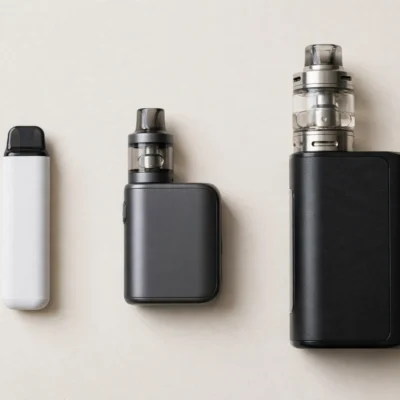
Mouth-to-lung (MTL) devices use low power, often 8 watts to 18 watts, with a tight draw that feels like a cigarette draw, and MTL vapers usually use freebase at 6 mg to 18 mg, or salt at 10 mg to 50 mg. Direct-to-lung (DTL) devices, also called sub-ohm devices, use high power, often 40 watts and above, with wide airflow and large vapour clouds, and DTL vapers usually use freebase at 0 mg to 6 mg only. Salt nicotine at 20 mg or higher in a sub-ohm device can cause dizziness and nausea, so salt and sub-ohm tanks do not mix at high strengths.
| Device type | Draw style | Power range | Usual strength |
|---|---|---|---|
| Small pod, disposable | Mouth-to-lung | Low | 20 mg to 50 mg salt, or 6 mg to 18 mg freebase |
| Starter kit, MTL tank | Mouth-to-lung | Low to mid | 6 mg to 18 mg freebase, or 10 mg to 20 mg salt |
| Sub-ohm tank, high power mod | Direct-to-lung | High | 0 mg to 6 mg freebase only |
Coil resistance and wattage shift the result inside these bands: a low resistance coil at high wattage vaporises more liquid, so drop the strength.
How Do PG/VG Ratio and Flavour Change Perceived Strength?
PG/VG ratio and flavour change how strong a nicotine strength feels, even though they do not change the mg/mL number on the label. Propylene glycol (PG) carries flavour and gives a stronger throat hit, while vegetable glycerin (VG) makes denser vapour and feels smoother. A 12 mg liquid at 50/50 PG/VG feels harsher than a 12 mg liquid at 70/30 VG/PG. High PG suits pods, high VG suits sub-ohm devices, and menthol or mint can make a lower strength feel more satisfying, while creamy flavours can mask harshness. Flavour does not change the nicotine number, and a smooth flavour does not make a high strength safe for a sub-ohm device.
What Are the Signs Your Nicotine Strength Is Too High or Too Low?
The signs that a nicotine strength is wrong show up in cravings, puff pattern, throat feel, and body response within the first few days, and they point in opposite directions for too high and too low. A strength that is too low leaves cravings unsatisfied and pushes puff count up. A strength that is too high causes harshness and body symptoms and pushes puff count down, because each puff feels unpleasant.
Signs your strength is too low:
- Cravings return soon after vaping, even after a full session.
- You puff almost constantly to chase satisfaction.
- You feel irritable or unable to focus shortly after vaping.
Signs your strength is too high:
- Vapour feels harsh or scratchy, and you cough often.
- You feel dizzy, lightheaded, or jittery after a short session.
- You feel nauseous, or you get a headache after vaping.
If high-strength symptoms appear, stop vaping, drink water, sit down, and wait for the symptoms to pass. When you resume, step down one level. If low-strength signs persist after a week, step up one level, and check device fit at the same time. Seek medical advice if symptoms are severe, or if chest pain or breathing trouble appears. This guide is for adult vapers only, and it is not medical advice.
How Do You Step Down Nicotine Strength Safely?
To step down nicotine strength safely, drop by one level at a time, hold each level for 2 weeks to 4 weeks, and only drop again when cravings stay settled for a full week at the current level. A slow plan works better than a sudden jump to 0 mg, because sudden jumps often cause chain vaping, irritability, and a return to cigarettes.
A common path for a United States pod vaper is: 50 mg salt, then 35 mg, then 25 mg to 30 mg, then 20 mg, then 10 mg to 12 mg, then 6 mg freebase, then 3 mg, then 0 mg. A common path for a United Kingdom or European Union pod vaper is: 20 mg salt, then 10 mg, then 6 mg freebase, then 3 mg, then 0 mg. A common path for a sub-ohm vaper is: 6 mg freebase, then 3 mg, then 0 mg. Not every level is sold in every market, so pick the nearest sold level below your current level.
If cravings return strongly after a drop, step back up one level, hold for 2 weeks, and try again. Smokers who want to quit nicotine fully should also talk to a doctor or pharmacist about proven quit aids.
What Nicotine Strength Should Non-Smokers and New Vapers Choose?
Adults who never smoked should choose 0 mg nicotine, and adults who never used nicotine should not start nicotine use to try vaping. Nicotine is addictive, and a non-smoker gains no benefit from adding nicotine to a habit that can be enjoyed at 0 mg. New vapers who did smoke should start from the smoking habit chart, not from a friend’s strength, and should avoid high salt strengths in high power devices. This guide is written for adults of legal vaping age only, and adults should not supply vaping products to minors.
How Do You Read a Disposable, Pod, and Bottle Label?
To read a nicotine label correctly, find the number, check the unit, convert to mg/mL, and check the device type the product is made for. Bottles usually state mg/mL plus bottle size, so multiply mg/mL by size for total nicotine. Pods state percent or mg/mL plus pod size. Disposables state percent plus puff rating, but puff ratings are maker estimates, so treat them as a rough guide, not a dose measure.
Regional caps change what you can buy. In the United Kingdom, the European Union, and Canada, retail e-liquid is capped at 20 mg/mL (2 percent). In the United States, no federal cap at 20 mg/mL applies in the same way, so disposables and pods at 50 mg/mL (5 percent) are common.
Puff tiers and authenticity checks pair with label reading, because strength, device, and seller checks together decide a safe purchase.
Conclusion
A nicotine strength guide for vapers works when it turns a confusing label into a clear starting point, a fair test, and a safe adjustment rule. Convert percent to mg/mL by multiplying by 10, pick freebase or salt based on device type, start from the smoking habit chart, and test the starting strength for a full week. Low power mouth-to-lung devices need higher strengths, high power sub-ohm devices need low freebase only, and PG/VG ratio and flavour change feel, not the mg number. Move by one level at a time, step down slowly, and choose 0 mg if you never smoked.
Next, read our guide on the best disposable vapes before your next purchase.
FAQs
What is 2 percent nicotine in mg?
2 percent nicotine is 20 mg/mL, because percent times 10 gives mg/mL. A 2 percent pod and a 20 mg/mL bottle state the same strength, and 2 percent is the retail cap in the United Kingdom and the European Union.
Is 5 percent nicotine a lot?
Yes, 5 percent nicotine is a high strength, because 5 percent equals 50 mg/mL. A 5 percent disposable suits low power pods and disposables in markets where 50 mg is sold, and it should never be used in a high power sub-ohm tank.
What nicotine strength should a pack-a-day smoker start with?
A pack-a-day smoker who uses a low power mouth-to-lung pod often starts at 12 mg freebase or 20 mg to 30 mg nicotine salt. Test that starting strength for a full week, then move up or down by one level based on cravings and harshness.
Can I use nicotine salt in a sub-ohm device?
No, high strength nicotine salt should not be used in a sub-ohm device, because sub-ohm tanks vaporise large amounts of liquid per puff. Sub-ohm vapers should use freebase at 0 mg to 6 mg only, to avoid dizziness, nausea, and harshness.
How do I know if my nicotine strength is too strong?
Your strength is too strong if vapour feels harsh or burning, if you feel dizzy, lightheaded, or nauseous after a short session, or if you get a headache after vaping. Stop vaping, drink water, wait for symptoms to pass, then step down one level when you resume.
How long should I stay at each strength when stepping down?
Stay at each step-down level for 2 weeks to 4 weeks, and drop again only after a full settled week with no return to cigarettes and no constant chain vaping. If cravings spike after a drop, step back up one level, hold for 2 weeks, and try again.
Is 0 mg vaping still satisfying for cravings?
No, 0 mg liquid will not satisfy chemical nicotine cravings, because it holds no nicotine. A 0 mg liquid can satisfy flavour, hand-to-mouth routine, and vapour feel, so it works best as the final step after a gradual step-down plan, not as a first step for a heavy smoker.