Written by James Foster for Digital Geek Spot. Last updated: November 2026.
Delta 8 THC is a psychoactive cannabinoid found in the cannabis plant in trace amounts, and it produces a milder high than delta 9 THC because it binds less strongly to CB1 receptors in the brain, which control mood, memory and appetite. Nearly all delta 8 products on store shelves are made in a lab by converting hemp-derived CBD with acid and heat, since the plant holds less than 1 percent delta 8 by dry weight. This guide explains what delta 8 THC is, how it works, what it does to your body, how long it lasts, whether it shows on a drug test, and where it stands legally in 2026, when a new federal law closes the loophole that made it widely available.
Key Takeaways
- Delta 8 THC is a psychoactive cannabinoid, an isomer of delta 9 THC, with about half the potency.
- The cannabis plant holds less than 1 percent delta 8 THC, so nearly all commercial delta 8 is converted from hemp-derived CBD in a lab.
- Delta 8 THC produces relaxation, mild euphoria, appetite increase and nausea relief, with side effects that mirror delta 9 THC.
- The FDA has not evaluated or approved delta 8 THC products for safe use, and 104 adverse event reports reached the FDA between December 2020 and February 2022.
- Delta 8 THC triggers a positive drug test because it breaks down into THC-COOH, the same metabolite drug tests screen for.
- A federal law signed November 12, 2025 (H.R. 5371) takes effect in November 2026 and removes chemically converted cannabinoids from the federal hemp definition.
Table of Contents
- What Is Delta 8 THC?
- How Is Delta 8 THC Made?
- Delta 8 THC vs Delta 9 THC: What Is the Difference?
- What Does Delta 8 THC Do to Your Body?
- What Are the Benefits of Delta 8 THC?
- Is Delta 8 THC Safe?
- How Much Delta 8 THC Should You Take?
- How Long Does Delta 8 THC Last?
- Will Delta 8 THC Show Up on a Drug Test?
- Is Delta 8 THC Legal in 2026?
- Who Should Avoid Delta 8 THC?
- How to Choose a Safer Delta 8 Product
- Frequently Asked Questions
What Is Delta 8 THC?
Delta 8 THC is a psychoactive cannabinoid found in the cannabis plant in trace amounts, chemically almost identical to delta 9 THC except for the position of one double bond. Delta 8 THC carries the double bond on the 8th carbon, while delta 9 THC carries it on the 9th carbon, and that single shift changes how strongly the molecule binds to cannabinoid receptors. The full chemical name is delta-8-tetrahydrocannabinol, and its molecular formula is C21H30O2, identical to delta 9 THC.
Delta 8 THC is one of more than 100 cannabinoids in the Cannabis sativa plant, alongside CBD, delta 9 THC, CBG and CBN. It occurs naturally in hemp and marijuana, but only in amounts below 1 percent of the plant’s total cannabinoid content.
The delta-8-tetrahydrocannabinol page on Wikipedia lists its drug class as a cannabinoid receptor agonist and its legal status in the US as disputed. Delta 8 THC acts as a partial agonist at CB1 and CB2 receptors, the same targets delta 9 THC acts on, but it binds to CB1 with lower affinity, and that lower affinity accounts for its milder effects.
Our CBD guides on Digital Geek Spot cover CBD, THC and the other major cannabinoids in plain language.
How Is Delta 8 THC Made?
Most delta 8 THC is made in a lab by converting hemp-derived CBD with acidic chemicals and heat. The process is called isomerization. Manufacturers start with CBD oil extracted from legal hemp, add an acid catalyst, apply heat, and rearrange the CBD molecule into delta 8 THC.
Natural extraction cannot supply the market, since a plant holds less than 1 percent delta 8 THC. Isomerization solves the supply problem, and it creates a new problem: the reaction produces byproducts, and solvents and acids used in conversion can remain in the finished product when the cleanup step is weak. The FDA and the CDC have both warned that delta 8 products may carry contaminants, unknown byproducts and unexpectedly high levels of delta 9 THC.
Lab testing is the only way to know what is inside a delta 8 product. A certificate of analysis (COA) from an independent lab lists the cannabinoid content and screens for solvents, heavy metals and pesticides, while products without a COA give the buyer no way to check the label.
Delta 8 THC vs Delta 9 THC: What Is the Difference?
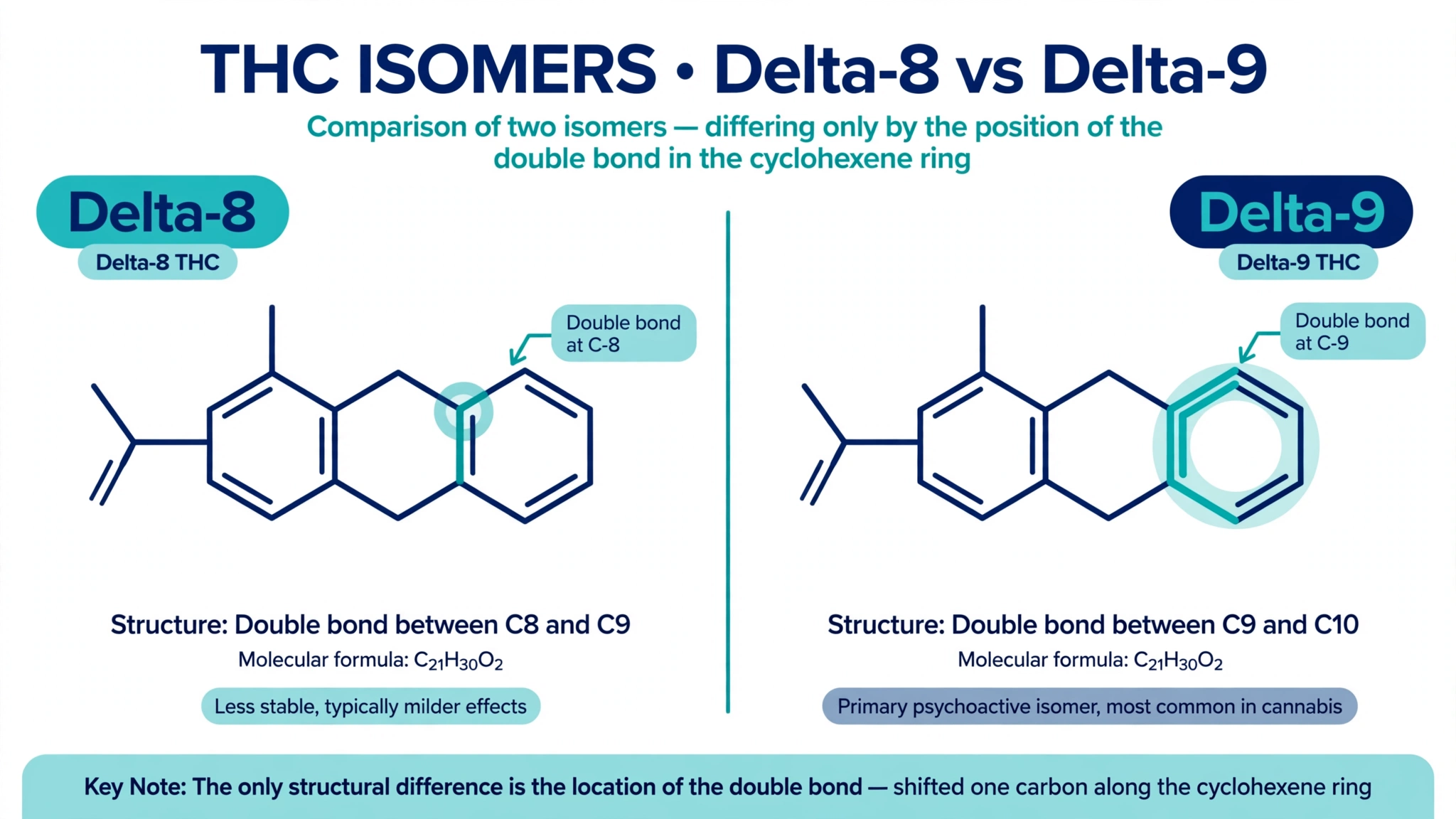
Delta 8 THC and delta 9 THC share the same molecular formula and differ only in the position of one double bond, and that difference makes delta 8 about half as potent as delta 9. Both compounds are psychoactive, both bind to CB1 and CB2 receptors, and both break down into the same THC-COOH metabolite.
| Feature | Delta 8 THC | Delta 9 THC |
|---|---|---|
| Double bond position | 8th carbon | 9th carbon |
| Natural amount in plant | Less than 1 percent | Up to 30 percent in marijuana |
| Potency | About half of delta 9 | Full potency, the reference standard |
| Typical high | Milder euphoria, clearer head | Stronger euphoria, more likely anxiety or paranoia |
| Source of most products | Converted from hemp CBD in a lab | Extracted from cannabis or hemp plants |
| Federal legal status (US) | Gray area, closing in November 2026 | Controlled substance, legal only in regulated state programs or hemp products under 0.3 percent |
| FDA approval | None | None for recreational use, approved in 2 prescription drugs |
| Drug test result | Positive for THC | Positive for THC |
Delta 9 THC is the compound most people mean when they say THC, and it drives the classic cannabis high, with strong euphoria and, at higher doses, anxiety or paranoia in some users. Delta 8 THC gives a softer version of the same experience, with relaxation and a clearer head. A 2021 clinical trial from Johns Hopkins University School of Medicine found that at higher doses, delta 8 produces effects nearly identical to delta 9 THC, so the gap between the two narrows as the dose rises.
Our full comparison of the two compounds goes deeper into potency, effects and testing: CBD vs THC: Key Differences Explained.
What Does Delta 8 THC Do to Your Body?
Delta 8 THC binds to CB1 receptors in the brain and CB2 receptors in the body, and it changes mood, appetite, sleep and pain perception. The endocannabinoid system regulates mood, sleep, memory, appetite and pain, and delta 8 THC plugs into that system the same way delta 9 THC does. Effects start within minutes for vaped delta 8 and within 45 to 120 minutes for edibles.
Common effects include relaxation, mild euphoria, a clearer head than delta 9 gives, increased appetite, reduced nausea and better sleep. Some users pick delta 8 because delta 9 makes them anxious. Side effects mirror delta 9 THC: dry mouth, red eyes, sleepiness, slowed reaction time and impaired memory. At higher doses, adverse effects include anxiety, paranoia, confusion, fast heart rate, nausea and vomiting, and driving after delta 8 use carries the same risk as driving after delta 9 use.
What Are the Benefits of Delta 8 THC?
Delta 8 THC shows four properties in the research record: antiemetic, anxiolytic, analgesic and neuroprotective effects. The National Cancer Institute lists delta 8 THC as an antiemetic (prevents nausea and vomiting), an anxiolytic (reduces anxiety), an analgesic (relieves pain) and a neuroprotective agent (protects neuron structure and function). These labels come from early studies, not from large human trials, and the FDA has approved no medical use for delta 8 THC.
The strongest human data comes from a 1995 study of 8 pediatric cancer patients. Researchers gave the children delta 8 THC before chemotherapy and in six-hour increments after treatment, and no vomiting occurred in the 24 hours after treatment. The sample was tiny, and no large trial has repeated the result, so the finding points to a direction for research rather than a proven treatment.
Delta 8 appeals to people who find delta 9 too strong, since the milder high lets them seek relaxation or sleep without the intensity delta 9 brings. None of these uses has FDA approval, and no delta 8 product can legally claim to treat a condition.
Is Delta 8 THC Safe?
No, delta 8 THC is not proven safe, and the FDA has not evaluated or approved delta 8 THC products for safe use in any context. The compound has a thin research record, with no long-term human safety trials, and the products carry a separate risk, since the market lacks consistent regulation and testing.
The FDA received 104 adverse event reports linked to delta 8 THC between December 2020 and February 2022, and 55 percent of those cases required medical intervention, including emergency services or hospital admission. At least 2 deaths have been associated with delta 8 THC products. Reported effects included hallucinations, vomiting, tremor, anxiety, dizziness, confusion and loss of consciousness, and delta 8 edibles that look like candy have led to child hospital visits after accidental ingestion.
Product quality is the bigger day-to-day risk. Independent lab tests have found delta 8 products with contaminants, leftover solvents and delta 9 THC levels above the legal limit, and some products held far less delta 8 than the label claimed. The FDA has issued consumer advisories and warning letters to sellers who marketed delta 8 products with unproven health claims. A Cleveland Clinic psychiatrist, Dr. David Streem, sums up the clinical view in plain terms: delta 8 products are very risky.
How Much Delta 8 THC Should You Take?
A first-time user should start with 5 to 10 mg of delta 8 THC and wait at least 90 minutes before taking more. Edibles take 45 to 120 minutes to start working, and taking a second dose too early is the most common cause of an overwhelming experience. No official dose exists because the FDA has not evaluated delta 8 THC.
| Experience level | Edible dose | Vape dose | Notes |
|---|---|---|---|
| Beginner, first time | 5 to 10 mg | 1 to 2 short puffs | Wait 90 minutes before more |
| Beginner, low tolerance | 5 to 15 mg | 1 to 3 puffs | Effects last 3 to 6 hours |
| Intermediate | 15 to 45 mg | 3 to 5 puffs | Tolerance builds with regular use |
| Advanced, high tolerance | 45 mg and above | 5 or more puffs | Higher doses raise adverse effect risk |
Delta 8 is less potent per milligram than delta 9, so a 15 mg delta 8 gummy produces effects roughly comparable to a 10 mg delta 9 gummy, though individual responses vary. A dose taken on an empty stomach starts faster and feels stronger than the same dose taken after a meal. Tinctures sit between vapes and edibles: a typical tincture dose is half a dropper, about 1 mL, with effects starting in 45 to 60 minutes.
No dose is safe for everyone, so people who take prescription drugs should check with a doctor first, and pregnant people, breastfeeding people and anyone under 21 should not use delta 8 THC.
How Long Does Delta 8 THC Last?
Delta 8 THC effects last 3 to 6 hours for edibles at standard doses of 10 to 25 mg, and 1 to 5 hours for vaped delta 8. The product form sets the timeline, since each form enters the body by a different route.
| Product form | Onset | Peak | Total duration |
|---|---|---|---|
| Vape or smoke | 1 to 5 minutes | 15 to 30 minutes | 1 to 5 hours |
| Tincture under the tongue | 15 to 45 minutes | 45 to 90 minutes | 2 to 4 hours |
| Edible or gummy | 45 to 120 minutes | 2 to 4 hours | 3 to 6 hours, up to 8 hours at higher doses |
Most users report feeling fully back to baseline within 5 to 6 hours after an edible, compared with 6 to 8 or more hours for delta 9. The compound itself clears fast, with a half-life of about 30 minutes, but its metabolites stay far longer, which is why drug tests detect delta 8 days or weeks after the effects end.
Will Delta 8 THC Show Up on a Drug Test?
Yes, delta 8 THC will show up on a standard drug test, because the body converts it into THC-COOH, the same metabolite that drug tests screen for. Standard urine panels cannot tell delta 8 apart from delta 9, THCA or THC-P, since all of them break down into THC-COOH. A label that says federally legal hemp does not change the test result.
Detection windows depend on the test type and on how often the person uses delta 8.
| Test type | Detection window, single use | Detection window, regular use |
|---|---|---|
| Urine | 3 to 10 days | 2 to 4 weeks, up to 30 days or more for daily users |
| Blood | 2 days | Up to 30 days |
| Saliva | 1 to 3 days | Up to 30 days |
| Hair | Up to 90 days | Up to 90 days |
Metabolites store in fat tissue and release slowly, so a daily user can test positive 30 to 60 days after the last use. Anyone facing a scheduled drug test should stop all THC products at least 4 weeks before the test, and longer if use is frequent or heavy.
Is Delta 8 THC Legal in 2026?
Delta 8 THC sits in a closing legal gray area. The 2018 Farm Bill legalized hemp and capped delta 9 THC at 0.3 percent by dry weight, and it never mentioned delta 8, so sellers used that gap to sell delta 8 made from hemp CBD in states where cannabis stays illegal. A law signed November 12, 2025 takes effect in November 2026 and removes chemically converted cannabinoids from the federal hemp definition.
H.R. 5371, Section 781, signed November 12, 2025, excludes cannabinoids chemically synthesized outside the plant, which covers nearly all commercial delta 8, and it takes effect November 12, 2026. After that date, most delta 8 products on the market become federally prohibited.
State law adds a second layer. More than 20 states have banned or heavily restricted delta 8 THC as of 2026, including Alaska, Colorado, Delaware, Idaho, Iowa, Montana, New York, North Dakota, Rhode Island, Utah, Vermont and Washington. In the United Kingdom, delta 8 is a Class B controlled drug under the Misuse of Drugs Act 1971, so possessing, selling or making it is illegal there.
Who Should Avoid Delta 8 THC?
Pregnant people, breastfeeding people, children, people under 21, people facing drug tests and people who drive for work should avoid delta 8 THC. The FDA warns that delta 8 products have not been evaluated for safe use, and the risk is highest for groups with no safety data. People who take prescription drugs should talk to a doctor first, since cannabinoids use liver enzymes that process many common medicines, and people with heart conditions should note that delta 8 can raise heart rate.
How to Choose a Safer Delta 8 Product
No delta 8 product is proven safe, but a third-party lab report, a clear label and a licensed seller lower the risk. The market has no federal quality standard, so the buyer has to check quality. Use this checklist before buying any delta 8 product.
- Ask for a certificate of analysis from an independent lab, and match the batch number on the report to the batch number on the product.
- Check that the report lists delta 8 THC, delta 9 THC and CBD content, screens for residual solvents, heavy metals and pesticides, and keeps delta 9 under 0.3 percent.
- Buy from a licensed seller with a real address and a customer service contact, not from a social media seller or a gas station shelf.
- Skip products with medical claims on the label, since the FDA has approved no medical use for delta 8.
- Skip products with packaging that looks like candy or snacks, since those appeal to children and draw regulator attention.
- Start with the lowest dose and keep the product locked away from children and pets.
A COA is not a safety guarantee. It only shows what one batch contained on one test date, and a clean COA does not change the FDA position that delta 8 products lack approval. The checklist reduces risk, and it does not remove it.
Conclusion
Delta 8 THC is a psychoactive cannabinoid, an isomer of delta 9 THC, with about half the potency and a milder high. The plant holds less than 1 percent of it, so nearly all commercial delta 8 is converted from hemp CBD with acid and heat. It brings relaxation, mild euphoria, appetite increase and nausea relief, plus dry mouth, red eyes, sleepiness and impaired reaction time. The FDA has not evaluated or approved any delta 8 product for safe use, and 104 adverse event reports reached the FDA between December 2020 and February 2022, with 55 percent needing medical intervention. Delta 8 THC shows on drug tests because it breaks down into THC-COOH. The legal window is closing: H.R. 5371 takes effect in November 2026 and more than 20 states already ban or restrict delta 8. Anyone who still considers delta 8 should check current law in their state, demand a third-party lab report, start with 5 to 10 mg, and never drive after using it.
If you want the wider cannabinoid picture, read our CBD gummies health benefits guide next, and browse the Digital Geek Spot homepage for more health, tech and lifestyle coverage.
Frequently Asked Questions
What is delta 8 THC in simple terms?
Delta 8 THC is a psychoactive cannabinoid found in tiny amounts in the cannabis plant, chemically almost identical to delta 9 THC except for the position of one double bond. It produces a milder high than delta 9 THC. Nearly all delta 8 products are made in a lab by converting hemp-derived CBD with acid and heat.
Is delta 8 THC safe?
No, delta 8 THC is not proven safe. The FDA has not evaluated or approved delta 8 THC products for safe use in any context. The FDA received 104 adverse event reports between December 2020 and February 2022, and 55 percent needed medical intervention. Products may also carry contaminants, leftover solvents and delta 9 levels above the legal limit.
What is delta 8 THC good for?
Delta 8 THC is reported to help with relaxation, nausea relief, appetite increase and sleep, and the National Cancer Institute lists it as antiemetic, anxiolytic, analgesic and neuroprotective. A 1995 study of 8 pediatric cancer patients found no vomiting after chemotherapy when delta 8 was given. No medical use has FDA approval, so these are research findings, not proven treatments.
How long does delta 8 THC last?
Delta 8 THC effects last 3 to 6 hours for edibles and 1 to 5 hours for vaped delta 8. Edibles take 45 to 120 minutes to start, while vapes start within minutes. Most users feel back to baseline within 5 to 6 hours after an edible, though larger doses can last 8 hours or more.
Will delta 8 THC make you fail a drug test?
Yes, delta 8 THC will make you fail a standard drug test. The body converts delta 8 into THC-COOH, the same metabolite drug tests screen for, so the test cannot tell delta 8 from delta 9. Urine tests detect it for 3 to 10 days after single use and up to 30 days for daily users.
Is delta 8 THC legal in 2026?
Delta 8 THC is in a closing gray area. Hemp-derived delta 8 was federally tolerated under the 2018 Farm Bill, but H.R. 5371, signed November 12, 2025, removes chemically converted cannabinoids from the federal hemp definition from November 2026. More than 20 states already ban or restrict delta 8.