Written by James Foster for Digital Geek Spot. Last updated: November 2026.
How long does CBD stay in your system? A single dose of CBD usually clears your body in 2 to 5 days, while daily use can keep CBD detectable for 1 to 2 weeks. The exact time depends on the dose, how often you use CBD, the product type, and your body. CBD has a half-life of about 18 to 32 hours, which means your body needs that long to remove half of one dose. This guide gives clearance timelines by method and dose, the 6 factors that change the timeline, and drug test windows for urine, blood, saliva, and hair. You will also find a practical plan for stopping CBD before a test and the steps to check a product label before you buy.
Key Takeaways
- A single CBD dose usually clears in 2 to 5 days. Daily use can stretch clearance to 1 to 2 weeks, and very high daily doses can take up to 4 weeks.
- CBD half-life runs about 18 to 32 hours for most doses (Source: Millar et al., 2018).
- Standard drug tests screen for THC, not CBD. Full-spectrum CBD products carry trace THC, and that trace THC is what can trigger a positive result.
- Urine tests detect THC metabolites for 3 to 30 days. Blood tests cover 1 to 2 days. Saliva tests cover up to 72 hours. Hair tests can reach 90 days.
- No drink, supplement, or workout clears CBD faster. Time is the only reliable way to clear CBD from your system.
Table of Contents
- How Long Does CBD Stay in Your System?
- What Is CBD Half-Life?
- How Long Does CBD Stay in Your System by Method?
- How Long Does CBD Stay in Your System for Occasional vs Daily Users?
- What 6 Factors Affect How Long CBD Stays in Your System?
- Does CBD Show Up on a Drug Test?
- How Long Does CBD Stay in Your System Before a Drug Test?
- CBD vs THC: How Detection Differs
- How to Clear CBD From Your System
- Is CBD Safe to Use Before a Drug Test?
- Frequently Asked Questions
How Long Does CBD Stay in Your System?
How long does CBD stay in your system? A single dose clears in 2 to 5 days for most people, while daily use keeps CBD in the body for 1 to 2 weeks. Very high daily doses can take up to 4 weeks to clear fully. A drug clears after about 4 to 5 half-lives, and CBD half-life runs about 18 to 32 hours for most doses. CBD is fat-soluble, so it stores in fat tissue and leaves the body more slowly than water-soluble compounds.
CBD, short for cannabidiol, is a compound found in hemp and cannabis plants. Unlike THC, CBD does not cause a high. The CBD category on Digital Geek Spot covers oils, gummies, vapes, and lab reports in more depth.
What Is CBD Half-Life?
CBD half-life is the time your body needs to remove half of a CBD dose, and published studies place it at about 18 to 32 hours for most doses. After one half-life, half the dose remains. After two half-lives, a quarter remains. After 4 to 5 half-lives, less than 5 percent remains, and the dose counts as cleared.
Ohlsson et al. (1986) measured a terminal half-life of 24 hours after intravenous dosing and 31 hours after smoking. A systematic review by Millar et al. (2018) reported values from 1.4 hours for an oral spray to 5 days for chronic oral use. The wide range reflects dose size, method, and frequency.
Half-life is not the same as effect time: CBD effects last 2 to 8 hours, while CBD stays detectable for days after the effects end. The table in the next section puts half-life, onset, effect time, and detection time side by side.
How Long Does CBD Stay in Your System by Method?

How long CBD stays in your system depends on the method: vaped CBD clears fastest at 1 to 3 days, while edibles and gummies clear slowest at 3 to 7 days for a single dose. Swallowed CBD passes through the liver first, a step called first-pass metabolism, which slows clearance. Inhaled CBD skips that step and clears faster.
| Method | Onset | Effect time | Half-life | Single-dose clearance |
|---|---|---|---|---|
| Vape or inhalation | 2 to 10 minutes | 2 to 3 hours | About 31 hours | 1 to 3 days |
| Oil or tincture under the tongue | 15 to 45 minutes | 4 to 6 hours | About 24 hours | 2 to 5 days |
| Gummies or edibles | 30 to 90 minutes | 6 to 8 hours | 2 to 5 days | 3 to 7 days |
| Capsules | 30 to 90 minutes | 6 to 8 hours | 2 to 5 days | 3 to 7 days |
| Oral spray | 15 to 30 minutes | 3 to 5 hours | 1.4 to 10.9 hours | 10 hours to 2 days |
| Topical cream | 30 to 60 minutes | 4 to 6 hours locally | Minimal blood levels | Hours, mostly local |
Oils held under the tongue sit between vapes and edibles. Gummies and capsules travel through the stomach and liver, so they take longest to clear. Topical creams reach the blood in tiny amounts. Oral sprays show the widest half-life range, from 1.4 to 10.9 hours.
Oral CBD has bioavailability as low as 6 percent, because the liver breaks down most of a swallowed dose first. A 25 mg gummy and a 25 mg vape dose put different amounts of CBD into the blood, so the gummy takes longer to clear.
How Long Does CBD Stay in Your System for Occasional vs Daily Users?
Daily CBD use stretches clearance far beyond a single dose, because CBD builds up in fat tissue and releases slowly over days. One 25 mg gummy clears in about 2 to 5 days for an occasional user, but a daily user on the same dose can need 7 to 14 days. Each new dose adds CBD before the last dose has cleared, so the total body load rises over weeks of daily use.
| Dose | Occasional user | Daily user |
|---|---|---|
| 5 to 15 mg (low) | 1 to 3 days | 3 to 7 days |
| 25 to 50 mg (moderate) | 2 to 5 days | 7 to 14 days |
| 100 mg or more (high) | 5 to 10 days | 2 to 4 weeks |
| 500 mg or more (clinical dose) | 14 to 28 days | Up to 6 weeks |
These are general estimates from half-life data, not exact predictions for one person. A study of 14 Huntington’s disease patients on 700 mg of CBD per day for 6 weeks measured half-life at 2 to 5 days. Most buyers use far less, so the low and moderate rows match most real use. Count from your last dose, not your first.
Frequency also changes what a drug test sees. A daily full-spectrum dose adds trace THC every day, and that trace THC accumulates in fat tissue the same way CBD does.
What 6 Factors Affect How Long CBD Stays in Your System?
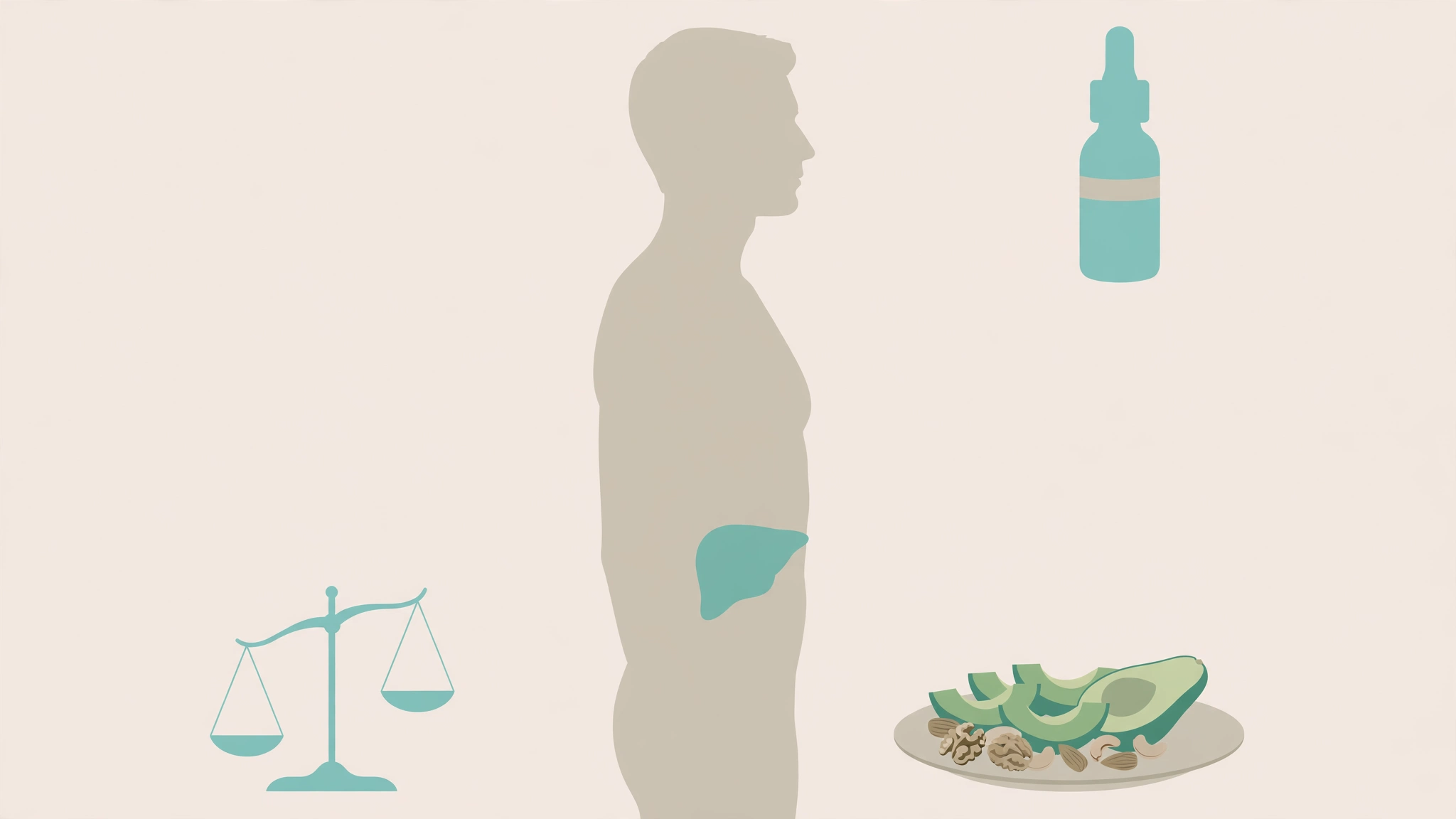
Six factors decide how long CBD stays in your system: dose, frequency, method, body fat, metabolism, and food. Each factor moves the timeline by hours or days, and several factors stack. A high daily gummy dose clears far more slowly than a single low vape dose.
1. Dose. Larger doses take longer to clear. A study found that 1.35 mg of CBD was detectable for about 6 hours, while higher doses stayed detectable for days.
2. Frequency of use. Daily use builds CBD stores in fat tissue. Occasional use clears in days, while daily use can take weeks. Frequency matters more than any single dose.
3. Method of use. Edibles and capsules clear slowest because they pass through the liver. Vapes clear fastest because they skip first-pass metabolism. Oils sit in the middle.
4. Body fat and weight. CBD dissolves in fat, so people with more body fat store more CBD and release it more slowly. Two people on the same dose can clear CBD days apart for this reason.
5. Metabolism and liver function. The liver breaks down CBD using enzyme families called CYP2C19, CYP2C9, and CYP3A4. Liver conditions, age, and medicines that use the same enzymes can slow clearance. People on liver-processed medicines should ask a doctor before using CBD.
6. Food. Taking CBD with a fatty meal raises absorption, so more CBD enters the blood and more needs clearing. Taking CBD on an empty stomach gives lower absorption and a shorter timeline, but also weaker effects.
Product type adds a seventh practical factor. Full-spectrum CBD contains trace THC up to 0.3 percent, broad-spectrum has the THC removed, and isolate contains CBD only. Product type changes drug test risk far more than CBD clearance, which the next section covers.
Does CBD Show Up on a Drug Test?
No, pure CBD does not show up on a standard drug test, because standard tests screen for THC metabolites, not CBD. The risk comes from THC in the product. Full-spectrum CBD legally contains up to 0.3 percent THC, and daily use lets that trace THC build up in fat tissue. Broad-spectrum and isolate products carry far less risk, if a third-party lab report confirms the label.
Standard workplace urine tests use an immunoassay screen with a 50 ng/mL cutoff for THC metabolites, under SAMHSA guidelines. CBD and its main metabolites do not trigger a positive result on the six major commercial immunoassay platforms at that cutoff. Two CBD metabolites cross-reacted only at 1,000 ng/mL, far beyond what normal CBD use produces. The danger is mislabeled or full-spectrum product, not CBD itself.
Read our guide on does CBD show up on drug tests for the full breakdown of test types and cutoffs.
| Test type | What it detects | Typical detection window |
|---|---|---|
| Urine | THC metabolites | 3 to 30 days |
| Blood | THC and CBD, recent use | 1 to 2 days for CBD, up to 7 days for metabolites |
| Saliva | THC, recent use | Up to 72 hours |
| Hair follicle | Long-term exposure history | Up to 90 days |
Urine testing is the most common workplace test, and it has the widest window. Occasional users usually test clear within 3 to 5 days, while daily users can test positive for 15 to 30 days or longer. Blood tests cover only recent use, usually 1 to 2 days. Saliva tests cover about 72 hours. Hair tests record about 90 days of history, but they are rare and costly.
Research on people who repeatedly used CBD-rich cannabis with small amounts of THC found that the THC metabolite passed the 15 ng/mL urine confirmation cutoff after about two weeks of regular use. Two weeks of daily full-spectrum use is enough to fail a urine test, even when the product is legal hemp CBD.
How Long Does CBD Stay in Your System Before a Drug Test?
Give yourself at least 2 weeks before a drug test if you use CBD occasionally, and 4 weeks or more if you use it daily. A single low dose clears in days, but a test date is not the time to trust a best-case number. The safe plan uses the long end of each range.
Follow these 4 steps before a scheduled test:
- Stop all CBD products on the date your timeline requires, and count from the last dose.
- Switch to an isolate product with a third-party lab report, if you must keep using CBD, and stop that too at least 1 week before the test.
- Read the certificate of analysis for THC content, and keep the report with your records.
- Tell the test administrator about any CBD use, if your workplace policy asks for disclosure.
No product clears CBD faster. Detox drinks, extra water, and heavy exercise do not remove CBD from fat tissue on a schedule you can trust. Water dilutes urine and can flag a sample as dilute. Exercise burns fat and can release stored metabolites into the blood. Time is the only reliable method.
If the test is unannounced, daily full-spectrum use carries real risk at any point. Isolate products with verified lab reports lower that risk, but no CBD product can guarantee a pass. Only stopping CBD removes the risk.
CBD vs THC: How Detection Differs
CBD and THC leave the body on different timelines. THC stores more aggressively in fat tissue and shows up on every standard test, while CBD does not. The table below puts the two side by side.
| Factor | CBD | THC |
|---|---|---|
| Causes a high | No | Yes |
| Screened on standard drug tests | No | Yes, via THC-COOH metabolite |
| Half-life | 18 to 32 hours for most doses | 20 to 36 hours, longer with daily use |
| Urine detection | 1 to 7 days for CBD itself | 3 to 30 days for metabolites |
| Blood detection | 1 to 2 days | Hours to 7 days for metabolites |
| Hair detection | Up to 90 days in specialized tests | Up to 90 days |
| Fat storage | Yes, moderate | Yes, strong |
Cannabidiol is the compound this guide covers, and its Wikipedia page lists its chemistry, legal status, and research record. THC is the compound drug tests look for, and a drug test screens for THC metabolites rather than CBD. CBD itself is not the target. THC contamination in a CBD product is the target, and full-spectrum products are the usual source.
Before you buy, read the product type on the label. Isolate means CBD only. Broad-spectrum means other hemp compounds with THC removed. Full-spectrum means trace THC is present by design. If a drug test is in your future, isolate with a lab report is the lowest-risk choice.
How to Clear CBD From Your System
Time clears CBD from your system, and no shortcut has evidence behind it. The body removes CBD through the liver and kidneys at a pace set by half-life. Water, sleep, and regular meals support normal liver and kidney function, but none of those steps shortens the half-life.
What helps, in plain terms, and Digital Geek Spot covers more CBD guides like this one for buyers who want the full picture:
- Stop taking CBD. The clearance clock starts at the last dose.
- Drink normal amounts of water. Over-drinking only dilutes urine.
- Keep a normal sleep schedule.
- Avoid new CBD products, including creams and drinks, until the test date passes.
- Keep the product label and lab report. If a test result is disputed, the report shows what you took.
What does not help:
- Detox drinks and kits have no published evidence for clearing CBD faster.
- Saunas and heavy sweating do not remove meaningful amounts of CBD.
- Extra exercise can release stored metabolites into the blood and raise short-term levels.
- Drinking large volumes of water before a test can flag the sample as dilute.
If you need CBD for sleep or pain and a test is coming, talk to a doctor about alternatives for the gap period. Stopping CBD for 2 to 4 weeks is safe for most people, since CBD is not addictive.
Is CBD Safe to Use Before a Drug Test?
CBD is safe in the general sense, but it is not safe for a drug test when the product contains THC. Pure CBD isolate with a verified lab report carries low test risk. Full-spectrum CBD carries real test risk, because the trace THC builds up with daily use. Safety and test risk are two different questions.
Common side effects are dry mouth, drowsiness, and reduced appetite. High oral doses can raise liver enzymes. None of those safety points change the drug test answer: a safe product can still fail a test if it contains THC.
Three checks lower the risk before a test:
- Buy isolate, not full-spectrum, when a test is possible.
- Read the third-party certificate of analysis, and confirm THC reads as not detected.
- Check that the lab report matches the batch number on your bottle.
If the label has no batch number, no lab report, or a THC level above 0.3 percent, do not use the product before a test. A cheap product with no lab report is the highest-risk purchase in the CBD market.
Frequently Asked Questions
How long does CBD stay in your system after one gummy?
One 25 mg CBD gummy usually clears in 2 to 5 days for an occasional user. Gummies pass through the liver, so they clear more slowly than vaped CBD. Daily gummy use stretches clearance to 7 to 14 days. The clock starts at the last gummy, not the first.
Will CBD show up on a drug test?
No, pure CBD will not show up on a standard drug test, because those tests screen for THC metabolites. Full-spectrum CBD products contain trace THC up to 0.3 percent, and daily use can build that THC up enough to fail a urine test. Isolate products with a verified lab report carry the lowest risk.
How long does CBD stay in your urine?
CBD itself stays in urine for about 1 to 7 days, while THC metabolites from full-spectrum products stay for 3 to 30 days. Occasional users usually clear in 3 to 5 days, while daily users can take 15 to 30 days.
How long does CBD stay in your blood?
CBD stays in blood for about 1 to 2 days after a single dose, and up to 7 days for metabolites with daily use. Blood tests focus on recent use, so they have the shortest window of the common tests. THC clears from blood within hours to a day for occasional use, though metabolites last longer.
Can you fail a drug test from CBD oil?
Yes, you can fail a drug test from CBD oil if the oil is full-spectrum and contains trace THC. Daily use of full-spectrum oil lets THC metabolites build up in fat tissue, and research shows they can pass the urine confirmation cutoff after about two weeks of regular use. Isolate oil with a lab report lowers that risk.
How can I get CBD out of my system faster?
You cannot get CBD out of your system faster, because clearance follows half-life and only time removes it. No drink, supplement, or workout shortens the timeline. Stop taking CBD, and allow 2 weeks for occasional use or 4 weeks for daily use before a test.
Conclusion
How long does CBD stay in your system? A single dose clears in 2 to 5 days, daily use takes 1 to 2 weeks, and very high daily doses can take up to 4 weeks. Half-life of 18 to 32 hours sets the pace. Standard drug tests look for THC, not CBD, so the real risk sits in full-spectrum products and their trace THC. Urine tests carry the longest window at 3 to 30 days. Time is the only reliable way to clear CBD, so stop early before a test and pick isolate products with lab reports.
Read our guide on how long CBD takes to work to match onset and effect times with the clearance timelines in this article, and plan your doses with both ends of the timeline in view.