Written by James Foster for Digital Geek Spot. Last updated: November 2026.
CBD oil for sleep sits at the center of a loud debate. Millions of people take a few drops under the tongue each night and report deeper rest, while doctors point out that the human trials are small, short, and mixed. CBD oil for sleep does help some people sleep better, but the proof is thin: small trials show modest gains in sleep quality for people whose poor sleep comes from anxiety or pain, while placebo-controlled trials in people with plain insomnia show little or no edge over a dummy pill. This guide walks through what CBD oil is, what the research really shows, how dose and timing change the result, the side effects and drug interactions to watch, and the steps to test it safely for seven nights.
Key Takeaways
- CBD oil helps some people sleep better, mostly by easing anxiety or pain, not by acting as a direct sedative.
- Placebo-controlled trials of CBD alone for insomnia show little or no benefit over a dummy pill.
- Low doses can feel mildly alerting, while higher doses of 25 to 50 mg and up link more often with calm and drowsiness.
- Start at 15 to 25 mg, take it 30 to 60 minutes before bed, and track sleep for at least 7 nights.
- CBD can interact with medicines processed by the liver, so check with a doctor or pharmacist first.
- For chronic insomnia, cognitive behavioral therapy for insomnia (CBT-I) has stronger evidence than any supplement.
Table of Contents
- What Is CBD Oil and How Does It Relate to Sleep?
- Does CBD Oil for Sleep Really Work?
- What Does the Research Say About CBD and Sleep?
- How Does CBD Oil Affect Sleep?
- CBD Oil vs Other Sleep Options
- How Much CBD Oil Should You Take for Sleep?
- Is CBD Oil Safe for Sleep?
- How to Choose a CBD Oil for Sleep
- How to Use CBD Oil for Sleep: A Simple 7 Night Plan
- What If CBD Oil Does Not Help You Sleep?
- Frequently Asked Questions
- Conclusion
What Is CBD Oil and How Does It Relate to Sleep?
CBD oil is a liquid product that holds cannabidiol (CBD), a compound from hemp and cannabis plants, mixed into a carrier oil such as MCT oil or hemp seed oil. CBD is one of more than 100 cannabinoids in the cannabis plant. CBD does not cause a high, because it does not activate the brain receptors that tetrahydrocannabinol (THC) activates. People take CBD oil by holding drops under the tongue for 30 to 60 seconds, then swallowing.
CBD oil relates to sleep through the endocannabinoid system, a network of receptors and signaling molecules that helps control mood, pain, appetite, and the sleep-wake cycle. The CBD category on Digital Geek Spot covers oils, gummies, vapes, and lab reports in more depth.
The market sells three types of CBD oil. Full-spectrum oil holds CBD plus small amounts of other cannabinoids, including trace THC under 0.3 percent, and terpenes. Broad-spectrum oil holds several cannabinoids but no THC. CBD isolate holds only CBD.
Does CBD Oil for Sleep Really Work?
CBD oil for sleep works for some people and not for others, and the honest answer depends on why a person sleeps badly. CBD oil for sleep shows its clearest results in people whose poor sleep comes from anxiety or chronic pain. CBD oil for sleep shows weak results in people with plain insomnia and no other health problem. In placebo-controlled trials of that group, CBD did not beat a dummy pill on sleep onset, sleep efficiency, or waking after sleep onset.
A 2019 case series by Shannon and colleagues followed 72 adults with anxiety or poor sleep who took 25 mg of CBD a day. Sleep scores improved in 66.7 percent of patients in the first month, then fluctuated over the study period (Source: Shannon et al., 2019). The study had no placebo group, so the result cannot separate the CBD effect from the placebo effect or from other care the patients received. A 2024 trial gave 150 mg of CBD nightly for two weeks to 30 people with moderate to severe insomnia. Insomnia scores fell in both the CBD group and the placebo group, and CBD did not beat placebo on most sleep outcomes (Source: Narayan et al., 2024).
What Does the Research Say About CBD and Sleep?

The research on CBD and sleep is early, small, and mixed. Four findings shape the current picture.
First, the Shannon case series from 2019 is the most cited study in this field. Patients took 25 mg of CBD a day in capsule form, with doses adjusted to a range of 25 to 175 mg. Sleep scores improved in 66.7 percent of patients in the first month, while 25 percent reported worse sleep (Source: Shannon et al., 2019).
Second, a 2017 systematic review by Babson and colleagues found promising evidence for CBD in REM sleep behavior disorder and tentative evidence for sleep quality gains more broadly (Source: Babson et al., 2017).
Third, the strongest placebo-controlled test of CBD alone for insomnia came in 2024. Narayan and colleagues gave 150 mg of CBD nightly for two weeks to people with moderate to severe insomnia. Both groups improved, and CBD did not outperform placebo on sleep onset, sleep efficiency, or wake after sleep onset (Source: Narayan et al., 2024).
Fourth, the positive results often come from products that mix CBD with THC. A 2021 trial by Walsh and colleagues gave 23 adults with insomnia an oil with 10 to 20 mg of THC plus small amounts of CBN and CBD for two weeks. In sleep diaries, people fell asleep about 8 minutes faster, but sleep-lab measurements showed no difference at all (Source: Walsh et al., 2021). A 2025 pooled analysis found CBD-only products had no clear effect on sleep, while the positive results came from THC-containing products (Source: Velzeboer et al., 2025).
How Does CBD Oil Affect Sleep?
CBD oil affects sleep through four paths, and none of them works like a sleeping pill. A sleeping pill forces drowsiness. CBD oil changes the signals that keep a person awake, and the effect depends on dose, timing, and the cause of the poor sleep.
The first path runs through the 5-HT1A serotonin receptor. CBD activates this receptor, which helps control mood, stress response, and the shift from alertness to relaxation.
The second path runs through anandamide, a signaling molecule in the endocannabinoid system. CBD slows FAAH, the enzyme that breaks anandamide down, so anandamide levels stay higher for longer. Anandamide links with a settled, calm baseline state that supports the shift into sleep.
The third path runs through cortisol, the stress hormone. One study found cortisol levels fell more when people took 300 or 600 mg of CBD oil (Source: Medical News Today, research review).
The fourth path is indirect and may be the most important. CBD eases anxiety and pain for some people, and anxiety and pain are two of the most common causes of poor sleep. When the anxiety or the pain eases, sleep follows without CBD acting on sleep directly. Digital Geek Spot has a full guide to CBD oil benefits for anxiety and sleep that covers this indirect path in more depth.
Dose changes the direction of the effect. Low doses of CBD can feel mildly alerting in some people, while higher doses link more often with calm and drowsiness.
CBD Oil vs Other Sleep Options
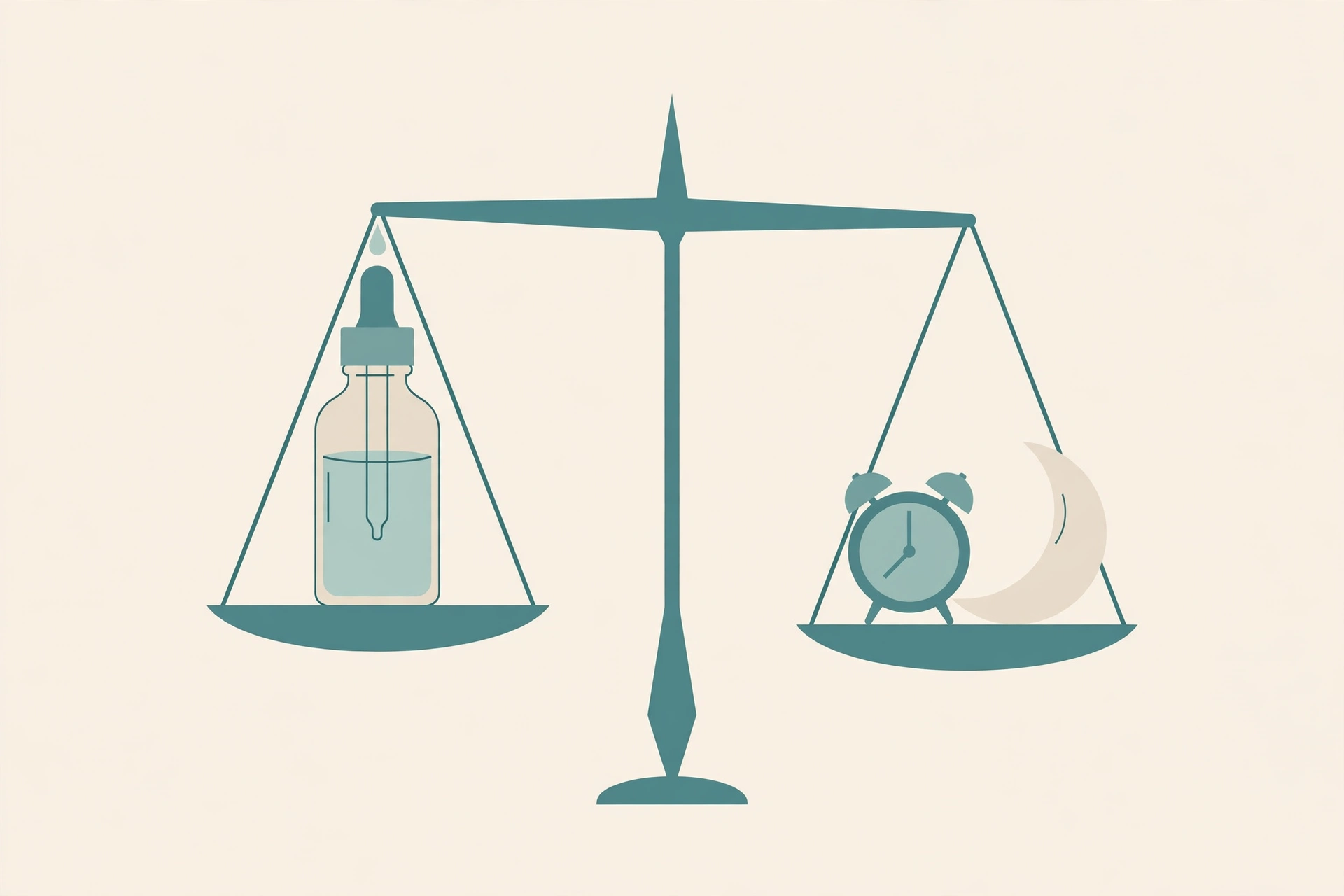
The table below compares CBD oil with the main alternatives.
| Option | Evidence for sleep | Onset | Main drawback |
|---|---|---|---|
| CBD oil | Mixed, small trials, weak for plain insomnia | 15 to 45 minutes | No fixed dose, drug interactions, uneven product quality |
| Melatonin | Modest help for falling asleep, best for timing shifts | 30 to 60 minutes | Morning grogginess, label doses often wrong |
| CBT-I (therapy) | Strongest evidence for chronic insomnia | Weeks of practice | Needs a trained provider or program, takes effort |
| THC plus CBD oil | Some diary gains, lab results weak | 15 to 45 minutes | REM sleep suppression, morning grogginess, legal limits |
| Prescription sleep medicine | Strong short-term effect | 15 to 30 minutes | Dependence, next-day drowsiness, needs a prescription |
| Sleep hygiene alone | Modest gains, free | Days to weeks | Needs steady habits, weak alone for chronic insomnia |
CBT-I, cognitive behavioral therapy for insomnia, beats every supplement in the research. CBT-I retrains the link between bed and sleep through fixed wake times, stimulus control, and sleep restriction. Trials show it helps about 70 to 80 percent of people with chronic insomnia, and the gains last after treatment ends.
Melatonin is the closest comparison to CBD oil, because both are sold over the counter and both have modest evidence. Melatonin is a hormone the pineal gland releases after dark to signal that night has started. Low doses of 0.5 to 3 mg help some people fall asleep faster, and doses above 5 mg add no sleep benefit.
How Much CBD Oil Should You Take for Sleep?
No official dose exists for CBD oil and sleep. The trials that exist point to a starting range and a method for finding a personal dose.
Start at 15 to 25 mg, taken 30 to 60 minutes before bed. The 25 mg starting dose comes from the Shannon case series, where 25 mg was the most common dose (Source: Shannon et al., 2019).
Raise the dose in steps of 5 to 10 mg every few nights if the starting dose does nothing. Stop raising the dose once sleep improves or once side effects appear. Most people who report a benefit settle between 25 and 50 mg. Doses above 150 mg have no clear added benefit for sleep in the trials, and they raise the chance of side effects and drug interactions.
Take CBD oil with a small snack that holds some fat, because food raises CBD absorption. Oral bioavailability of CBD is about 6 percent on an empty stomach and 36 to 57 percent with food (Source: Wikipedia, Cannabidiol). Track the result instead of guessing: write down the dose, the time taken, the time to fall asleep, the number of night wakings, and the morning feel for at least 7 nights at each dose.
Is CBD Oil Safe for Sleep?
CBD oil is generally safe for short-term use in healthy adults, and the side effects are usually mild. The main risks are drug interactions, liver effects at high doses, and product quality, not the CBD itself.
Common side effects include dry mouth, drowsiness, fatigue, diarrhea, and changes in appetite.
Drug interactions are the risk that matters most. CBD slows liver enzymes in the CYP450 family, mainly CYP3A4 and CYP2C19, which process many common medicines. When those enzymes slow down, the other medicine stays in the blood longer and its effect rises. Medicines that clash with CBD include blood thinners such as warfarin, some seizure medicines such as clobazam, some antidepressants, and some blood pressure medicines. The FDA has warned that CBD can harm the liver, interfere with prescription drugs, and affect alertness and mood (Source: FDA, 2019 to 2023 safety updates).
Four groups should ask a doctor before using CBD oil for sleep: people who take any daily prescription medicine, people with liver disease, pregnant people and people who are breastfeeding, and children, because the safety data for children covers only the prescription drug Epidiolex for epilepsy. The CBD market has no federal quality standard in the United States, and label amounts are often wrong. Third-party lab reports, called Certificates of Analysis, are the only check a buyer has.
How to Choose a CBD Oil for Sleep
Choose a CBD oil for sleep in four steps, and skip any product that fails one of them.
- Pick full-spectrum or broad-spectrum oil first, because most of the sleep research used products with more than one cannabinoid. Isolate is the fallback for people who must avoid THC entirely, such as people subject to drug testing.
- Read the Certificate of Analysis. The report should come from an independent lab, match the batch number on the bottle, and show the CBD amount within 10 percent of the label, THC under 0.3 percent, and no failed tests for pesticides, heavy metals, or mold.
- Check the CBD amount per milliliter, not just per bottle. A bottle that holds 1,000 mg in 30 ml gives about 33 mg per ml, so a 25 mg dose is about 0.75 ml.
- Pick a carrier oil that suits the stomach. MCT oil is the most common carrier and absorbs well. Hemp seed oil is a second choice. Avoid products with added flavors or herbal blends that hide the CBD amount.
How to Use CBD Oil for Sleep: A Simple 7 Night Plan
A 7 night plan gives CBD oil a fair test. Use the same dose, the same time, and the same bedtime each night, and change only one factor at a time.
- Night 1: set a fixed bedtime and wake time, and keep both fixed for all 7 nights.
- Night 1: take 25 mg of CBD oil 45 minutes before bed, with a small snack.
- Nights 1 to 3: keep the dose at 25 mg and write the sleep diary each morning.
- Night 4: if sleep has not changed and no side effects appeared, raise the dose to 35 mg.
- Nights 4 to 6: keep the dose at 35 mg and keep writing the diary.
- Night 7: compare the last 3 nights with the first 3 nights on time to fall asleep, night wakings, and morning feel.
- Night 7: decide by the diary. If sleep improved by at least 20 to 30 minutes of faster sleep onset or one fewer waking, keep the dose. If nothing changed, stop and try the next option below.
What If CBD Oil Does Not Help You Sleep?
CBD oil does not help every person sleep, and a failed test is useful information, not a reason to keep raising the dose. Three options have better evidence than CBD oil, and each one fits a different cause of poor sleep.
CBT-I is the first option for insomnia that lasts more than three weeks. A trained provider or a guided online program runs the treatment over 4 to 8 sessions.
Melatonin is the second option, for people whose main problem is falling asleep or a shifted body clock. Low doses of 0.5 to 3 mg, taken 30 to 60 minutes before bed, help some people fall asleep faster. Read our guide to what melatonin is and whether it is safe for the full dose and safety detail.
A doctor visit is the third option, and it is the right one when poor sleep lasts more than three weeks, when snoring and gasping point to sleep apnea, or when low mood and worry fill the day.
Frequently Asked Questions
Does CBD oil make you sleepy right away?
No, CBD oil does not make most people sleepy right away. CBD oil takes 15 to 45 minutes to reach the blood, and its effect is calm rather than drowsiness for most users. People who feel sleepy on CBD usually feel it at higher doses of 50 mg and up, or when CBD eases the anxiety that kept them awake.
How long does CBD oil take to work for sleep?
CBD oil takes 15 to 45 minutes to start working when held under the tongue, and most people take it 30 to 60 minutes before bed. The full effect on sleep quality may take several nights to judge, because one night of data cannot separate the CBD effect from a normal good night.
Is CBD oil better than melatonin for sleep?
Neither product is clearly better than the other, because both have modest evidence and both help different problems. Melatonin helps more with falling asleep and with body clock timing, while CBD oil helps more when anxiety or pain keeps a person awake. CBT-I beats both products for chronic insomnia.
Can I take CBD oil every night?
Most healthy adults can take CBD oil every night in the short term, and trials have used daily doses for 2 to 8 weeks without serious side effects. Long-term safety data beyond a few months is thin, so take breaks of a few nights each month and check with a doctor if daily use runs past three months.
Does CBD oil show up on a drug test?
CBD oil can show up on a drug test, because full-spectrum products hold trace THC and some products hold more THC than the label claims. CBD itself is not the target of most drug tests, but the THC in a full-spectrum product can trigger a positive result. Isolate products lower the risk, but only a lab report can confirm the THC amount.
What dose of CBD oil is best for sleep?
No single best dose exists, because trials used 15 to 300 mg with mixed results. Most people start at 15 to 25 mg, raise the dose in 5 to 10 mg steps every few nights, and settle between 25 and 50 mg. Doses above 150 mg show no clear added benefit for sleep and raise the chance of side effects.
Conclusion
CBD oil for sleep does help some people sleep better, but the proof is thin and the benefit depends on why a person sleeps badly. Small trials show modest gains in sleep quality for people whose poor sleep comes from anxiety or pain, while placebo-controlled trials in people with plain insomnia show little or no edge over a dummy pill. A fair test runs for 7 nights at 15 to 50 mg, with a sleep diary and a fixed bedtime, and the diary decides the result. For chronic insomnia, CBT-I has stronger evidence than any supplement, and a doctor visit is the right step when poor sleep lasts more than three weeks. Digital Geek Spot covers CBD oils, gummies, vapes, and lab reports across the site, and the CBD category holds the full set of guides.
Read our guide to how long CBD stays in your system to plan a break from CBD before a drug test or a doctor visit.