
Last updated: October 2026
Written by James Foster for Digital Geek Spot.
Anxiety and poor sleep feed each other in a loop that is hard to break. Racing thoughts keep you awake at night, and a short night makes anxiety worse the next day. CBD oil may help break this cycle by calming mental restlessness and lowering the body’s stress signals, though it is not a sedative. Clinical research shows promising but early results: in one study of 79 patients, 66.7 percent reported better sleep and 79.2 percent reported lower anxiety within the first month of CBD use (Shannon et al., 2019). This guide explains the CBD oil benefits for anxiety and sleep in plain language: how CBD acts on the brain, what studies found, dosing, oil types, timing, and safety facts.
Key Takeaways
- CBD oil benefits for anxiety and sleep come mainly from calming mental restlessness and lowering stress signals, not from sedation.
- CBD acts on serotonin 5-HT1A receptors and slows the breakdown of anandamide, the body’s own calming compound.
- In one 2019 study, 79.2 percent of patients reported less anxiety and 66.7 percent reported better sleep after one month.
- Trial data shows an inverted-U dose pattern: 300 mg outperformed both 150 mg and 600 mg for anxiety.
- Start low (15 to 25 mg), take it 30 to 60 minutes before bed, and stay consistent for two weeks before judging results.
- CBD can interact with prescription medicines through liver enzymes CYP3A4 and CYP2C19; talk to your doctor first if you take any regular medication.
Table of Contents
- What Are the Main CBD Oil Benefits for Anxiety and Sleep?
- How Does CBD Oil Affect Anxiety in the Brain?
- Does CBD Oil Really Help You Sleep?
- What Does the Research Say About CBD for Anxiety and Sleep?
- How Much CBD Oil Should You Take for Anxiety and Sleep?
- Full Spectrum vs Isolate: Which CBD Oil Works Better for Anxiety and Sleep?
- When and How Should You Take CBD Oil for Sleep?
- Is CBD Oil Safe? What Are the Side Effects and Drug Interactions?
- Frequently Asked Questions
What Are the Main CBD Oil Benefits for Anxiety and Sleep?
The main CBD oil benefits for anxiety and sleep are reduced mental restlessness, lower stress responses, easier sleep onset, and fewer night-time wake-ups. These benefits connect to each other: CBD does not force sleep the way a sedative does. It quiets the anxious mind that keeps people awake, which is why anxiety relief and sleep support go hand in hand.
The first benefit is a calmer mind before bed. Anxiety is one of the most common reasons people lie awake, and in a 2019 study of 79 adult outpatients (Shannon et al.), 79.2 percent reported lower anxiety scores within the first month of daily CBD use, most at doses between 25 and 75 mg per day. The second is a weaker stress response: CBD reduces cortisol release during stress (Neuropsychopharmacology, 2019), letting the nervous system shift toward rest in the evening.
The third benefit is steadier sleep through the night. Many people wake at 3am with a racing pulse and cannot get back to sleep, a pattern often driven by anxiety and cortisol dysregulation, exactly the pathways CBD is most studied for. In the same 2019 study, 66.7 percent of patients reported improved sleep scores in the first month.
The fourth benefit is what CBD does not do. It causes no intoxication, is not habit-forming, and leaves no next-day grogginess. The World Health Organization’s 2018 review found no signs of abuse or dependence potential. For more background, browse our CBD guides on Digital Geek Spot.
How Does CBD Oil Affect Anxiety in the Brain?
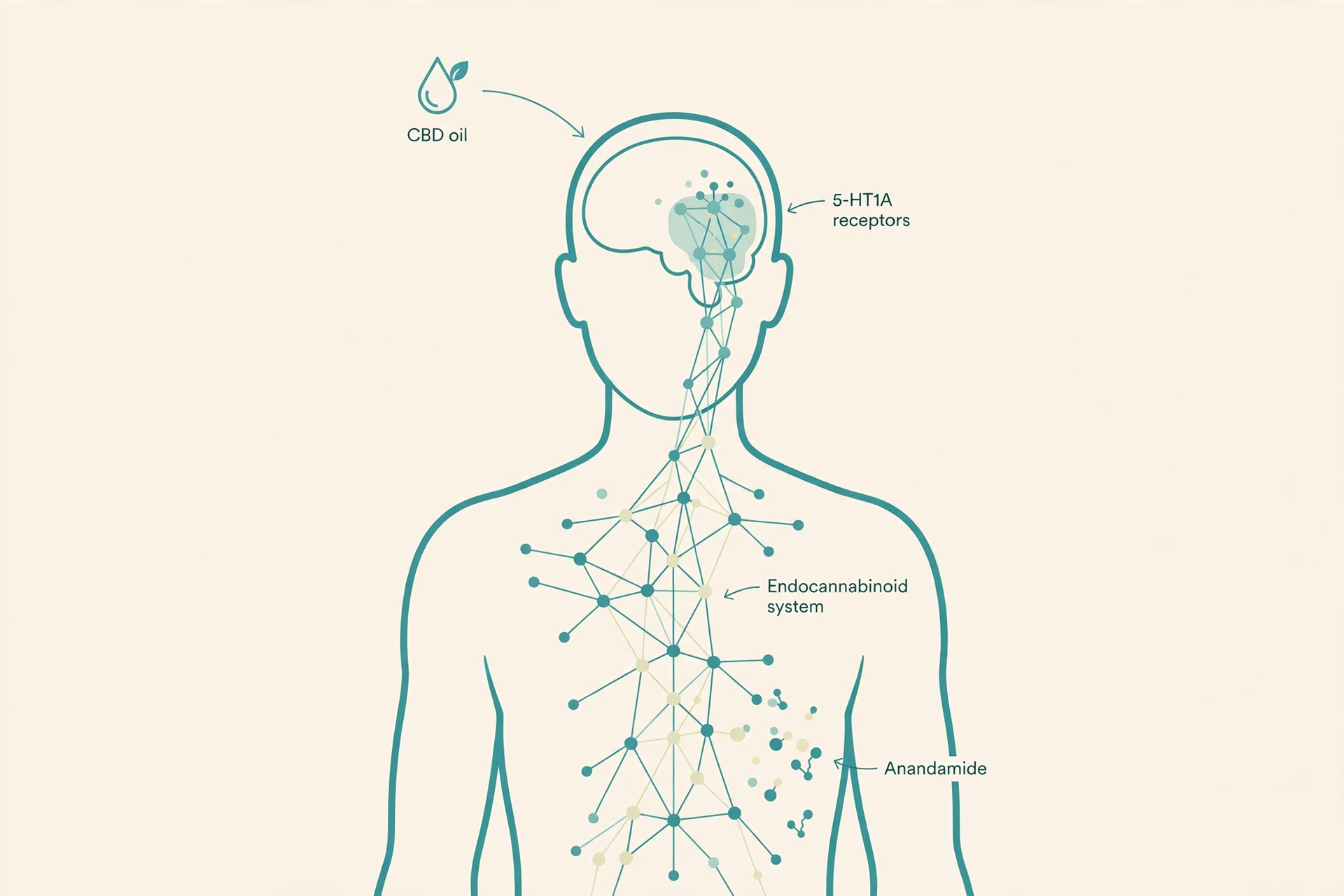
CBD oil affects anxiety in the brain through four overlapping pathways: serotonin 5-HT1A receptor activation, slower breakdown of anandamide, reduced amygdala activity, and lower cortisol release. This multi-pathway action explains why CBD may help in cases where single-target options fall short, and it also explains why effects vary from person to person.
The serotonin pathway is the most studied. CBD acts as a partial agonist at 5-HT1A receptors, the same receptor subtype targeted by buspirone, a common anti-anxiety medication. Activating these receptors modulates serotonin signaling in the prefrontal cortex, hippocampus, and amygdala, the regions most involved in fear processing. A brain imaging study confirmed the effect is real: 400 mg of CBD reduced anxiety and changed blood flow in anxiety-related brain regions.
The second pathway runs through anandamide. CBD inhibits FAAH, the enzyme that breaks down anandamide, one of the body’s own endocannabinoids, sometimes called the bliss molecule. With less FAAH activity, more anandamide stays active for longer, producing a calmer, less reactive nervous system. These pathways all run through the body’s wider cannabinoid network; for a deeper look, see the article on the endocannabinoid system (opens in a new tab).
Does CBD Oil Really Help You Sleep?
CBD oil helps sleep mainly by reducing the anxiety and mental restlessness that delay sleep onset, not by forcing drowsiness. Higher doses, around 50 mg and above in some reports, are linked with sleep-promoting effects, while low doses may be mildly alerting. Expect calmer nights, not a knocked-out feeling.
This distinction matters. Prescription sleep medicines force the brain toward unconsciousness. CBD removes the obstacles to sleep instead: anxious thoughts, a raised heart rate, stress hormones. Fix the anxious mind, and sleep tends to follow on its own. The 2019 Shannon study found 66.7 percent of patients reported better sleep in the first month, but a 2022 review (Velzeboer et al.) found inconsistent results across trials. Sleep is harder to measure than anxiety, and trial designs vary.
One pattern worth knowing is dose-dependent alertness. At low doses CBD may be slightly alerting, while moderate to higher doses produce the calming effect most people want at night. CBD may also help specific disruptions such as REM disturbances and nightmares seen in anxiety disorders and PTSD. CBN, sometimes called the sleep cannabinoid, pairs with CBD in many nighttime formulas, though evidence for CBN itself is still early.
What Does the Research Say About CBD for Anxiety and Sleep?
The research says CBD shows a measurable anxiety-reducing signal across several small trials and one 2024 meta-analysis, while sleep evidence is promising but less consistent. A pooled analysis of 8 randomized controlled trials with 316 participants found a substantial effect on anxiety, with an effect size (Hedges’ g) of minus 0.92 (Journal of Psychiatric Research, 2024). Large FDA-style trials have not been run yet.
| Study | Participants | CBD dose | Key outcome |
|---|---|---|---|
| 2024 meta-analysis (Journal of Psychiatric Research) | 316 across 8 RCTs | Various | Substantial anxiety reduction (Hedges’ g = -0.92); consistent across GAD, SAD, and PTSD |
| Bergamaschi et al., 2011 (SPST series) | 24 with social anxiety | 600 mg single dose | Reduced anxiety, cognitive impairment, and discomfort during public speaking |
| Linares et al., 2019 (SPST series) | 57 | 150, 300, or 600 mg | 300 mg most effective; inverted-U pattern confirmed |
| Shannon et al., 2019 | 79 outpatients | 25 to 75 mg per day | 79.2% less anxiety, 66.7% better sleep at 30 days; held at 3 months |
| PTSD case series, 2019 | 11 patients | 25 to 175 mg per day | 91% reduction in symptom severity at 8 weeks |
| WHO critical review, 2018 | Review of human data | Various | Generally well tolerated; no abuse or dependence potential |
What the evidence does not show matters too. No consumer CBD product is approved to treat any disease, and most trials had small samples under 100 participants. Surveys show strong demand, anxiety (42.6%) and sleep problems (42.5%) topped a 2021 survey of 387 users (Moltke and Hindocha), but surveys measure interest, not outcomes.
Read next: What is CBD oil and how does it work for the basics of the compound itself.
How Much CBD Oil Should You Take for Anxiety and Sleep?
Most adults should start with 15 to 25 mg per day and increase in 5 to 10 mg steps every few days until the desired effect appears. Clinical trials used 25 to 600 mg, but typical retail servings deliver 5 to 25 mg. Higher is not better: the inverted-U pattern means a middle dose often beats both low and high doses.
The inverted-U dose response is one of the most useful findings in CBD research. In a single-dose crossover trial (Linares et al., 2019), 300 mg of CBD reduced anxiety more than both 150 mg and 600 mg. At very high doses, CBD begins activating receptor subtypes that can partially offset its calming benefits. Trial doses and retail doses differ: the clearest results came from 300 to 600 mg pharmaceutical-grade single doses, yet many users report benefits at 5 to 25 mg, so individual sensitivity varies widely.
A practical titration plan:
- Start at 15 to 25 mg, in the evening for sleep or split across the day for anxiety.
- Hold that dose for 3 to 4 days and note sleep quality, morning alertness, and anxiety levels.
- Increase by 5 to 10 mg if nothing changed, then hold again.
- Stop increasing once you find a dose that works; do not chase a stronger effect past that point.
- If effects weaken after an increase, return to the previous dose; that was your sweet spot.
Body weight, metabolism, and product quality all shift the right dose. Keeping a simple log of dose, timing, and sleep quality for two weeks makes the pattern visible faster than guessing.
Full Spectrum vs Isolate: Which CBD Oil Works Better for Anxiety and Sleep?
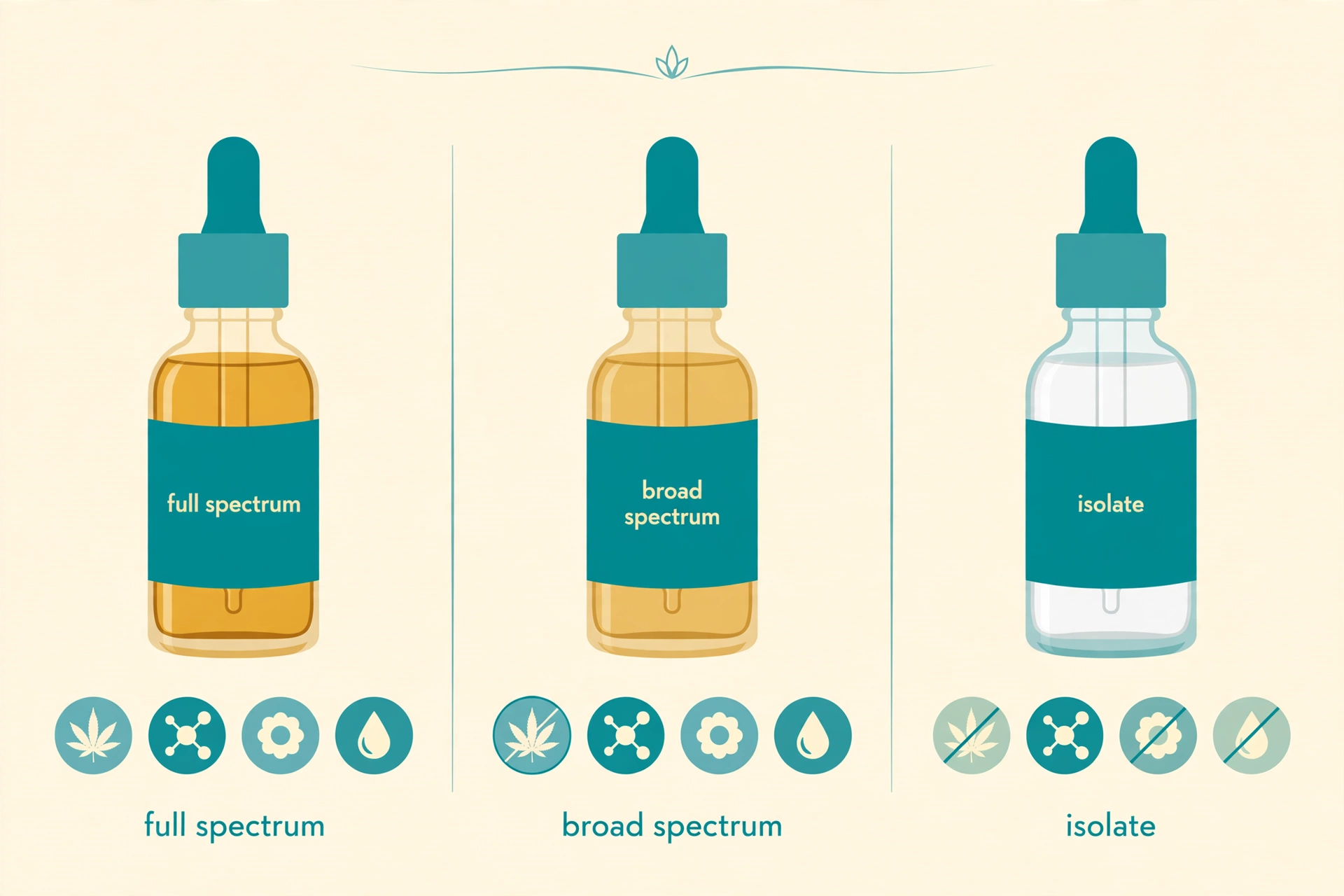
Full spectrum CBD oil may work better for sleep because it keeps the whole plant profile, including trace THC and calming terpenes, while isolate suits people who must avoid THC entirely. Research has shown that the trace amounts of THC in full spectrum products can support sleep in people without other medical conditions. Choose broad spectrum for a middle path with zero THC.
| Type | What it contains | Best for |
|---|---|---|
| Full spectrum | CBD plus minor cannabinoids, terpenes, and trace THC (typically 0.3% or less) | People comfortable with trace THC who want the complete plant profile |
| Broad spectrum | A wide range of cannabinoids and terpenes, all detectable THC removed | People who want extra plant compounds with zero THC |
| CBD isolate | CBD alone, usually 99% pure | People who want a pure CBD experience with no THC or other compounds |
The entourage effect, the idea that cannabinoids and terpenes work better together than CBD does alone, is the main argument for full spectrum. It has some supporting evidence, but human trials have not clearly demonstrated a large clinical advantage, so treat it as a real possibility, not a proven fact. Terpenes add small effects of their own: linalool is independently calming, and beta-caryophyllene activates CB2 receptors. One practical observation: dropper bottles with printed dose marks make nightly dosing far more consistent than unmarked droppers, where a “full dropper” varies widely.
When and How Should You Take CBD Oil for Sleep?
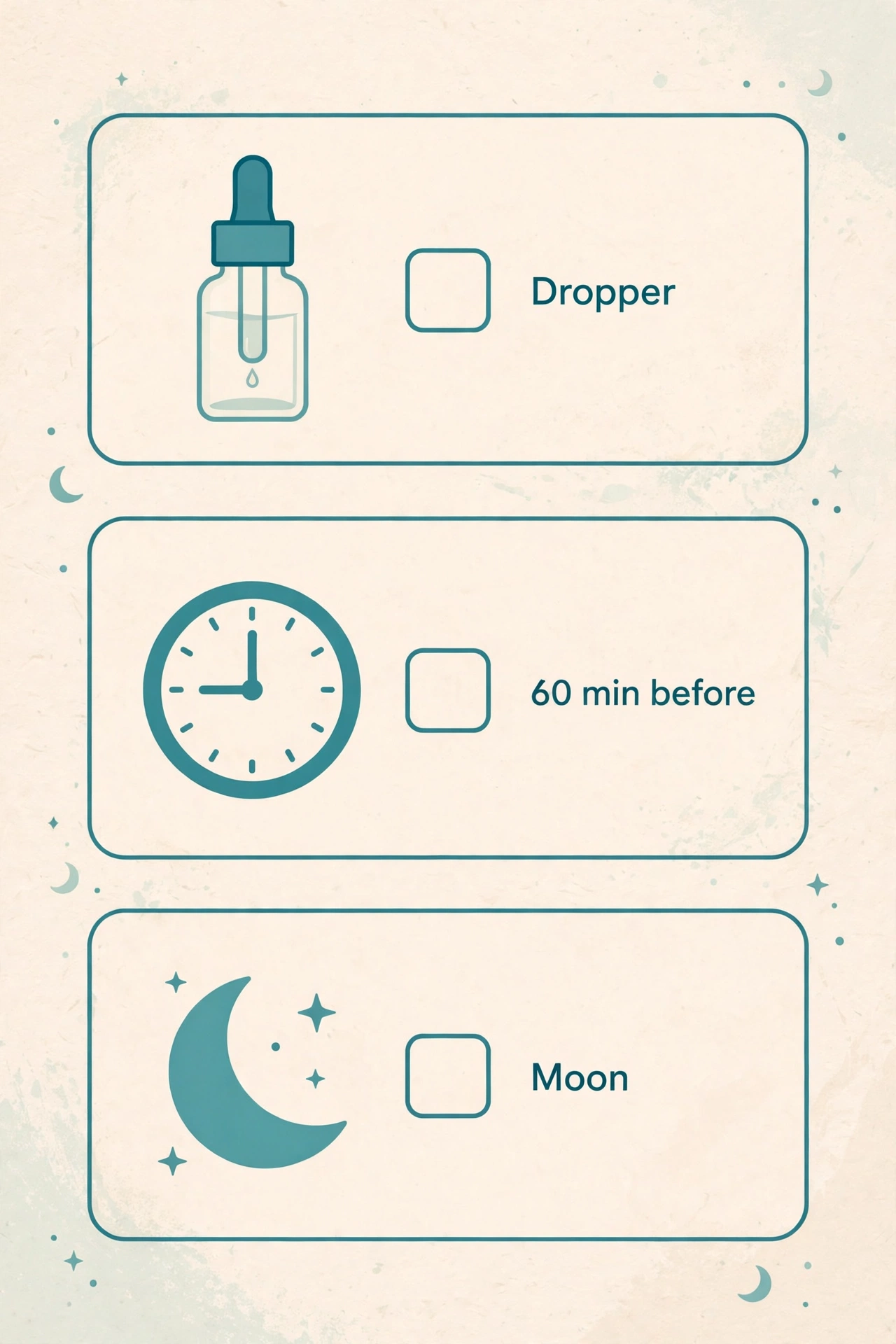
Take CBD oil for sleep 30 to 60 minutes before bed, holding the dose under your tongue for 60 to 90 seconds before swallowing. Sublingual use acts within 15 to 45 minutes. A fatty meal can raise absorption roughly four to five times (Taylor et al., 2018). Keep the same time and dose nightly for at least two weeks.
A simple routine covers the details most guides skip:
- Pick a nighttime oil. Choose a full spectrum oil that lists milligrams per serving and includes a third-party lab certificate. Skip daytime formulas with added stimulants.
- Find your dose. Start around 25 mg, give it several nights, then adjust in small steps. With CBD, less is often more.
- Time it right. Take the oil 30 to 60 minutes before bed so absorption lines up with your wind-down.
- Use it under the tongue. Hold the dose for 60 to 90 seconds. Sublingual absorption is faster than swallowing, which stretches onset to 30 minutes to 2 hours.
- Make it a nightly habit. Take it at the same time each night and give it two weeks before judging. Pair it with dim lights, no screens, and a cool room.
What you eat with CBD matters more than most people expect. Taylor (2018) found that a high-fat meal increased peak blood concentration about 4.9 times and total absorption about 4.2 times, compared with an empty stomach. CBD, or cannabidiol, is fat-soluble, which is why carrier oils like MCT are used in the first place (opens in a new tab).
Is CBD Oil Safe? What Are the Side Effects and Drug Interactions?
CBD oil is safe for most adults at typical doses, with side effects that are usually mild and dose-related. The World Health Organization’s 2018 review found CBD generally well tolerated with no abuse or dependence potential. The main risk is drug interactions: CBD affects liver enzymes CYP3A4 and CYP2C19, which process many common prescription medicines.
Common side effects, mostly seen at higher doses, are dry mouth, mild drowsiness, reduced appetite, and mild digestive upset. In epilepsy trials using very high doses (700 mg per day and above), CBD raised liver enzymes in some patients, so people with liver conditions should involve their doctor. At retail doses of 5 to 50 mg, serious side effects are uncommon.
Drug interactions are the main safety concern: blood thinners such as warfarin, some antidepressants and anti-seizure medicines, certain benzodiazepines, and some statins. Never stop or adjust a prescribed medicine to start CBD, and disclose CBD use to your prescriber before starting, if you take any regular medication. The UK Food Standards Agency advises that people who are pregnant, breastfeeding, or trying to conceive, and anyone under 18, should not use CBD except under medical direction. Also note: CBD itself is not what drug tests look for, but full spectrum oils contain trace THC that can register on sensitive tests.
This article is for educational purposes only and is not medical advice. Talk to a healthcare professional before using CBD, especially if you take prescription medicines.
Frequently Asked Questions
Does CBD oil help with anxiety?
Yes. CBD oil can reduce anxiety for many people, mainly by calming the stress response and quieting mental restlessness. A 2024 meta-analysis of 8 randomized trials found a substantial effect (Hedges’ g = -0.92). Results vary between people, and CBD is not an approved anxiety treatment, so keep expectations realistic and talk to your doctor first.
Does CBD oil make you sleepy?
Not directly. CBD oil does not act like a sedative; it supports sleep by reducing the anxiety that keeps you awake. Higher doses may cause drowsiness; low doses may be mildly alerting. If your sleep problem is anxiety-driven, calmer evenings usually bring easier sleep.
How long before bed should I take CBD oil?
Take CBD oil 30 to 60 minutes before bed. Under-the-tongue doses act within 15 to 45 minutes, while oil mixed into food or drink needs 30 minutes to 2 hours. Keep the same timing every night, since consistent use works better than occasional doses.
Can CBD oil replace my sleep medication?
No. CBD oil is not a proven replacement for prescribed sleep medication, and you should not stop a prescription to try it. CBD can also interact with sleep medicines through liver enzymes, raising their levels in the blood. Any change to medication needs your doctor’s guidance.
Is it safe to take CBD oil every night?
For most healthy adults, yes, nightly use appears safe at typical retail doses. The World Health Organization (2018) found no abuse or dependence potential. Effects may build over two to four weeks of consistent use. Pregnant or breastfeeding people, minors, and anyone on prescription medicine should check with a doctor first.
Will CBD oil show up on a drug test?
CBD itself is not what drug tests look for, but full spectrum oils contain trace THC that can register on sensitive tests. If testing matters for your job, choose broad spectrum or isolate products with zero THC, and check the product’s third-party lab certificate.
Conclusion
The CBD oil benefits for anxiety and sleep are real but indirect: CBD calms the restless mind and lowers stress signals, which lets sleep follow naturally. Research supports the anxiety effect more strongly than the sleep effect, with a 2024 meta-analysis finding a substantial anxiety reduction across 8 trials. Start with 15 to 25 mg, take it 30 to 60 minutes before bed, hold it under your tongue, and stay consistent for two weeks. Pick full spectrum for the complete plant profile or isolate to avoid THC entirely. And talk to your doctor first if you take prescription medicine, because CBD can change how those medicines are processed.