Last updated: November 2026 | Written by James Foster for Digital Geek Spot.
Is secondhand vape harmful? Secondhand vape aerosol is far less toxic than secondhand cigarette smoke, and health authorities have found no clear pattern of disease in bystanders from ordinary exposure. But secondhand vape is not harmless. The exhaled cloud holds nicotine, ultrafine particles, and traces of metals and other chemicals, so the risk depends on who breathes it, how long the exposure lasts, and how much air moves through the room.
Secondhand vape, also called passive vaping, is the aerosol a bystander breathes when someone nearby uses an e-cigarette. The cloud looks like smoke, but it is not smoke. No tobacco burns, so the cloud holds no tar and no carbon monoxide. The chemicals it does hold still matter, and this article sets out what research has found, who faces the most risk, and what vapers and bystanders can do about it.
Key Takeaways
- Secondhand vape aerosol is far less toxic than secondhand cigarette smoke, but it is not clean air.
- The exhaled cloud holds nicotine, ultrafine particles, volatile organic compounds, and trace metals.
- Children, pregnant people, and people with asthma, COPD, or heart conditions face the most risk.
- A 2024 UCL study found children exposed to indoor vaping absorbed 84% less nicotine than children exposed to indoor smoking.
- Ultrafine particles can linger in indoor air for 30 minutes or more after the vaper leaves the room.
- The most reliable protection is simple: vape outdoors, away from other people.
Table of Contents
- What Is Secondhand Vape?
- What Is in Secondhand Vape Aerosol?
- Is Secondhand Vape Harmful to Bystanders?
- Secondhand Vape vs Secondhand Smoke
- Who Is Most at Risk from Secondhand Vape?
- How Long Does Secondhand Vape Linger in a Room?
- What Is Thirdhand Vape Exposure?
- Can Secondhand Vape Affect You in a Car or Office?
- How Can Vapers Protect the People Around Them?
- What Should Bystanders Do About Secondhand Vape?
- What the Latest Research Found (2024 to 2026)
- Frequently Asked Questions
What Is Secondhand Vape?
Secondhand vape is the aerosol that bystanders breathe when someone nearby uses an e-cigarette. An electronic cigarette heats a liquid called e-liquid until it forms a fine mist. The user inhales the mist and exhales part of it back into the room. Anyone who shares that air breathes in the exhaled portion. That is secondhand vape.
The cloud is not water vapor. The phrase “just water vapor” comes from marketing, not science. An electronic cigarette heats propylene glycol and glycerin, usually with nicotine and flavoring, and the exhaled cloud carries droplets of those same ingredients.
Secondhand vape differs from secondhand smoke in one basic way. A cigarette burns tobacco and keeps producing smoke between puffs, while a vape produces aerosol only when the user draws on it. The total amount of chemicals released is lower, and the cloud clears faster, but the lower amount does not remove the risk.
What Is in Secondhand Vape Aerosol?
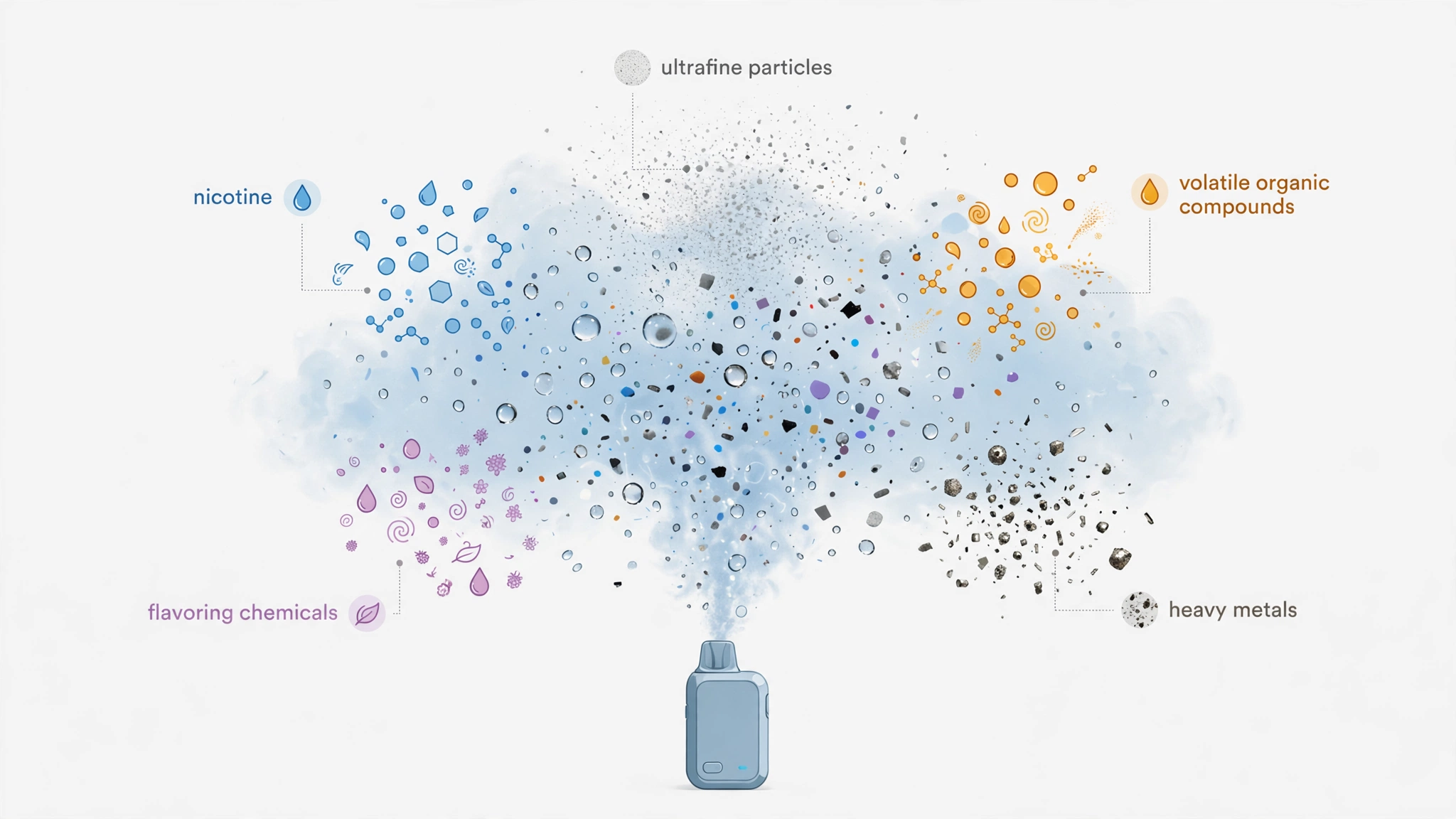
Diagram of the five ingredients found in secondhand vape aerosol.
Secondhand vape aerosol holds nicotine, ultrafine particles, volatile organic compounds, flavoring chemicals, and trace metals. Each ingredient comes from the e-liquid or from the device itself.
Nicotine is present in almost every non-zero nicotine product. Bystanders absorb it, and blood tests find cotinine, a nicotine byproduct, in non-smokers who share indoor space with vapers. Nicotine is the ingredient that makes vaping addictive, and bystander exposure to nicotine is the most measured effect in the research.
Ultrafine particles are droplets smaller than 2.5 micrometers, known as PM2.5 and smaller. These particles reach deep into the lungs, into the alveoli, the small air sacs where oxygen enters the blood. Indoor air studies show e-cigarette use raises PM2.5 to levels well above World Health Organization safe limits in enclosed rooms.
Volatile organic compounds include formaldehyde, acrolein, and benzene. Lab tests detect these compounds in exhaled vape aerosol across device types. Formaldehyde and benzene are known carcinogens. The amounts in secondhand vape are far lower than in cigarette smoke, but they are present.
Heavy metals come from the heating coil. Tests find lead, nickel, tin, chromium, iron, aluminum, and zinc in vape aerosol.
Flavoring chemicals add another layer. Some flavorings, including diacetyl, link to permanent lung scarring at occupational exposure levels, far above what a bystander breathes. The research has not tied bystander flavoring exposure to disease, but the chemicals are still part of what bystanders inhale.
| Ingredient | Where it comes from | What it does to bystanders |
|---|---|---|
| Nicotine | E-liquid | Absorbed into blood, measured as cotinine |
| Ultrafine particles (PM2.5) | Heated e-liquid | Reach deep lung tissue, raise indoor PM2.5 |
| Volatile organic compounds | Heated e-liquid | Formaldehyde, acrolein, benzene detected |
| Heavy metals | Heating coil | Lead, nickel, tin, chromium, iron, zinc |
| Flavoring chemicals | E-liquid flavorings | Irritation, long-term effects unclear |
Is Secondhand Vape Harmful to Bystanders?
Yes, secondhand vape is harmful to bystanders, but the harm is far smaller than the harm from secondhand cigarette smoke. The aerosol is not harmless, and the risk from ordinary exposure is low for healthy adults. The honest answer depends on the bystander and the setting.
Health authorities split on how to describe the risk. The UK view leans reassuring. A major 2018 evidence review commissioned by Public Health England, whose health functions now sit with the Office for Health Improvement and Disparities, concluded that “to date there have been no identified health risks of passive vaping to bystanders.” No later UK review has overturned that finding. The US view leans cautious. The Centers for Disease Control and Prevention (CDC) and the US Surgeon General state that secondhand e-cigarette aerosol is “not harmless water vapor,” pointing to the nicotine, ultrafine particles, and other chemicals the aerosol holds. The American Lung Association takes the same precautionary line.
Both positions rest on the same evidence. The difference is emphasis. The UK review stresses that no disease pattern has been found in bystanders. The US agencies stress that the chemicals are present and that long-term data is limited. Vaping is a young habit, and the studies that track bystanders for decades do not exist yet.
Short-term exposure has clear, measured effects. A 2026 systematic review in the Journal of Public Health examined five studies on secondhand e-cigarette aerosol exposure. In healthy non-smokers, 30 minutes of passive exposure caused eye, nose, and throat irritation, increased airway resistance, and lower exhaled nitric oxide. In people with COPD, short-term exposure changed surfactant protein-A levels, raised inflammatory markers, and caused throat irritation. These are real effects, and they appear fast.
Long-term exposure has no clear disease pattern yet. No study has tied ordinary secondhand vape exposure to lung cancer, heart disease, or death in bystanders. That gap may reflect low risk, or it may reflect short follow-up, since the research base is still young.
Secondhand Vape vs Secondhand Smoke
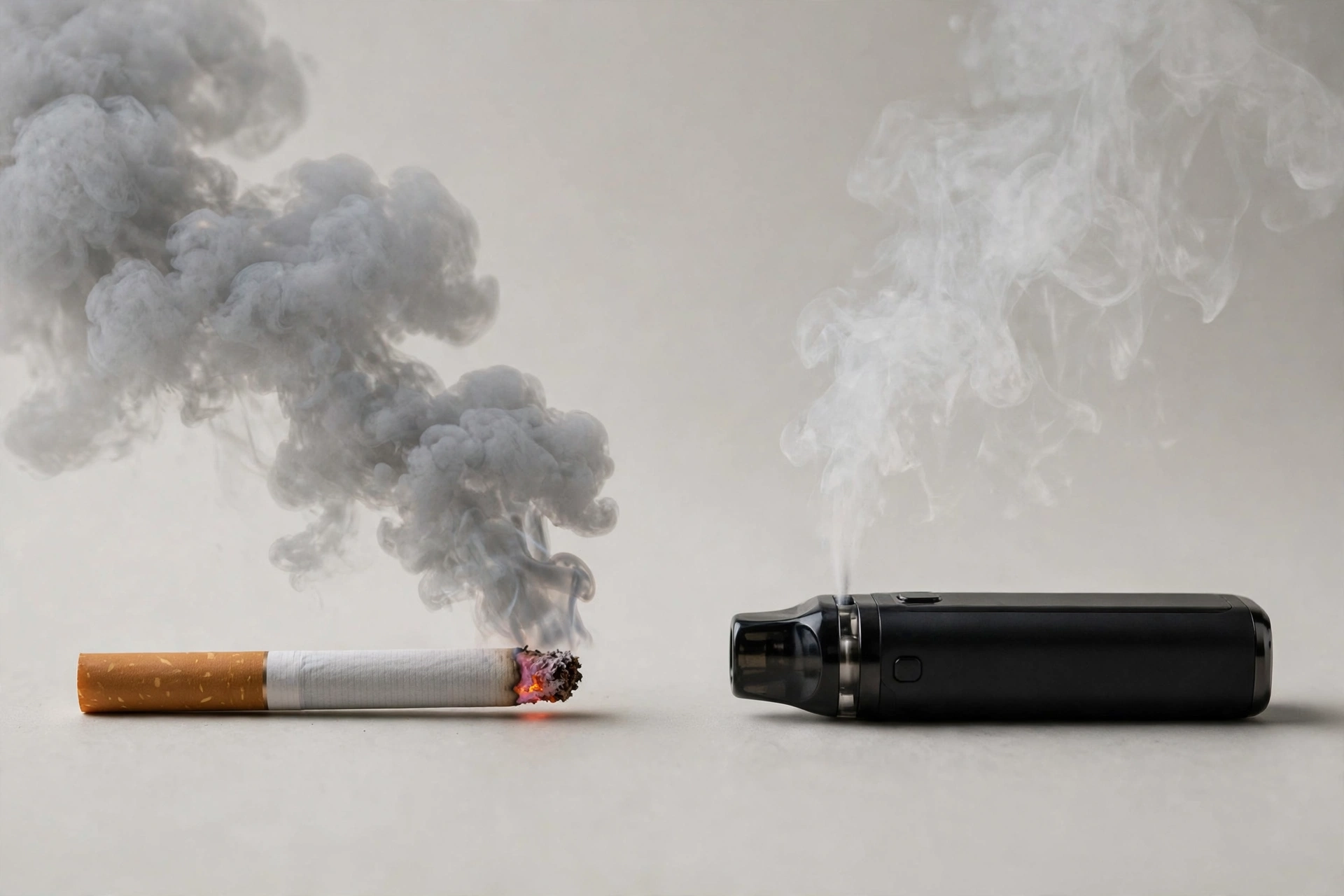
Side-by-side comparison of secondhand vape aerosol and secondhand cigarette smoke.
Secondhand vape is far less harmful than secondhand smoke, because vaping involves no combustion. A burning cigarette releases more than 7,000 chemicals, including at least 70 known carcinogens, plus tar and carbon monoxide. A vape releases a smaller set of chemicals at lower levels, with no tar and no carbon monoxide.
The comparison matters because secondhand smoke is a proven killer. Passive smoking causes many of the diseases caused by direct smoking, and the World Health Organization reported in 2023 that more than 1.3 million deaths are attributed to passive smoking worldwide every year. Secondhand vape has no comparable death toll, and no study has found one.
The table below compares the two side by side. Every row favors vaping over smoking. No row shows zero risk for vaping.
| Factor | Secondhand cigarette smoke | Secondhand vape aerosol |
|---|---|---|
| Source | Burning tobacco, continuous | Heated e-liquid, only when puffed |
| Tar | Yes, heavy | None |
| Carbon monoxide | Yes | None |
| Known carcinogens | At least 70 | Trace amounts (formaldehyde, some metals) |
| Nicotine in bystanders | Measurable and significant | Measurable but lower |
| Ultrafine particles | High | High counts, lower chemical load |
| Proven deaths in bystanders | Yes, over 1.3 million a year (WHO, 2023) | None established |
| Overall harm level | Severe, well documented | Lower than smoke, not harmless |
The gap between the two columns is wide. The gap between the vape column and clean air is real but narrow. Both gaps matter. A vaper who switches from cigarettes to vaping cuts the risk to people nearby by a large amount. A non-vaper who breathes vape aerosol still breathes chemicals they did not choose.
Who Is Most at Risk from Secondhand Vape?
Children, pregnant people, and people with asthma, COPD, or heart conditions face the most risk from secondhand vape. Healthy adults in ventilated spaces face the lowest risk. The risk rises with dose, and dose rises with time spent in the same air.
Children breathe faster than adults and have smaller, still-developing airways. Nicotine disrupts neurological development, and the CDC links secondhand e-cigarette exposure in children to higher rates of asthma flare-ups, respiratory infections, and behavioral effects. A 2024 study led by University College London researchers and published in JAMA Network Open measured cotinine in the blood of 1,777 US children aged 3 to 11. Children exposed to indoor vaping absorbed 84% less nicotine than children exposed to indoor smoking, while children exposed to neither absorbed 97% less. The study shows the risk is lower than smoke, and it also shows the nicotine is real.
Pregnant people face a separate concern. Nicotine crosses the placenta, and secondhand nicotine exposure during pregnancy adds to fetal nicotine load even when the mother does not vape herself. A 2025 systematic review in Women and Birth found that maternal vaping raises the risk of preterm birth, low birth weight, and small-for-gestational-age outcomes. The review studied active vaping, not secondhand exposure, so the bystander numbers are lower, but the direction of the risk is the same.
People with asthma or COPD react faster and harder. The chamber studies in the 2026 systematic review showed increased airway resistance and inflammatory markers in people with existing lung conditions after just 30 minutes of secondhand vape exposure. For a person with asthma, even a small irritant can trigger a flare-up. People with heart conditions need the same care, since nicotine raises heart rate and blood pressure and ultrafine particles can affect blood vessels. The bystander dose is low, but a person with heart disease has less room for extra strain.
Ex-smokers form a final group. The smell and sight of vaping can trigger cravings in people who quit nicotine. The risk here is relapse, not lung damage, and it is real enough that ex-smokers ask vapers to step away.
How Long Does Secondhand Vape Linger in a Room?
Ultrafine particles from secondhand vape can persist in indoor air for 30 minutes or more after the vaper leaves the room. The visible cloud clears in seconds, but the smallest particles stay airborne far longer. The cloud you see is not the whole exposure.
Room size and ventilation set the dose. A small closed room concentrates the aerosol. A large room with open windows dilutes it. Studies find that vaping indoors raises PM2.5 to levels well above World Health Organization safe limits, and the levels stay high until the air turns over. An open window cuts particle concentration, but it does not remove volatile organic compounds or ultrafine particles from shared air.
Outdoor air behaves differently. Wind and open space dilute the cloud within seconds, and the dose drops fast with distance. A few steps of distance outdoors cuts exposure far more than the same distance indoors. The practical rule follows from the physics: the smaller the space and the weaker the airflow, the longer the exposure lasts.
What Is Thirdhand Vape Exposure?
Thirdhand vape exposure is the chemical residue that vape aerosol leaves on surfaces after the cloud clears. Nicotine and other chemicals settle on walls, furniture, bedding, and car interiors. The residue stays after the air clears, and people touch it or breathe it back into the air later.
The US Environmental Protection Agency advises against vaping indoors, and surface buildup is one reason. The EPA notes that chemicals released from e-cigarettes can remain on surfaces long after the aerosol has cleared, leading to thirdhand exposure. Children face the most thirdhand risk. They crawl on floors, touch surfaces, and put hands in mouths. A child in a room where adults vape daily picks up residue even on days when no one vapes in front of them.
Thirdhand residue is hard to remove. Nicotine binds to surfaces and fabrics, and regular dusting only helps in part. Washing bedding, curtains, and soft furnishings cuts the residue, and hard surfaces need wiping with a damp cloth and a mild cleaner. Air fresheners do not remove it. The only full fix is to stop vaping in the room and clean the surfaces after.
Can Secondhand Vape Affect You in a Car or Office?
Yes, a car is the worst common setting for secondhand vape, and an office with shared air is the next worst. The setting sets the dose, and small enclosed spaces set the highest dose.
A car holds a small volume of air, and the windows stay shut in most weather. One vaper in a car fills that air fast, and every passenger breathes the same air. Children in the back seat sit closest to the cloud. The safe rule for a car is simple: no vaping inside, at any time, with any passenger.
An office depends on the ventilation system. A modern office with strong air exchange dilutes the aerosol, but the dilution is slow, and the aerosol spreads to desks nearby. Most workplaces ban vaping indoors under the same policy as smoking. A vaper who uses a device at a desk exposes every colleague who shares the air, so stepping outside is the only move that removes the exposure.
A home depends on the room and the habit. A vaper who uses a device in one room every evening builds up both airborne particles and surface residue, while a vaper who steps outside keeps the home air clean. The difference shows in PM2.5 readings, and it shows in the cotinine levels of children who live in the home.
Outdoors, the risk drops fast. Wind dilutes the cloud in seconds, and distance does the rest. A vaper who stands a few meters away from other people outdoors exposes almost no one. The exception is a crowded outdoor space, such as a queue or a bus stop, where people stand close together. A step to the side fixes that too.
How Can Vapers Protect the People Around Them?
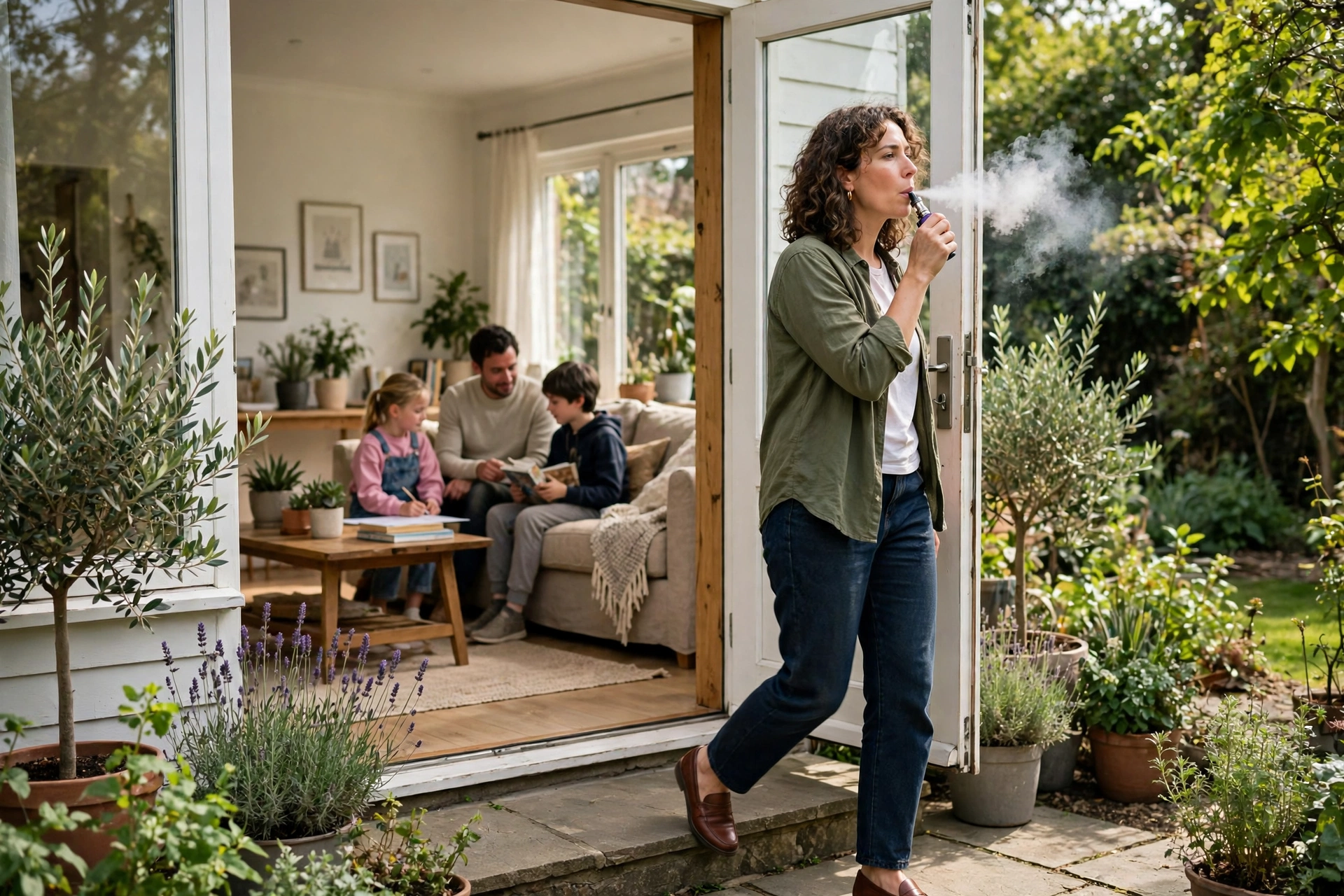
Checklist of seven steps vapers can take to protect the people around them.
Vapers protect the people around them by taking the cloud outside and away from other people. The steps below cost nothing, and each one cuts someone else’s dose.
- Vape outdoors, away from doors, windows, and other people.
- Never vape in a car with passengers, and never vape around children.
- Never vape in a room where a pregnant person sleeps or spends time.
- Ask before vaping in someone else’s home, and accept no as the answer.
- Step away from queues, bus stops, and crowded outdoor spaces before using a device.
- Keep vaping out of bedrooms and living rooms, so residue does not build up on soft furnishings.
- Wash hands and change outer clothing after heavy vaping sessions before holding a baby.
The courtesy rule is worth stating in plain terms. The person who did not choose to vape did not choose to breathe the aerosol. The vaper holds the device, so the vaper holds the choice. Stepping outside is a small move for the vaper and a full fix for the bystander.
What Should Bystanders Do About Secondhand Vape?
Bystanders cut exposure by moving to fresh air, opening a window, and asking the vaper to step outside. The bystander does not need a confrontation. A short, plain request works in most cases.
Move first. Step away from the cloud, move upwind outdoors, or leave the room. Distance and fresh air cut the dose faster than any other move. A few meters outdoors removes almost all exposure.
Open a window if the vaping happens indoors. Ventilation lowers particle levels, though it does not remove every chemical. A fan that pulls air out of the room works better than a fan that stirs the air around.
Ask plainly. “Please vape outside” is enough. Most vapers do not know the cloud reaches other people, and most step outside when asked. A workplace or a landlord can set the rule in writing, which removes the need for any single person to ask.
Protect children first. A parent who vapes should step outside every time, and a parent who does not vape should keep children out of rooms where others vape. The child’s faster breathing and developing lungs make the same cloud a larger dose for them.
Know the local rules. UK law under the Smoke-Free Regulations 2006 does not automatically cover vaping, but many venues ban it under their own policies. US rules vary by state and city. A venue sign that bans vaping settles the question without a debate.
What the Latest Research Found (2024 to 2026)
The newest research confirms the middle position: secondhand vape is far less harmful than secondhand smoke, and it is not harmless. The studies quoted above point the same way. The UCL cotinine study shows a large cut in nicotine dose versus smoking, with a dose that is still measurable. The Thorax study of over 2,000 young adults links regular home exposure to bronchitic symptoms, wheeze, and shortness of breath. The 2026 Journal of Public Health review shows irritation and higher airway resistance after just 30 minutes. The 2026 University of California, Riverside study adds the newest finding: vape aerosol reacts with indoor ozone to form ultrafine particles carrying metals and peroxides, and the smallest particles produced 100 times more free radicals per unit of weight than larger particles. That study is new and needs replication, but it points to a risk older studies missed: the aerosol changes after it leaves the device, and the aged particles may harm lungs more than fresh ones.
Frequently Asked Questions
Is secondhand vape harmful to children?
Yes, secondhand vape is harmful to children, and children face more risk than adults from the same cloud. Children breathe faster and have smaller, still-developing airways, so the same exposure is a larger dose for them. The CDC links secondhand e-cigarette exposure in children to higher rates of asthma flare-ups, respiratory infections, and behavioral effects. A 2024 UCL study found measurable nicotine in the blood of children exposed to indoor vaping.
Can secondhand vape cause cancer?
No study has tied secondhand vape exposure to cancer in bystanders. The aerosol holds trace amounts of formaldehyde and benzene, which are known carcinogens, but the amounts are far lower than in cigarette smoke. The research base is young, and no long-term study has tracked bystanders for decades. The honest answer is that no cancer link has been found, and the long-term data is still incomplete.
Is secondhand vape worse than secondhand smoke?
No, secondhand vape is far less harmful than secondhand smoke. Vaping involves no combustion, so the aerosol holds no tar and no carbon monoxide, and it carries far fewer chemicals at lower levels. Secondhand smoke causes over 1.3 million deaths a year worldwide, according to the World Health Organization (2023). No deaths have been tied to secondhand vape. Less harmful is not the same as harmless.
How long does secondhand vape stay in the air?
Ultrafine particles from secondhand vape can stay in indoor air for 30 minutes or more after the vaper leaves the room. The visible cloud clears in seconds, but the smallest particles stay airborne far longer. Room size and ventilation set the real time. A small closed room holds the particles longest, and an open window cuts the time. Outdoor air clears the cloud within seconds.
Is it safe to vape around a baby?
No, it is not safe to vape around a baby. Babies breathe faster than adults, their lungs and brains are still developing, and nicotine disrupts neurological development. The CDC advises against any secondhand e-cigarette exposure for infants. A vaper should step outside every time, and should wash hands and change outer clothing before holding a baby after a heavy session.
Does opening a window remove secondhand vape?
Opening a window lowers secondhand vape levels, but it does not remove the exposure. Ventilation dilutes the aerosol and cuts particle concentration, yet volatile organic compounds and ultrafine particles remain in shared air. A fan that pulls air out of the room works better than a fan that stirs the air. The only move that removes the exposure is vaping outdoors, away from other people.
Conclusion
Is secondhand vape harmful? The evidence gives a clear middle answer. Secondhand vape aerosol is far less toxic than secondhand cigarette smoke, and no disease pattern has been found in bystanders from ordinary exposure. But the aerosol is not harmless. It holds nicotine, ultrafine particles, volatile organic compounds, and trace metals, and short-term exposure causes irritation and higher airway resistance within 30 minutes.
The risk is not spread evenly. Children, pregnant people, and people with asthma, COPD, or heart conditions carry the most risk, and small enclosed spaces like cars concentrate the dose. The newest research, including the 2026 ozone study, shows the aerosol can change after it leaves the device, which adds a reason for care indoors.
The fix is simple and it works. Vapers who step outside and away from other people remove almost all bystander exposure. Bystanders who move to fresh air and ask for the same courtesy cut what is left. Secondhand vape is a small risk for most adults, and a real one for the people who can least afford it. The kindest move is also the easiest: take the cloud outside.
For more on vaping and health, browse the Vape category on Digital Geek Spot. If you want the comparison in full, read Vape vs Cigarettes: Which Is Worse for Your Health? and What Is Vaping and How Do Vape Devices Work?. Digital Geek Spot covers vaping, health, and tech with plain, sourced guides.