
Last updated: November 2026 | Written by Lucas Hayes for Digital Geek Spot.
Startup booted financial modeling is the process of forecasting revenue, costs, cash flow and profitability for a startup that funds itself from founder money and customer revenue, with no venture capital and no bank loans. The phrase “startup booted” is short for bootstrapped. A bootstrapped startup has no investor buffer, so the model must answer one question first: how many months can this business survive on the cash it has and the cash its customers will pay? This guide builds that model step by step, with a worked 12-month example, break-even math, runway math, pricing rules, hiring rules and founder pay. The goal is a model that tells a founder what to do next, not a model that predicts the future.
Key Takeaways
- Startup booted financial modeling means forecasting a self-funded startup, where customer revenue must pay every cost.
- Cash runway is the most important number in the model. Cash balance divided by average monthly net burn equals runway in months.
- Model cash weekly for the first 6 months, then monthly. Keep a cash buffer of 2 to 3 months of operating expenses.
- Break-even revenue equals fixed costs divided by gross margin percent. Break-even customers equal fixed costs divided by contribution per customer.
- Build three scenarios (conservative, realistic, optimistic) and make spending decisions on the conservative case.
- Compare forecast to actuals every month. A variance above 10 percent on revenue or costs triggers a model update.
- Pay the founder a fixed monthly amount in the model. Founder pay is a cost, not a leftover.
Table of Contents
- What Is Startup Booted Financial Modeling?
- Why Does a Bootstrapped Startup Need a Financial Model?
- What Are the Core Parts of a Booted Startup Financial Model?
- How Do You Build a Startup Booted Financial Model Step by Step?
- How Do You Forecast Revenue Without Outside Funding?
- What Is the 13-Week Cash Forecast and Why Does It Come First?
- How Do You Calculate Break-Even and Runway?
- Booted vs VC-Backed Financial Modeling
- Worked Example: A 12-Month Model for a Bootstrapped SaaS Startup
- How Do You Price, Hire and Spend Using the Model?
- What Are the Most Common Financial Modeling Mistakes?
- How Often Should You Update a Bootstrapped Financial Model?
- Which Tools Work Best for Startup Booted Financial Modeling?
- Frequently Asked Questions
- Conclusion
What Is Startup Booted Financial Modeling?
Startup booted financial modeling is the process of forecasting a startup’s revenue, expenses, cash flow, profitability and financial position when the business relies on founder resources and internally generated revenue. The more common term is bootstrapped financial modeling. “Booted” is short for bootstrapped: building a business with founder savings, early customer revenue and reinvested profit instead of outside investment.
A financial model is a spreadsheet that turns operating assumptions into financial outcomes. The chain runs: assumptions, drivers, revenue, costs, profit, working capital, cash flow, ending cash, decisions. Change the price, and revenue changes. Change revenue, and cash changes.
The model has 5 core parts: revenue assumptions, cost structure, cash flow forecast, profit and loss statement, and break-even analysis. A booted model adds a sixth part: runway, the months the business survives at the current burn rate. It differs from traditional startup modeling in one way: it assumes no future funding round. A venture-backed model can show losses for years because the next round covers them. A booted model cannot.
Why Does a Bootstrapped Startup Need a Financial Model?
A bootstrapped startup needs a financial model because cash is the constraint, not valuation. A funded startup can survive months of losses. A bootstrapped startup that runs out of cash stops operating. The model is the early warning system that shows the cash shortfall weeks before it arrives.
The model answers 5 practical questions: how much cash does the business have, how much will it need in the next 3 months, when could cash become tight, which assumptions create the greatest risk, and what must be true for the plan to work? Digital Geek Spot covers founder finance in its Net Worth section, where self-funded business topics sit beside founder wealth profiles.
The U.S. Small Business Administration recommends financial projections as part of formal business planning, with monthly or quarterly projections during the first year. Source: U.S. Small Business Administration (2026). For a bootstrapped startup, monthly projections in year one are the operating plan, not a formality.
What Are the Core Parts of a Booted Startup Financial Model?
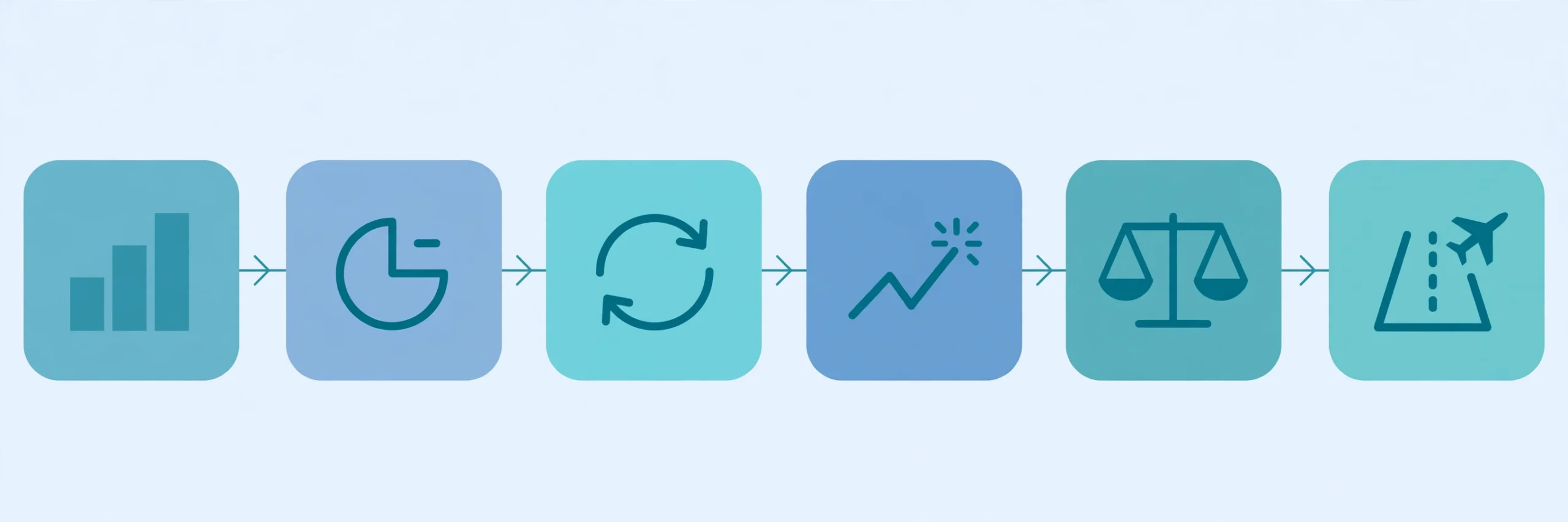
A booted startup financial model has 6 core parts: revenue assumptions, cost structure, cash flow forecast, profit and loss statement, break-even analysis and runway analysis.
1. Revenue assumptions
Revenue assumptions state how money enters the business. A subscription business calculates revenue as ending customers multiplied by monthly price. List each driver: customers, price, frequency, churn and payment terms. Mark estimates clearly, because the monthly review tests those numbers first.
2. Cost structure
Cost structure splits costs into fixed and variable. Fixed costs stay the same each month: rent, software, insurance and salaries. Variable costs rise with sales: payment fees, hosting per user and materials. Record every cost with its payment date.
3. Cash flow forecast
The cash flow forecast tracks real money in and out: beginning cash plus inflows minus outflows equals ending cash. Inflows are payments actually received, not invoices sent. If any month goes negative, the plan needs a fix now.
4. Profit and loss statement
The profit and loss statement (P&L) tracks revenue when earned and expenses when incurred: revenue minus cost of goods sold equals gross profit, and gross profit minus operating expenses equals operating profit. A founder reads the P&L for margin health and the cash forecast for survival.
5. Break-even analysis
Break-even analysis finds the point where total revenue equals total costs. Break-even revenue equals fixed costs divided by gross margin percent. Break-even units equal fixed costs divided by selling price minus variable cost per unit. The month the business passes break-even, customer revenue funds the whole operation.
6. Runway analysis
Runway analysis states how many months the business survives at the current burn rate: cash balance divided by average monthly net burn equals runway in months. Hold a cash buffer of 2 to 3 months of operating expenses, and flag any month where runway falls below 3 months.
| Component | What it covers | Why it matters for a bootstrapped startup |
|---|---|---|
| Revenue assumptions | Customers, price, frequency, churn | Shows if income is real or guessed |
| Cost structure | Fixed and variable costs | Sets the minimum survival number |
| Cash flow forecast | Real money in and out each month | Prevents cash crunches |
| Profit and loss | Revenue minus all expenses | Tracks true profitability |
| Break-even analysis | When income covers all costs | The milestone where the business funds itself |
| Runway analysis | Months of cash left at current burn | The survival number the founder watches weekly |
How Do You Build a Startup Booted Financial Model Step by Step?
To build a startup booted financial model, define the business model, list assumptions, forecast revenue bottom-up, list costs, build the cash flow forecast and P&L, calculate break-even and runway, then create three scenarios.
Step 1: Define the business model
Write one sentence that states the revenue formula, such as “Customers pay $49 per month for software.” Every later number traces back to this sentence.
Step 2: Create the assumptions tab
Put every assumption on one tab with four columns: assumption, value, unit, source. Examples: price $49, churn 4 percent per month, new customers 20 per month, processing fee 2.9 percent. The source column separates facts from guesses.
Step 3: Forecast revenue bottom-up
Build revenue from drivers, not from a target. Start with the current customer count, add new customers, subtract churned customers, and multiply ending customers by price.
Step 4: List all costs with payment dates
List fixed costs (founder pay, salaries, rent, software, insurance) and variable costs (payment fees, hosting per user, materials, commissions). Add the payment date for each cost.
Step 5: Build the cash flow forecast
Build a monthly cash forecast for at least 12 months. Start with the opening bank balance, add cash collected, and subtract cash paid out. Use collected cash, not invoiced revenue: a $5,000 invoice with 30-day terms is $0 of cash in the invoice month and $5,000 in the next month.
Step 6: Build the P&L and calculate break-even
Build the P&L from the same revenue and cost lines. Then calculate break-even revenue: fixed costs divided by gross margin percent. If fixed costs are $8,000 per month and gross margin is 80 percent, break-even revenue is $10,000 per month.
Step 7: Create three scenarios
Create three scenarios: conservative, realistic and optimistic. Change the drivers, not just the totals. Make spending decisions on the conservative case: if it shows a shortfall in month 7, cut costs or raise revenue now.
How Do You Forecast Revenue Without Outside Funding?
To forecast revenue without outside funding, build it bottom-up from customers, price and churn, use conservative growth rates, and count only cash collected in each month.
Start with the current customer count and monthly revenue. Add new customers by channel: referrals, search, social media, partnerships and direct sales. Give each channel a monthly number based on recent actuals. Subtract churn each month, then apply the collection adjustment: if customers pay 30 days after invoice, shift one month of revenue into the next month in the cash forecast.
Use cohort thinking for subscription revenue. Track each monthly cohort separately: how many joined, how many remain after 3 months, how many expand to a higher plan. Cohort tracking shows whether churn is a new-customer problem or an old-customer problem. Set the forecast horizon at 12 to 24 months, and replace estimates with actuals every month.
What Is the 13-Week Cash Forecast and Why Does It Come First?
The 13-week cash forecast is a week-by-week list of expected cash in and cash out for the next 13 weeks, and it comes first because payroll and rent cannot wait for a monthly forecast to catch up.
Build it with rows for each inflow and outflow category and columns for each of the 13 weeks. Ending cash equals starting cash plus inflows minus outflows for each week. Confirm actuals every Monday and roll the window forward one week.
Set two triggers. If ending cash dips below 2 payroll cycles, trigger a spend freeze and a revenue push: pause discretionary spending, chase overdue invoices and offer an early-payment discount. If ending cash falls below 1 payroll cycle, the founder acts the same day.
How Do You Calculate Break-Even and Runway?
Break-even revenue equals fixed costs divided by gross margin percent, and runway equals cash balance divided by average monthly net burn. Both formulas use numbers the model already holds.
Work through a small example. A bootstrapped software startup has fixed costs of $6,000 per month: founder pay $3,000, software $500, contractors $1,500 and other fixed costs $1,000. Gross margin is 85 percent. Break-even revenue is $6,000 divided by 0.85, which equals $7,059 per month. At a $49 price and a $41.65 contribution per customer, break-even customers equal 144.
Now calculate runway. The business holds $24,000 in cash. Monthly cash inflow is $4,000 and monthly cash outflow is $7,000, so net burn is $3,000 per month. Runway is $24,000 divided by $3,000, which equals 8 months. Decide on the conservative case: if it shows a shortfall in month 7, cut a contractor now or raise prices now.
Booted vs VC-Backed Financial Modeling
Booted financial modeling plans around constraints, while VC-backed modeling plans around growth. The table below shows the differences across 8 areas.
| Area | Bootstrapped model | VC-backed model |
|---|---|---|
| Funding assumption | Revenue must fund operations | Future rounds fund losses |
| Time horizon | 12 to 24 months | 3 to 5 years |
| Most important metric | Cash runway | Growth rate and market share |
| Revenue forecast | Bottom-up, conservative | Top-down, aggressive |
| Hiring rule | Hire when revenue covers the salary for 3 to 6 months | Hire ahead of revenue |
| Cash buffer | 2 to 3 months of operating expenses | 12 to 18 months after a raise |
| Profit target | Break-even within 12 months | Profitability in year 3 to 5 |
| Model purpose | Survival map and decision tool | Fundraising pitch and board report |
A booted founder reads the model to decide what to do this week. A VC-backed founder reads the model to show investors what the business could become.
Worked Example: A 12-Month Model for a Bootstrapped SaaS Startup

This worked example models a bootstrapped software startup with a $49 monthly price, starting from 40 customers and $18,000 in cash. The numbers are a teaching example with stated assumptions, not a promise. Each month, new customers arrive, churn removes customers, and 20 percent of revenue is collected one month late.
Assumptions: starting customers 40, new customers 15 per month, monthly churn 4 percent, price $49 per month, payment fees and hosting 15 percent of revenue, fixed costs $5,500 per month (founder pay $3,000, contractors $1,500, software $600, other $400), starting cash $18,000, 20 percent of revenue collected one month late.
| Month | Customers | Revenue | Costs | Net cash flow | Closing cash | Runway |
|---|---|---|---|---|---|---|
| 1 | 51 | $2,499 | $5,875 | -$3,376 | $14,624 | 4.3 months |
| 2 | 64 | $3,136 | $5,970 | -$2,834 | $11,790 | 4.2 months |
| 3 | 76 | $3,724 | $6,059 | -$2,335 | $9,455 | 4.0 months |
| 4 | 88 | $4,312 | $6,147 | -$1,835 | $7,620 | 4.2 months |
| 5 | 99 | $4,851 | $6,228 | -$1,377 | $6,243 | 4.5 months |
| 6 | 110 | $5,390 | $6,309 | -$919 | $5,324 | 5.8 months |
| 7 | 121 | $5,929 | $6,389 | -$460 | $4,864 | 10.6 months |
| 8 | 131 | $6,419 | $6,463 | -$44 | $4,820 | 109 months |
| 9 | 141 | $6,909 | $6,536 | $373 | $5,193 | Cash positive |
| 10 | 150 | $7,350 | $6,603 | $747 | $5,940 | Cash positive |
| 11 | 159 | $7,791 | $6,669 | $1,122 | $7,062 | Cash positive |
| 12 | 168 | $8,232 | $6,735 | $1,497 | $8,559 | Cash positive |
Months 1 to 4 burn cash fast, and runway falls to 4 months. Months 5 to 8 slow the burn, and month 8 nearly breaks even. Month 9 turns cash positive, and closing cash rebuilds to $8,559 by month 12. The business reaches 168 customers, above the 144 break-even count.
The example shows 3 lessons. First, the collection lag matters: 20 percent of revenue arriving a month late costs about $1,000 of cash in the early months. Second, churn compounds: 4 percent monthly churn removes 7 customers by month 12. Third, the danger zone is months 3 to 5, when cash falls below $10,000. A founder who sees that dip cuts a cost in month 2, not in month 5.
For another finance platform breakdown, read our Crypto30x.com review.
How Do You Price, Hire and Spend Using the Model?
To price, hire and spend using the model, test price changes against contribution margin, hire only when recurring revenue covers the new salary for 3 to 6 months, and approve spending only when the conservative scenario stays cash positive.
Price from contribution margin, not from competitors alone. Contribution per customer equals price minus variable cost per customer. At $49 with 15 percent variable costs, contribution is $41.65. A price rise to $59 lifts contribution to $50.15 and cuts break-even customers from 144 to 120. Test a price change in the model before announcing it.
Hire on a revenue rule. A bootstrapped startup hires a full-time employee only when recurring revenue consistently covers the new salary for at least 3 to 6 months. Contractors come first, because a contractor contract ends and a salary does not.
Pay the founder a fixed monthly amount and record it as a cost. Founder pay of $3,000 a month in the worked example is a real cost, not a leftover. A founder who takes no pay builds a business that cannot afford its own founder.
Approve spending with a simple test: does the conservative scenario stay cash positive in every month after this spend? Marketing spend gets a second test: the cost to win a customer must pay back within 6 months. A $120 acquisition cost at $41.65 monthly contribution pays back in 3 months. A $300 acquisition cost pays back in 8 months, too slow for a bootstrapped business.
What Are the Most Common Financial Modeling Mistakes?
The most common financial modeling mistakes are confusing profit with cash, forecasting top-down, and ignoring churn.
- Counting invoiced revenue as cash. Fix: build the cash forecast from collected cash only.
- Forecasting top-down from market size. Fix: build revenue bottom-up.
- Ignoring churn. Fix: model churn every month. A 4 percent monthly churn rate removes 38 percent of customers in a year.
- Forgetting taxes, payroll dates and annual bills. Fix: put every tax date and annual bill in the cash forecast with its real date.
- Leaving founder pay out of costs. Fix: record founder pay as a fixed monthly cost from month 1.
- Using one scenario. Fix: build three cases, and spend on the conservative case.
- Never updating the model. Fix: compare forecast to actuals every month.
- Building a 15-tab model nobody maintains. Fix: keep 6 tabs and update them monthly.
How Often Should You Update a Bootstrapped Financial Model?

Update a bootstrapped financial model weekly in the first year for cash, and monthly for the full forecast. The weekly check takes 30 minutes. The monthly check takes 2 hours.
The weekly check runs every Monday. Confirm last week’s actual cash in and cash out against the 13-week forecast. Roll the window forward one week. Below 2 payroll cycles means a spend freeze and a revenue push.
The monthly check runs in the first week of each month. Replace forecast numbers with actuals for the month just ended. Calculate variance for revenue, costs, cash and customers. A variance above 10 percent on any line triggers an assumption update. Then rebuild the 3 scenarios and check runway again. Update the model immediately when a major event happens: losing a large client, signing a large contract, changing price or hiring.
Which Tools Work Best for Startup Booted Financial Modeling?
Google Sheets and Excel remain the best tools for startup booted financial modeling, because they are free, flexible and transparent. A founder outgrows spreadsheets only when monthly revenue passes $100,000 or headcount passes 20.
| Tool | Cost | Best for |
|---|---|---|
| Google Sheets | Free | First model, sharing, scenario toggles |
| Microsoft Excel | Paid | Offline work, larger models, templates |
| Founderpath template | Free | SaaS 24-month forecast, no signup |
| LivePlan | Paid | Guided forecasting, small business templates |
| SCORE templates | Free | Pre-built model templates for US founders |
| Wave Accounting | Free | Actuals, invoicing, cash tracking |
| QuickBooks | Paid | Actuals, payroll, tax-ready records |
Start in Google Sheets or Excel. Build 6 tabs: assumptions, revenue, costs, P&L, cash and scenarios. Link every cell with formulas so one change flows through the model. Use accounting software for actuals, not for forecasts.
Frequently Asked Questions
What is startup booted financial modeling?
Startup booted financial modeling is the process of forecasting a startup’s revenue, expenses, cash flow, profitability and financial position when the business relies on founder resources and internally generated revenue. The more common term is bootstrapped financial modeling.
Is “startup booted financial modeling” the correct term?
The phrase is used online, but “bootstrapped financial modeling” is more natural business terminology. “Booted” is short for bootstrapped. StartupBooted.com is a separate consulting brand that sells financial modeling services from $10,000, so the phrase can also mean that brand.
How long should a bootstrapped financial model forecast?
A bootstrapped financial model should forecast at least 12 months ahead, and 24 months when possible. Twelve months captures seasonal patterns and annual bills. Update the model monthly and immediately after any major business change.
What is the most important metric in booted financial modeling?
Cash runway is the most important metric in booted financial modeling. It measures how many months a startup survives at its current burn rate: cash balance divided by average monthly net burn.
When should a bootstrapped startup hire its first employee?
A bootstrapped startup should hire a full-time employee only when recurring revenue consistently covers the new salary for at least 3 to 6 months. Contractors come first, because a contractor contract ends and a salary does not.
What tools do I need to build a bootstrapped financial model?
Google Sheets or Excel is enough to build a bootstrapped financial model. Both are free or low cost, and both support formulas, scenarios and sharing. Add accounting software such as Wave or QuickBooks for actuals.
How do I know if my financial model is realistic?
A financial model is realistic when its assumptions come from recent actuals, signed contracts or observed rates, and when the conservative scenario still ends every month with cash in the bank. A variance above 10 percent on revenue or costs means an assumption needs an update.
Conclusion
Startup booted financial modeling turns a self-funded startup into a business a founder can steer. The model starts with one sentence: the revenue formula. It grows into 6 parts: revenue assumptions, cost structure, cash flow forecast, P&L, break-even and runway. The 13-week cash forecast comes first, because payroll cannot wait. Three scenarios keep the founder honest, and the conservative case makes the spending decisions. The worked example shows the pattern: cash falls for 8 months, turns positive in month 9, and rebuilds by month 12. Founder pay is a cost, not a leftover. A founder who runs this model every week knows the cash position, the break-even date and the runway.
Read next: Tozymagazine Com Trending Explained: What It Is, Why It Ranks, and Is It Legit.