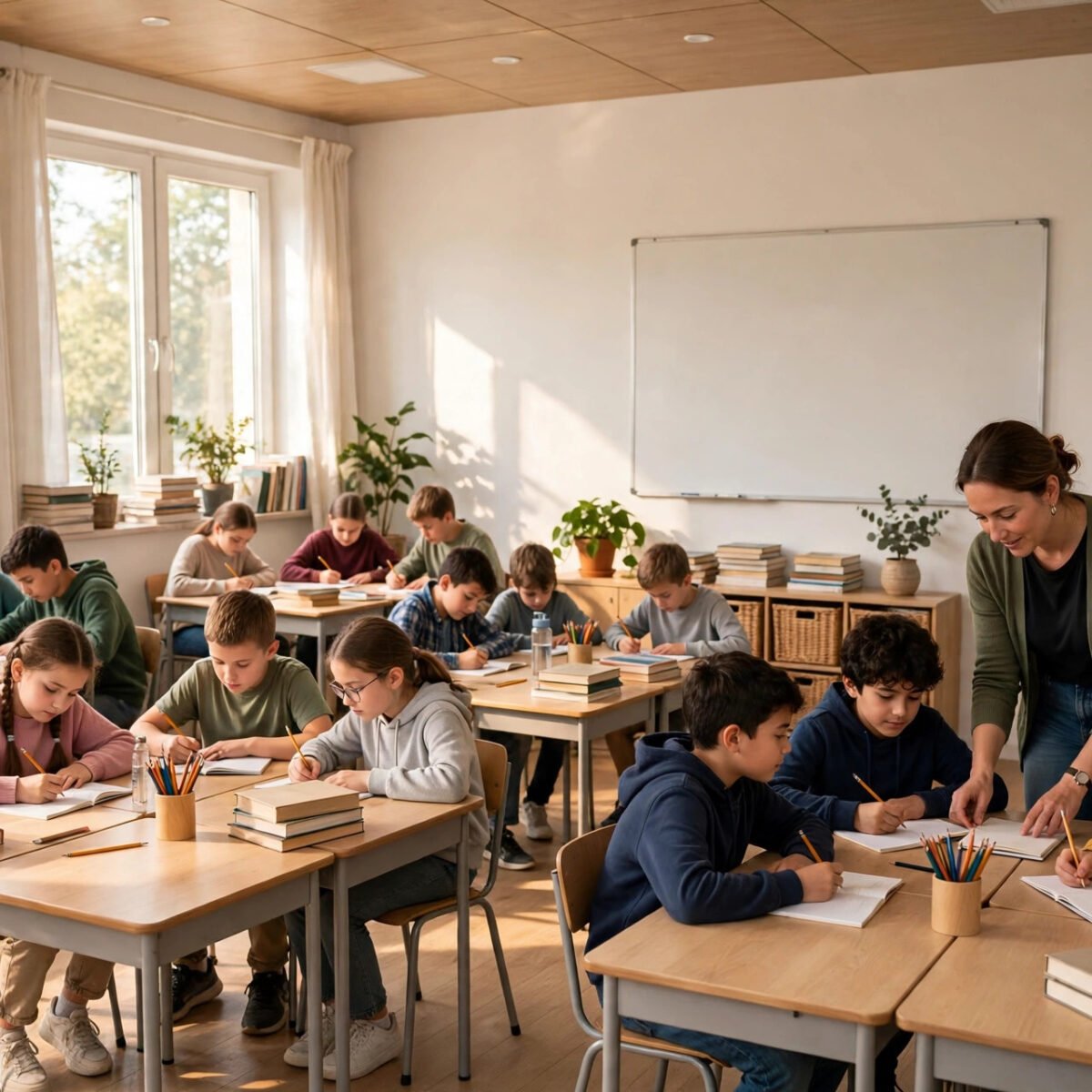
Classroom 15 is a term with more than one meaning, and that is why it confuses so many searchers. In its best documented use, Classroom 15 is the title of a 2020 book about a fourth grade class in Roseburg, Oregon, and the Cold War controversy that followed a simple pen pal project. In everyday school language, it can also mean a classroom with about 15 students, or simply a room numbered 15 in a school building.
Because the phrase looks so similar to Classroom 15x and Classroom 30x, many people assume all three are the same website, app, or learning platform. They are not. This guide explains classroom 15 on its own terms, what the book covers, what a 15 student classroom looks like in practice, and how teachers, students, and parents can use the idea well.

Key Takeaways: Classroom 15 is best known as a 2020 book by Peter Laufer and University of Oregon journalism students about a Roseburg fourth grade pen pal project that drew FBI attention during the McCarthy era. In school planning, classroom 15 can also describe a small class of about 15 students, which allows more individual attention, discussion, and feedback than a large class. Classroom 15 is not the same thing as Classroom 15x or Classroom 30x, and it is not, by itself, a single app or gaming website.
The book gives the term its clearest identity. It follows students at Riverside School in Roseburg, in rural Oregon timber country, whose teacher set a geography assignment that reached far beyond the classroom wall. The students imagined a place as far from Oregon as possible and wrote to children of a similar age in the Soviet Union.
What happened next turned a school project into a national story. The request was denied, publicity followed, and J. Edgar Hoover’s FBI investigated. The book uses that chain of events to explore censorship, fear during the Red Scare, and the power of student curiosity.
The small class meaning is different, but it is just as useful. A classroom of 15 students is small enough for a teacher to know each learner, check understanding during a lesson, and adjust the work without stopping the whole class. It is also large enough for group work, debate, and different viewpoints, which a very tiny group can lack.
What does classroom 15 mean?
Classroom 15 means different things in different contexts, so the safest answer is to check the context first. It can be a book title, a class size, or a room number, and each use is legitimate in its own setting.
When a writer uses the capitalised title Classroom 15, they are usually referring to the book. When a school leader talks about a classroom of 15, they are usually talking about staffing, space, and teaching. When a student says, “Meet me in Classroom 15,” they are usually giving a location, not naming a method.
That distinction matters for search. If you type the phrase looking for games, lessons, or login help, you may land on pages about other products with similar names. If you are looking for the book or for small class teaching, use those extra words in your search, for example “Classroom 15 book” or “classroom of 15 students.”
The three common uses at a glance
| Use of the term | What it refers to | Who it helps most |
|---|---|---|
| Classroom 15, the book | A 2020 investigative book about the Roseburg fourth graders and the FBI inquiry | Readers, students, and teachers studying journalism, history, and censorship |
| A classroom of 15 students | A small class size that supports individual attention and active learning | Teachers and students who want more discussion, feedback, and support |
| Room 15 | A numbered classroom in a school building | Students, parents, and visitors finding a specific class |
What is the book Classroom 15 about?
Classroom 15 is about how a fourth grade pen pal project in Oregon became a Cold War controversy. The teacher, Ray “Bud” McFetridge, assigned a geography project, and the students wrote letters to counterparts in the Soviet Union. Janice Boyle, the class secretary, reached out to Oregon’s Congressional representative, Charles O. Porter, for help making the connection.
Representative Porter forwarded the letter to Secretary of State Christian Herter. A week later, the students learned that their request had been denied. In the climate of McCarthyism, officials feared that Communist propaganda could influence young schoolchildren, even though the assignment itself was a simple classroom exercise.
The story did not end there. News coverage spread from the Roseburg News-Review to the New York Times, and the FBI investigated. Agents travelled to Roseburg, collected material, and took it to the Bureau’s regional headquarters in Portland. The teacher and the Congressman faced criticism from outraged citizens, the school board, and readers across the country.
Despite the effort to stop the project, news of it reached Russia and appeared in Pravda. Children from the Soviet Union then sent letters to their Roseburg counterparts, and many of those letters were confiscated by authorities. The pen pal initiative was quashed almost as quickly as it had begun.
Who wrote Classroom 15, and why does that matter?
The book grew out of an investigative reporting class at the University of Oregon. Peter Laufer, who held the James Wallace Chair in Journalism at the University of Oregon School of Journalism and Communication, led the project, and journalism students carried out the research and writing. Ann Curry wrote the foreword.
That origin is part of the book’s value for teachers. It is described by its publisher, Anthem Press, as a remarkable example of experiential learning, and as a practical tool for teaching student conceived research, use of the Freedom of Information Act (FOIA), and shoe leather journalism. In plain terms, students did not just read about reporting, they did the reporting.
The student researchers followed old leads, tracked down people connected to the original class, and worked through documents and letters, including a file of letters in Cyrillic script. That slow, detailed work is why the book is useful in journalism and history classes, not just as a story about the past.
What can readers learn from Classroom 15?
- How censorship can work through fear, pressure, and official action, not only through a formal ban.
- How a local school story can become a national story once newspapers pick it up.
- How FOIA requests and careful interviews can uncover material that was hidden for decades.
- How students can lead real research when a teacher gives them a clear question and room to follow it.
- Why free expression in schools still matters in current public debate.
The book has 222 pages and was published by Anthem Press on December 15, 2020. Its full subtitle is “How the Hoover FBI Censored the Dreams of Innocent Oregon Fourth Graders.” For a reader who wants history told through real people rather than abstract policy, that subtitle is an accurate preview.
If you enjoy learning through comparison, you may also find it helpful to read about online learning versus the traditional classroom, because the Roseburg story shows what a traditional classroom could do long before online tools existed, and what limits it faced.
What does a classroom of 15 students look like?
A classroom of 15 students looks calmer and more flexible than a crowded room, but it is not simply a smaller version of a lecture hall. The teacher can move between groups, hear every student in a discussion, and notice quickly when someone is stuck.
Typical features include:
- Small group tables or movable desks, so students can switch from solo work to group work without a major rearrangement.
- A discussion circle or a shared table for whole class talk, where every student has a realistic chance to speak.
- Zones for different work, such as a quiet reading corner, a project table, and a space for teacher led small group help.
- Visible learning tools, such as a whiteboard, a display screen, and printed guides that students can use without waiting for the teacher.
- Clear routines for starting work, asking for help, and sharing results, so the small size supports independence rather than constant supervision.
How is teaching different in a class of 15?
In a large class, a teacher often has to teach to the middle of the group and hope the rest keep up. In a class of 15, the teacher can check understanding more often, give feedback during the lesson, and pull a small group aside for extra help while the rest continue a project.
That does not mean the work is easier. It means the teacher can use methods that are hard to manage with 30 or more students, such as debates, hands on tasks, peer feedback, and presentations. Students also have fewer places to hide, which can be good for participation, but teachers need to build trust so quiet students feel safe to speak.
Technology can support this model, but it does not replace it. A shared document, a quiz tool, or a class device can give instant feedback, yet the main benefit remains human: more time, more attention, and more conversation. For device choices, see this comparison of Chromebook versus laptop before buying for a classroom.
How do teachers use a 15 student classroom in practice?
Teachers use a 15 student classroom by planning for participation, not just for delivery. A common lesson flow is short, direct teaching, followed by group work, followed by a check of what students understood.
A practical example looks like this:
- Start together (5 to 10 minutes): introduce one clear question or skill, and show a short example.
- Work in groups (15 to 25 minutes): students solve a problem, discuss a text, or build something, while the teacher visits each group.
- Check and share (10 minutes): groups share findings, the teacher corrects misunderstandings, and students note what to improve.
- Finish alone (5 to 10 minutes): each student writes a short answer, reflection, or next step, so the teacher can see individual progress.
Good note taking helps this model work, because students need to capture discussion, not just copy from a board. These tips on how to take notes effectively in college also apply well to school students, especially the habit of writing questions, not just answers.
Teachers can also use the small size for choice. One group might read a harder text, another might practise a basic skill, and a third might work on a creative task. That kind of differentiation is possible in larger classes too, but it is much easier to manage when there are only 15 students to track.
What are the benefits and limits of a classroom of 15?
The benefits are easy to see in daily teaching, and they are mainly about relationships and feedback.
- Teachers can learn each student’s strengths, gaps, and interests more quickly.
- Students get more chances to speak, ask questions, and receive feedback.
- Discussions can go deeper, because the teacher can follow up with each student.
- Group work is easier to organise, and every group can be visited during a lesson.
- Quieter students may feel more comfortable contributing in a smaller group.
The limits are mainly practical, and schools should name them honestly:
- Smaller classes need more teachers and more rooms, which costs more.
- A class of 15 still needs strong teaching, because size alone does not guarantee good learning.
- Very small groups can offer fewer viewpoints, so teachers should mix groups and bring in outside material.
- Scheduling can be harder, especially for specialist subjects with few teachers.
Parents and school leaders should therefore ask not only “How many students are in the class?” but also “What does the teacher do with that smaller size?” A class of 15 with passive lectures may help less than a larger class with active, well planned teaching.
How is classroom 15 different from classroom 15x and classroom 30x?
Classroom 15 is different from Classroom 15x and Classroom 30x because the names point to different ideas, even though they look alike in search results. No credible source found for this article shows that Classroom 15, as the book title or as a 15 student class, is the same product, platform, or official programme as those other terms.
Classroom 15x is widely discussed online in two ways: as an unblocked games portal used by students, and as a modern learning model built around small groups, flexible space, and technology. Classroom 30x, as covered on this site, is a separate topic with its own features and uses. Readers who want that comparison can read Classroom 30x separately, rather than assuming it is an upgrade or a version of Classroom 15.
A simple rule helps: if a page asks you to play games, log in, or download something, it is not describing the Classroom 15 book. If a page talks about a class of about 15 students, it may be describing the small class model, but you should still check whether the writer means 15 students, 15x, or something else entirely.
This distinction protects readers from wasted time and from false claims. It also protects teachers, who should not adopt a tool or a model based on a similar name alone.
How can schools set up a classroom for 15 students?
Schools do not need a full rebuild to try a 15 student classroom. A pilot in one subject or one year group is often the sensible first step.
- Choose one willing teacher and one clear goal, such as better discussion in English or more practical work in science.
- Arrange movable furniture into groups of three to five, with space for the teacher to walk between groups.
- Create a quiet zone for reading and solo work, and a shared zone for presentations.
- Agree on routines for group roles, help signals, and sharing work, so students know what to do without constant direction.
- Use simple tech well, such as shared documents and short formative quizzes, rather than buying many tools at once. A guide to best AI tools for students can help teachers shortlist options, but tools should support the lesson, not replace discussion.
- Review the pilot after a term: ask students what helped, what felt rushed, and what they would change.
For more ideas on classroom learning in general, visit the Digital Geek Spot homepage and browse the Technology section for related guides on study tools, devices, and online learning.
Who is classroom 15 for?
Classroom 15, in its book form, is for readers interested in journalism, American history, censorship, and student led research. It suits older school students, college students, and general readers who want a true story told through student voices.
Classroom 15, in its small class form, is for teachers who want more interaction, for students who learn best through discussion and feedback, and for parents weighing school choices. It is also for school leaders testing whether smaller groups help a particular subject or age group.
It is not a quick fix. A school that reduces class size without training teachers, planning group work, and reviewing results may see little change. A school that uses the smaller size deliberately, with clear routines and useful feedback, is more likely to see the benefit.
Frequently asked questions about classroom 15
What is classroom 15?
Classroom 15 is most clearly the title of a 2020 book about a Roseburg, Oregon fourth grade class, and it can also mean a classroom with about 15 students or a room numbered 15.
Is classroom 15 the same as classroom 15x?
No. Classroom 15x is discussed online as a separate games portal and learning model, while Classroom 15 is the book title and the small class idea described here. The similar names cause confusion, but they are not interchangeable.
Is classroom 15 a website or an app?
Not by itself. There is no single official Classroom 15 app established by the sources for this article. If a site uses the name for games or logins, check carefully what it actually offers before using it.
What is the Classroom 15 book about?
It is about a Roseburg fourth grade pen pal project to the Soviet Union that was denied during the McCarthy era, investigated by the FBI, and later uncovered by University of Oregon journalism students.
Who wrote Classroom 15?
Peter Laufer led the project with University of Oregon journalism students, and Ann Curry wrote the foreword. The book was published by Anthem Press in 2020.
How many students are in a classroom of 15?
About 15 students. That size allows more individual attention and discussion than a large class, while still giving enough students for varied group work.
How can teachers use a 15 student classroom?
Teachers can use short whole class teaching, small group tasks, quick feedback checks, and individual reflection, with movable furniture and clear routines to support each stage.
Is a classroom of 15 always better than a larger class?
Not always. Smaller size helps when teaching is active, feedback is frequent, and groups are well planned. Strong teaching, clear goals, and good routines matter as much as the number of students.
Classroom 15 rewards a careful reader. Whether you came for the book, for small class teaching, or simply to clear up a confusing search term, the key is to name which meaning you mean, use it deliberately, and judge it by what actually happens in the room, not by the name alone.