Jet lag is the price your body charges for crossing time zones faster than your internal clock can follow. That internal clock, your circadian rhythm, adjusts by roughly one to two hours per day, which is why a 10-hour time difference can leave you foggy for nearly a week. The quick answer: the best way to avoid jet lag on long flights is to shift your sleep schedule 30 to 60 minutes per day for 2 to 3 days before departure, manage light exposure strategically (morning light when traveling east, evening light when traveling west), stay hydrated, and switch to destination time the moment you board. Note: this is general travel information, not medical advice. Talk to your doctor about sleep aids or supplements.
How to Avoid Jet Lag: Strategy Summary
| Phase | Key Actions | Why It Works |
|---|---|---|
| 3 days before | Shift sleep 30 to 60 min/day toward destination time; increase water intake | Gives your circadian rhythm a head start instead of one big jump |
| Booking | Choose flights arriving in the early evening local time when possible | Makes the first night’s sleep easier to time correctly |
| During the flight | Set watch to destination time; sleep and eat on that clock; eye mask; hydrate | Aligns behavior with the new time zone from hour one |
| Light exposure | Eastbound: seek morning light. Westbound: seek evening light | Light is the strongest signal that resets your internal clock |
| After landing | Stay up until local bedtime; 20 to 30 min nap max; get outside | Prevents your body from anchoring to the old time zone |
What Jet Lag Actually Is
Jet lag happens because your body’s circadian rhythm, the roughly 24-hour cycle that governs sleep, hormones, digestion, and alertness, cannot adjust to a new time zone as fast as a plane can transport you there. Crossing three or more time zones in a single flight typically triggers symptoms: daytime fatigue, insomnia at night, difficulty concentrating, headaches, irritability, and digestive discomfort. Research cited in travel medicine literature suggests nearly 30 percent of travelers experience gastrointestinal discomfort from jet lag, and cognitive performance can measurably decline while the body is misaligned.
Eastbound travel (losing hours) is generally harder than westbound travel (gaining hours), because it is physiologically easier to stay up later than to fall asleep earlier. Understanding this asymmetry shapes every strategy below.
Before the Flight: Prepare Your Body Clock
Shift Your Sleep Schedule Gradually
Start 2 to 3 days before departure. If you are traveling east, go to bed and wake up 30 to 60 minutes earlier each day. If traveling west, shift 30 to 60 minutes later each day. Research on circadian adaptation shows that even a one-hour shift per day meaningfully reduces jet lag symptoms. For a New York to London trip (5 hours east), going to bed one hour earlier for three to five nights before departure gives your body a significant head start.
Shift meal times along with sleep. Eating on the new schedule reinforces the adjustment, since digestion is also tied to your circadian rhythm. Our guide on packing light for a week can also trim pre-trip stress, and lower stress means better sleep in the nights before you fly.
Pick Your Flight Times Strategically
Where you have a choice, flights that arrive in the early evening local time tend to make the first night’s sleep easier to time correctly. You land, have dinner, and go to bed at a normal local hour, rather than arriving at 7 a.m. and fighting to stay awake for a full extra day. When comparing options, booking flights at the cheapest time can also reveal better-timed itineraries, since off-peak flights sometimes have friendlier arrival windows.
Hydrate Before You Fly
Increase your water intake in the 48 hours before departure. Dehydration worsens fatigue, headaches, and grogginess, all of which amplify jet lag. Avoid excess alcohol and salty foods in the days before the flight. Keep a reusable water bottle in your carry-on and refill it at airport water stations.
During the Flight: Sync to Destination Time
Set Your Watch to Destination Time Immediately
As soon as you board, mentally switch to destination time. Sleep, eat, and stay awake according to that clock, not your departure city. It sounds simple, but aligning your in-flight behavior with the new time zone meaningfully speeds up adjustment. If it is nighttime at your destination, put on an eye mask and try to sleep. If it is daytime there, stay awake, read, or watch a film.
Manage Light Exposure Like a Tool
Light is the single strongest signal your circadian rhythm responds to. Use an eye mask to block light when it is night at your destination, even if it is daytime outside the plane window. When it should be morning at your destination, open the shade or use a bright light. Some travelers use blue-light-blocking glasses to avoid light at counterproductive times. Apps that track destination sunrise and sunset times can help you plan exposure precisely.
Stay Hydrated in the Cabin
Airplane cabins have very low humidity, which dehydrates you faster than normal. The commonly cited guidance is to drink roughly eight ounces of water per hour of flight time. Sip water regularly rather than waiting until you feel thirsty. Avoid alcohol: it may feel like it helps you sleep, but it dehydrates you, fragments sleep quality, and increases headaches and tiredness on arrival. Limit caffeine to the hours when it is daytime at your destination, and avoid it in the 6 to 8 hours before you want to sleep.
Move Your Body
Get up and walk the aisle every couple of hours. Stretch in your seat: ankle circles, shoulder rolls, and gentle twists keep blood circulating. Movement fights stiffness, aids digestion, and helps you sleep better. Compression socks improve circulation in the legs and reduce swelling on long flights; the CDC notes that prolonged sitting raises the risk of deep vein thrombosis (DVT), so compression socks are a sensible precaution on flights over 4 to 6 hours.
Create a Sleep-Friendly Setup
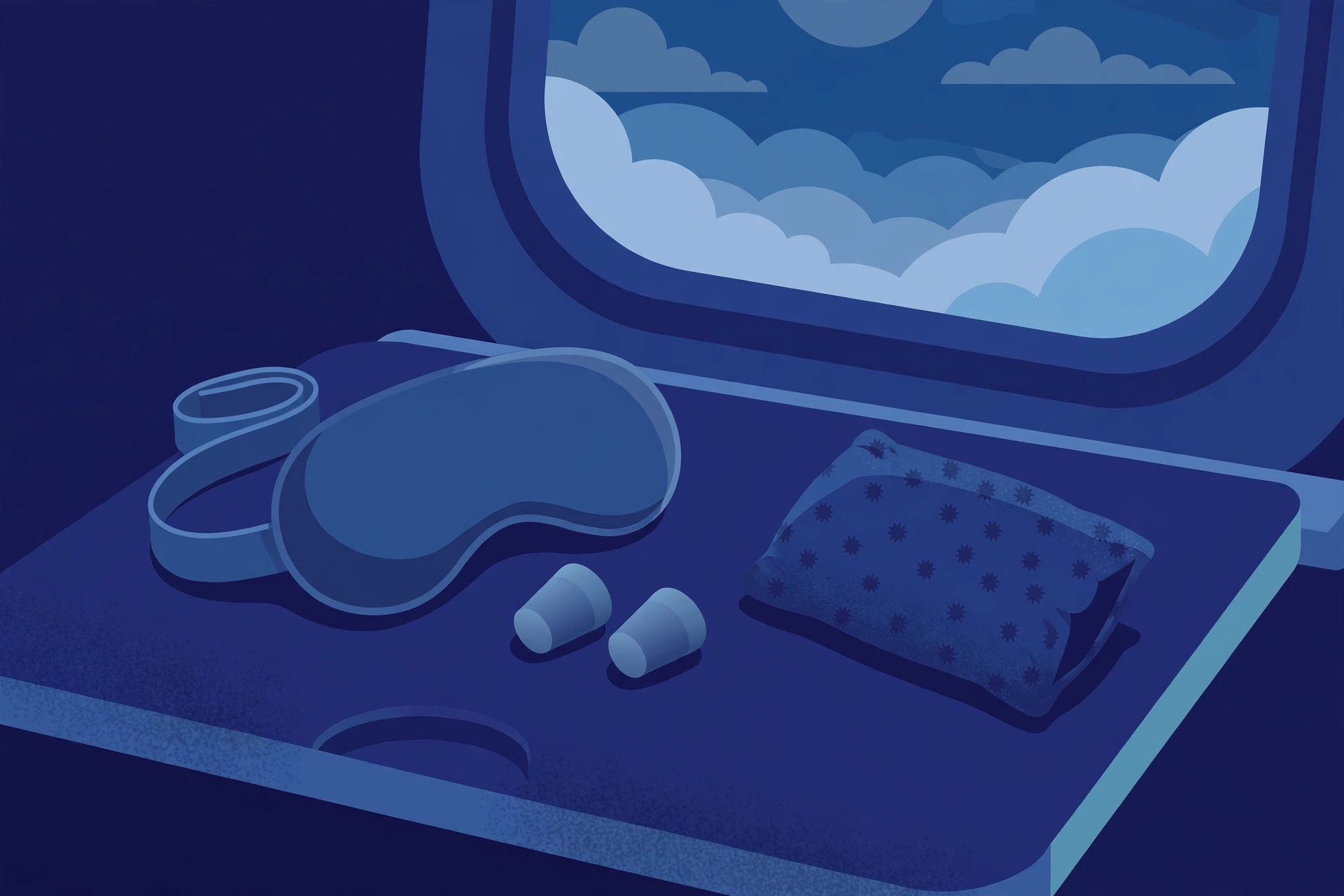
Pack a small sleep kit in your carry-on: a contoured eye mask that blocks light without pressing on your eyes, foam earplugs or noise-canceling earbuds, a supportive travel pillow, and a light blanket or large scarf. Familiar sleep cues (the same mask, the same playlist of calming audio) train your brain to fall asleep faster, even in an upright seat.
Use Melatonin Cautiously
Melatonin is a hormone supplement many travelers use short-term to encourage sleep at the new bedtime. Typical guidance is a low dose 30 to 60 minutes before desired sleep at the destination, for a few nights only. It is not a sedative and it does not work for everyone. This is general information, not medical advice: talk to your doctor or pharmacist before using melatonin or any sleep aid, especially if you take other medications or have a health condition.
After Landing: Lock In the New Time Zone
Get Outside Into Daylight
Natural daylight is the most powerful reset signal available. On arrival day, spend at least 30 minutes outside. If you traveled east, seek bright morning light to advance your clock. If you traveled west, get light in the late afternoon and early evening to delay it. A morning walk after an eastbound arrival does more for adjustment than almost any supplement.
Stay Up Until Local Bedtime
This is the hardest and most important rule. No matter how tired you are, stay awake until a reasonable local bedtime on arrival day. If you are extremely tired, a short 20 to 30 minute power nap is fine, but anything over 45 minutes can anchor your clock to the old time zone and delay adjustment by days.
Eat on Local Time
Have your meals at local mealtimes from the first day, even if you are not hungry. Regular meal timing reinforces the new rhythm for your digestive system, which reduces the stomach discomfort many travelers feel.
Keep Arrival Day Low-Stakes
Book light, low-pressure plans for your first day: a walking tour, a casual meal, relaxed sightseeing. Avoid scheduling critical business meetings or intense workouts until your body has had a night or two to adapt. Gentle exercise like walking or swimming can help, but save the hard sessions for day three onward. If you are still hunting for accommodation, see how to find cheap last-minute hotels for flexible options near your arrival airport.
Eastbound vs. Westbound: Different Playbooks
| Strategy | Eastbound (e.g., US to Europe) | Westbound (e.g., Europe to US) |
|---|---|---|
| Pre-trip shift | Bed earlier, wake earlier | Bed later, wake later |
| Morning light | Seek it: advances your clock | Avoid it early: delays adjustment |
| Evening light | Avoid it: dim lights, limit screens | Seek it: bright light late afternoon |
| In-flight sleep | Sleep on the plane if it is night at destination | Stay awake if it is day at destination |
| Difficulty | Harder: you must fall asleep earlier | Easier: you stay up later |
Gear That Helps: A Carry-On Checklist
- Contoured eye mask: Blocks cabin light completely for daytime sleep
- Earplugs or noise-canceling earbuds: Cuts engine drone and cabin noise
- Travel pillow: Supports your neck so you can actually fall asleep upright
- Compression socks: Reduces swelling and DVT risk on long flights
- Reusable water bottle: Track and maintain hydration easily
- Electrolyte packets: Help replace minerals lost in dry cabin air
- Blue-light-blocking glasses: Avoid alerting light at the wrong times
- Healthy snacks: Nuts, fruit, and protein bars beat salty cabin snacks
For the full packing system, check the best travel apps for 2026, which include tools for tracking sleep, light exposure, and hydration on the go.
Frequently Asked Questions
How long does jet lag last?
As a rough rule, your body adjusts about one time zone per day, sometimes one to two. A 6-hour difference typically takes 3 to 6 days to fully resolve, though following the strategies in this guide can shorten that noticeably. Eastbound trips usually take longer than westbound ones.
Does melatonin really help with jet lag?
Many travelers and some sleep specialists report that low-dose melatonin taken 30 to 60 minutes before the desired bedtime at the destination helps them fall asleep during the first few nights. Evidence is mixed and it does not work for everyone. This is general information, not medical advice: consult your doctor before use.
Should I sleep on the plane or stay awake?
Follow destination time. If it is nighttime at your destination during the flight, try to sleep. If it is daytime there, stay awake. Sleeping at the wrong time can make adjustment harder, so the eye mask and earplug strategy matters in both directions.
Is it better to arrive in the morning or evening?
Evening arrivals are generally easier. You land, eat dinner, and go to bed at a normal local time. Morning arrivals force you to stay awake through a full day while exhausted, which most travelers find brutal.
Can exercise help beat jet lag?
Gentle exercise like walking, especially outdoors in daylight, helps reset your clock and improves sleep quality. Avoid intense workouts late in the evening during the first couple of days, as they can delay sleep onset.
Does the direction of travel really matter?
Yes. Eastbound travel is consistently harder because you must fall asleep earlier and wake earlier than your body wants. Westbound travel, where you stay up later, aligns better with most people’s natural tendency to drift later. Plan extra recovery time for eastbound trips.
Verdict: The Jet Lag Plan That Actually Works
There is no magic cure for jet lag, but the combination that works best is unglamorous and free: shift your sleep 30 to 60 minutes per day before departure, live on destination time from the moment you board, use light exposure strategically (morning light eastbound, evening light westbound), hydrate aggressively, skip the alcohol, and stay up until local bedtime on arrival day. Travelers who follow this full protocol typically report cutting their adjustment time dramatically compared to doing nothing. Your first trip using this system is the experiment: note what worked, refine it, and every long-haul flight after that gets easier. For more ways to travel smarter, explore the guides at DigitalGeekSpot.