


Shopping for CBD as a beginner can feel like reading a foreign language. Labels throw around terms like full spectrum, COA, terpenes, and isolate, and product pages assume you already know what they mean. This guide explains 9 essential CBD terms for beginners in plain English, so you can read any label, compare products confidently, and spot vague marketing when you see it.
Learning the vocabulary is the single highest-leverage thing a new CBD shopper can do. It takes about ten minutes, and it permanently upgrades your ability to tell a transparent product from a sketchy one. Bookmark this page and refer back to it whenever a label confuses you.
1. CBD (Cannabidiol)
CBD, short for cannabidiol, is one of over a hundred naturally occurring compounds called cannabinoids found in the cannabis plant. Commercial CBD products are made from hemp, a variety of cannabis bred to contain very low THC. Unlike THC, CBD is not intoxicating: it does not produce a high.
When you see “CBD” on a label, it refers to this specific compound. A product’s CBD content should be stated in milligrams, such as “1000 mg CBD per bottle.” That number is the foundation of every potency calculation you will ever do as a shopper.
2. THC (Tetrahydrocannabinol)
THC, short for tetrahydrocannabinol, is the cannabinoid responsible for the intoxicating effects of cannabis. Hemp-derived CBD products sold legally in the United States must contain no more than 0.3 percent THC by dry weight, a level that does not produce intoxication in finished products.
THC matters to shoppers for two reasons. First, full-spectrum products contain trace amounts of it, which some people prefer to avoid entirely for personal, professional, or testing-related reasons. Second, product labels and lab reports always list THC content, so knowing the term helps you verify that a product stays within the legal limit.
3. Full Spectrum
“Full spectrum” means the product contains CBD plus the full range of other naturally occurring hemp compounds, including other cannabinoids, terpenes, and trace THC within the legal limit. The idea behind full-spectrum products is that these compounds work together, a concept often called the entourage effect.
Whether the entourage effect is meaningful is still debated, but the term itself is well defined: full spectrum equals whole-plant extract with THC intact. If you want the complete picture of extract types, read our detailed comparison of full spectrum vs broad spectrum vs isolate CBD.
4. Broad Spectrum
“Broad spectrum” is the middle ground. Like full spectrum, it contains CBD plus other hemp compounds such as additional cannabinoids and terpenes, but the THC has been removed or reduced to non-detectable levels. It is designed for shoppers who want a multi-compound product without any THC.
One caution: “broad spectrum” is less strictly defined than “full spectrum,” and testing methods vary. A trustworthy brand’s lab report should confirm that THC is actually absent. Vague use of the term without lab backup is a yellow flag.
5. Isolate
CBD isolate is pure CBD, typically 99 percent or more, with all other plant compounds removed. It usually appears as a white crystalline powder that manufacturers blend into oils, edibles, or topicals. Isolate products contain no THC and no terpenes.
Isolate is the simplest extract type to understand and the easiest to verify on a lab report, since the report should show CBD and little else. Shoppers who want to avoid every other hemp compound generally choose isolate products.

6. Terpenes
Terpenes are aromatic compounds found in hemp and many other plants. They are what give different hemp strains their distinctive smells, from citrusy to piney to earthy. Terpenes are present in full-spectrum and broad-spectrum products, since those preserve more of the plant’s natural profile, and are removed when making isolate.
Some product marketing attributes specific effects to individual terpenes, but that goes beyond what the vocabulary lesson requires. For a beginner, the key point is simpler: “terpenes” on a label or lab report tells you the product retains more of the plant’s natural aromatic compounds, which is characteristic of less-refined extracts.
7. Carrier Oil
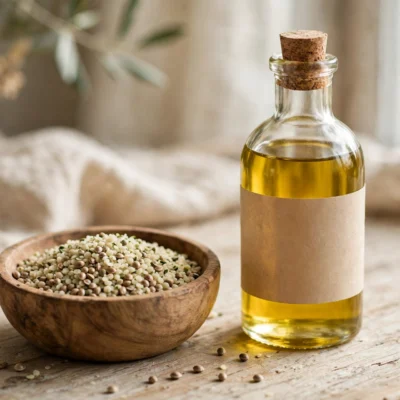
A carrier oil is the base oil that CBD extract is blended into so it can be bottled and measured. Common carrier oils include MCT oil (derived from coconut), hemp seed oil, and olive oil. The carrier oil makes up most of the liquid in the bottle; the CBD extract is a small fraction of the total volume.
The carrier oil affects taste, texture, and sometimes shelf life, but it does not change the CBD content. When a label lists “hemp seed oil” as an ingredient, check whether CBD milligrams are also stated: the carrier alone does not make it a CBD product. We cover this confusion in detail in our guide to hemp seed oil vs CBD oil.
8. COA (Certificate of Analysis)
A COA, or certificate of analysis, is a third-party lab report that verifies what is actually in a CBD product. It lists the measured amounts of CBD, THC, and often other cannabinoids, plus test results for contaminants like heavy metals, pesticides, and microbes. Reputable brands publish a COA for every product batch and link it on the product page or print a QR code on the label.
The COA is the single most important trust document in CBD shopping. Labels can claim anything; the COA is independent verification. If a brand does not publish COAs, or publishes one generic report for all products, treat that as a serious warning sign. Our beginner-friendly walkthrough on how to read a CBD lab report teaches you to interpret one in minutes.
9. Potency
Potency simply means strength: how much CBD a product contains relative to its size. It is usually expressed as total milligrams per bottle, milligrams per milliliter, or milligrams per serving. A 30 ml bottle with 1500 mg of CBD is more potent than a 30 ml bottle with 500 mg, even though the bottles look the same.
Potency is not a quality grade. A low-potency product from a tested, transparent brand is better than a high-potency product from a brand with no lab reports. Compare potency only after you have confirmed the basics: real CBD content, a published COA, and clear labeling. Our label-math guide explains how much CBD is in a dropper so you can convert any label into plain numbers.
Putting the Vocabulary to Work: Reading a Real Label
Let us tie all nine terms together with a realistic example. Imagine a label that reads: “Full-spectrum hemp extract, 1000 mg CBD per 30 ml bottle, MCT carrier oil, third-party tested, scan QR code for COA.”
With your new vocabulary, you can decode every phrase. “Full-spectrum” tells you it contains whole-plant compounds including trace THC. “1000 mg CBD per 30 ml” gives you the potency, about 33 mg per ml. “MCT carrier oil” names the base oil. “Third-party tested” plus a QR code to the COA means you can verify the claims independently. That is a transparent label, and you recognized it in seconds.
Now imagine a label that reads only: “Hemp oil, 1000 mg hemp extract, natural.” No mention of CBD in milligrams, no extract type, no carrier oil named, no COA. You now know exactly what is missing, and that knowledge is worth more than any single product recommendation.

Terms That Should Make You Cautious
Beyond the nine core terms, watch for language that sounds technical but means nothing. Phrases like “nano CBD,” “proprietary blend,” or “pharmaceutical grade” are unregulated marketing terms. “Proprietary blend” in particular can hide how much CBD a product actually contains. Legitimate technical terms, like the nine above, always come with numbers you can check.
Also be wary of absolute health claims on packaging or product pages. CBD products are not approved to treat or cure conditions, and brands that promise otherwise are violating advertising rules as well as your trust. This article is for general information only and is not medical advice.
Quick-Reference Glossary
| Term | Plain-English meaning |
|---|---|
| CBD | Cannabidiol, the non-intoxicating hemp compound products are built around |
| THC | Tetrahydrocannabinol, the intoxicating cannabinoid; capped at 0.3% in legal hemp products |
| Full spectrum | Whole-plant extract with CBD, other compounds, and trace THC |
| Broad spectrum | Multi-compound extract with THC removed |
| Isolate | Pure CBD only, all other compounds removed |
| Terpenes | Aromatic plant compounds that give hemp its smell |
| Carrier oil | The base oil, such as MCT or hemp seed oil, that CBD extract is blended into |
| COA | Certificate of analysis: the third-party lab report verifying a product’s contents |
| Potency | Strength, expressed as milligrams of CBD per bottle, per ml, or per serving |
Nine terms, ten minutes, and you can now read any CBD label with confidence. That is the entire goal of product literacy: replacing guesswork with a short checklist that works every time. For more beginner-friendly explainers, explore the guides on the DigitalGeekSpot homepage.
Frequently Asked Questions
What is the most important CBD term for a beginner to know?
COA, the certificate of analysis. It is the independent lab report that proves a product contains what its label claims. Every other term helps you read the label; the COA helps you verify it.
What is the difference between full spectrum and broad spectrum CBD?
Full spectrum contains the whole range of hemp compounds including trace THC within the legal limit. Broad spectrum contains multiple hemp compounds but has the THC removed.
Does CBD isolate contain THC?
No. CBD isolate is purified CBD with other plant compounds, including THC, removed. People who want to avoid THC entirely often choose isolate products.
What are terpenes in CBD products?
Terpenes are aromatic compounds naturally present in hemp that give it its distinctive smell. They remain in full-spectrum and broad-spectrum products but are removed when making CBD isolate.
Why do CBD labels list a carrier oil?
The carrier oil, such as MCT or hemp seed oil, is the base liquid the CBD extract is blended into. It makes up most of the bottle’s volume and affects taste and texture.
What does potency mean on a CBD label?
Potency means strength: how many milligrams of CBD the product contains per bottle, per milliliter, or per serving. Higher potency means more CBD per dropper, not higher quality.
1 Comment