If you have ever asked how much CBD in a dropper there really is, the honest answer is: it depends entirely on the bottle. A dropper is just a measuring tool, and the amount of CBD it delivers is set by the product’s total potency and bottle size. Once you learn a small amount of label math, you can read any CBD bottle and know exactly what each dropper, or each milliliter, contains. This guide explains how to decode potency labels, calculate milligrams per dropper, and understand serving sizes, without any guesswork.
Learning this skill matters because CBD labels can be confusing. Some highlight big numbers that refer to the whole bottle, others emphasize hemp extract weight instead of CBD, and serving sizes vary from brand to brand. The math below works for any tincture-style CBD oil product, and it only takes a minute once you know the steps.
The Two Numbers That Matter: Total Milligrams and Bottle Size
Every CBD oil label should show two key numbers. The first is the total CBD content of the bottle, expressed in milligrams, such as 500 mg, 1000 mg, or 1500 mg. The second is the bottle size, usually in milliliters, most commonly 30 ml. Together, these two numbers tell you the product’s concentration, which is what determines how much CBD is in a dropper.
The calculation is simple division. Divide the total milligrams by the total milliliters to get the milligrams per milliliter:
Total mg of CBD / bottle size in ml = mg of CBD per ml
For example, a 30 ml bottle labeled as containing 1000 mg of CBD works out to about 33.3 mg per ml. A 30 ml bottle with 500 mg works out to about 16.7 mg per ml. Same bottle size, very different strength, which is why the total milligram number matters more than the bottle’s physical size.
How Much CBD Is in One Full Dropper?
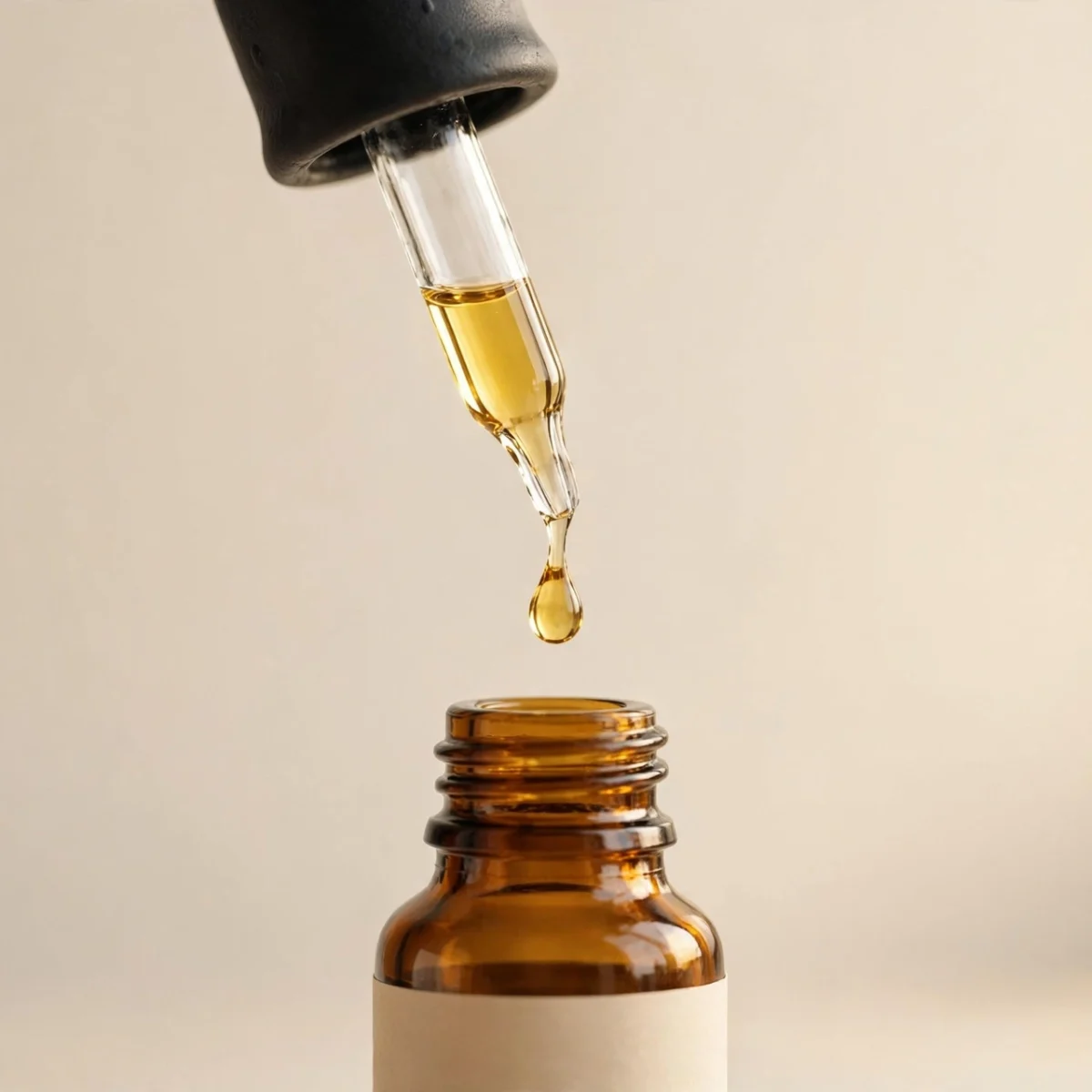
Here is the part most people get wrong: a full dropper does not automatically equal one milliliter. Droppers vary, but most standard CBD bottle droppers hold about 1 ml when filled completely, which is roughly 20 drops. Some droppers are marked with measurement lines at 0.25, 0.5, 0.75, and 1.0 ml; others are unmarked, in which case a full squeeze of the bulb is approximately 1 ml.
So to answer the core question: the CBD in one full dropper equals the milligrams per ml you calculated above. For that 1000 mg, 30 ml bottle, one full dropper holds about 33 mg of CBD. For a 1500 mg, 30 ml bottle, one full dropper holds about 50 mg. The dropper is the same tool in both cases; the concentration is what changes the answer.
If your dropper has measurement lines, you can estimate fractions easily. Half a dropper, or 0.5 ml, of that 1000 mg bottle would contain about 16.7 mg of CBD. This is purely label math: it describes what is in the bottle, not how much anyone should take.
Serving Size vs. Dropper: Reading the Supplement Facts
Many labels also list a “serving size,” which is the manufacturer’s suggested amount per use, often 1 ml but sometimes more or less. The label should also state how many servings are in the bottle and how many milligrams of CBD are in each serving. These three numbers should be consistent with each other, and checking that consistency is a quick quality signal.
For example, if a 30 ml bottle claims 30 servings of 1 ml each, and each serving contains 33 mg of CBD, the total should be about 1000 mg. If the numbers do not add up, treat that as a red flag about the brand’s attention to detail. Reputable brands also publish third-party lab reports that confirm the label’s claims; our guide on how to read a CBD lab report shows you how to verify those numbers independently.
Total CBD vs. Hemp Extract: A Common Labeling Trick
Not every big number on a label means CBD. Some products advertise “1000 mg hemp extract” rather than “1000 mg CBD.” Hemp extract is the total plant extract, of which CBD is only one component. A bottle with 1000 mg of hemp extract might contain far less actual CBD, and the exact amount should be listed separately.
When comparing products, always compare milligrams of CBD to milligrams of CBD, not extract to extract. If a label only lists hemp extract weight and never states the CBD content clearly, that is a sign of vague labeling, and you may want to choose a more transparent brand. Clear labels are one of the simplest markers of a trustworthy product.
Potency Categories: What Low, Medium, and High Strength Mean
CBD oils are often described as low, medium, or high potency. These are informal categories, but they generally map to the milligrams-per-ml concentration:
- Low potency: roughly 10 to 20 mg of CBD per ml. Common in starter-size bottles around 300 to 600 mg per 30 ml.
- Medium potency: roughly 20 to 40 mg of CBD per ml. The most common range, covering 600 to 1200 mg per 30 ml bottles.
- High potency: roughly 40 mg per ml and above. Bottles labeled 1500 mg, 2000 mg, or more per 30 ml fall here.
Higher potency is not inherently better. It simply means each dropper contains more CBD, so the bottle lasts longer if you use small amounts. The right potency depends on the product’s purpose in your routine and your budget, not on a bigger number being superior.
Why Bottle Size Can Be Misleading
Two bottles can look identical on the shelf but contain very different amounts of CBD. A small 15 ml bottle with 750 mg of CBD is more concentrated, at 50 mg per ml, than a large 60 ml bottle with 1000 mg, at about 16.7 mg per ml. Shoppers who compare only the total milligram number, or only the bottle size, can easily misjudge which product is stronger or a better value.
The reliable comparison is always milligrams per ml, or equivalently, cost per milligram of CBD. Divide the price by the total CBD milligrams to get the price per milligram, and compare that across products. This strips away packaging differences and shows what you are actually paying for.
What About Drops? Counting Individual Drops
Some people prefer to count drops rather than use a full dropper. As a rough rule of thumb, there are about 20 drops in 1 ml of oil, though this varies with the dropper tip and the oil’s thickness. To estimate CBD per drop, divide the mg per ml by 20. For our 1000 mg, 30 ml example at 33.3 mg per ml, each drop contains roughly 1.7 mg of CBD.
Drop counting is less precise than using the dropper’s measurement lines, but it can be useful for understanding small amounts. Just remember it is an estimate, not a laboratory measurement.
Checking Your Math Against the Lab Report
Once you can read the label, the next step in product literacy is verifying it. Third-party lab reports, often called certificates of analysis, list the tested CBD content of a product batch. The tested total should be reasonably close to the labeled total; small variations are normal because hemp is a natural product, but large gaps suggest poor quality control.
Make this a habit with any new brand: calculate the mg per ml from the label, then confirm the lab report backs it up. Brands that make this easy, with batch-specific reports linked on the product page, are generally more trustworthy than brands that hide or skip testing. For a deeper dive, see our walkthrough of CBD lab reports for beginners.
Quick Reference: Common Bottle Configurations
| Bottle size | Total CBD | Approx. mg per full dropper (1 ml) |
|---|---|---|
| 30 ml | 500 mg | ~16.7 mg |
| 30 ml | 1000 mg | ~33.3 mg |
| 30 ml | 1500 mg | ~50 mg |
| 30 ml | 2000 mg | ~66.7 mg |
| 15 ml | 750 mg | ~50 mg |
| 60 ml | 1000 mg | ~16.7 mg |
Keep in mind these figures describe the product’s contents, not recommendations. This article explains label math only; it does not advise how much CBD to use. CBD can interact with certain medications, and product quality varies widely, so this article is for general information only and is not medical advice.
Label literacy is one of the most useful skills a CBD shopper can build. Once you can convert any label into milligrams per dropper in under a minute, vague marketing loses its power over your wallet. For more plain-language explainers on CBD products and labels, visit the DigitalGeekSpot homepage.
Frequently Asked Questions
How much CBD is in a dropper?
It depends on the bottle’s concentration. Divide the total CBD milligrams by the bottle size in milliliters to get mg per ml; one full dropper is usually about 1 ml, so it contains roughly that many milligrams of CBD.
Is one dropper always 1 ml?
Approximately, but not exactly. Most standard CBD droppers hold about 1 ml when full. Droppers with printed measurement lines are more reliable; unmarked droppers require estimating a full squeeze.
What does 1000 mg on a CBD label mean?
It should mean the bottle contains 1000 mg of CBD in total. Check whether the label says “CBD” or “hemp extract,” since extract weight includes other plant compounds and is not the same as CBD content.
How many servings are in a 30 ml CBD bottle?
If the serving size is 1 ml, there are about 30 servings. Always check the label’s stated serving size and servings per container, since manufacturers define these differently.
Why do two same-sized bottles have different potencies?
Because potency is set by how much CBD extract goes into the oil, not by the bottle’s size. A 30 ml bottle can hold 500 mg or 2000 mg of CBD; only the label’s total milligram number tells you which.
How can I verify the label is accurate?
Look up the product’s third-party lab report and compare the tested CBD total to the labeled total. Small differences are normal; large ones are a warning sign.